

Data center coolants: ThermaGraph™ graphene cooling fluids
ThermaGraph™ is our line of graphene coolants for data center cooling. Each product is graphene at a low loading (0.5–1.5 wt% in ThermaGraph™, 0.05–0.20 wt% in ThermaGraph-D™), in a carrier fluid matched to how your servers are cooled: ThermaGraph™ in deionized water, a liquid cooling fluid for data centers running indoor closed loops, and ThermaGraph-D™ in white mineral oil, a graphene immersion cooling fluid for single-phase tanks. For the basics of the material, see what is graphene.
It's for data center operators, cooling engineers and integrators who want to test a new fill in a system they already run, using their own baseline data. Patent pending. Made in the USA in Charlotte, NC.
Patent pendingMade in the USALow graphene loadingClosed loop + immersionApplication-specific thermal and electrical qualification
Cold plates, CDUs or rear-door heat exchangers?
Use ThermaGraph™, the water-loop coolant for indoor CDU, direct-to-chip (D2C) and rear-door loops.
Servers submerged in a single-phase tank?
Use ThermaGraph-D™, the graphene-enhanced dielectric for single-phase immersion of live boards.
These are two separate products. Don't mix them, and don't use one in place of the other.
Where ThermaGraph™ fits in your cooling system
ThermaGraph™ works on the fluid side. It doesn't change your hardware. It replaces the liquid that carries heat away from it. In a liquid-cooled data center, heat moves from the chip into a cold plate or an immersion tank, into the coolant, through a coolant distribution unit (CDU) or heat exchanger, and out to the facility water and heat-rejection plant. Our products go into the part of that path closest to the servers.
- Water loops: CDU, direct-to-chip and rear-door heat exchangers
- Use ThermaGraph™, graphene in deionized water. It's for indoor, conditioned technology cooling loops in closed copper systems where freeze protection isn't specified. If the loop holds glycol, it's drained first. ThermaGraph™ is a new fill, not a top-off.
- Single-phase immersion tanks
- Use ThermaGraph-D™, graphene in Drakeol white mineral oil, formulated as a dielectric for boards that sit directly in the fluid.
- Not a fit for ThermaGraph™ today
- Loops that need freeze protection (they should stay on a glycol fluid), outdoor or unconditioned loops, and two-phase boiling systems, which need a different product discussion and a different TDS.
- Coatings are a different approach
- Some cooling products work on surfaces instead, as coatings on coils, cold plates or heat exchangers. ThermaGraph™ isn't a coating and doesn't treat surfaces. It changes the fluid inside the equipment you already run.
New to these terms? See the cooling glossary below, or read Graphene coolants for AI data centers: what lab tests show and what they don't.
ThermaGraph™ for closed-loop liquid cooling
A graphene nanofluid in deionized water, with no glycol, for indoor CDU, direct-to-chip (D2C) and rear-door loops. Same copper, same pumps, new fill.
- Electrical and thermal
- Formulated for low electrical conductivity (deionized-water base) and enhanced thermal conductivity. Not a dielectric — for closed-loop indirect cooling only. Measured values on each lot's Certificate of Analysis.
- Carrier
- Deionized water. No glycol and no freeze package.
- Graphene loading
- 0.5–1.5 wt%, stated on the certificate of analysis (COA). It's kept low on purpose, because sludge isn't a feature.
- Heat transfer
- +6% to +18% higher convective heat transfer coefficient (HTC) than a glycol baseline, in our internal pumped-loop tests.
- Thermal conductivity
- Measured against DowFrost LC25 on the signed lab sheet. Water's thermal conductivity is already above LC25's; the graphene is additional.
- Where it fits
- Indoor, conditioned technology cooling systems (TCS/DECS) only, in closed copper loops where freeze protection isn't specified. Its freeze point is 0 °C.
- What it isn't
- Not a freeze fluid, not a dielectric and not a top-off. Its electrical conductivity is low but not zero, so never use it to immerse live boards. If your loop holds inhibited propylene glycol such as DowFrost LC25, drain it first.
- Materials
- Corrosion coupons go in with every pilot. It isn't a substitute for LC25's inhibitor package until the coupon results come back.
ThermaGraph™ vs. DowFrost LC25
| Property | ThermaGraph™ | DowFrost LC25 |
|---|---|---|
| Job | Indoor CDU / D2C / rear-door water loop. Graphene nanofluid. | Specified PG25 for technology cooling loops |
| Carrier | Deionized water. No glycol. No freeze package. | 25% inhibited propylene glycol |
| Freeze | 0 °C. Indoor / conditioned TCS only. | PG25 freeze protection to −10 °C (Dow) |
| Heat transfer | +6% to +18% HTC vs glycol baseline (internal loop tests). | Baseline in the same geometry |
| Thermal k | Versus LC25 on the signed lab sheet. Water's k is already above LC25; graphene is additional. | 0.485 W/m·K at 50 °C (Dow published) |
| Loading | 0.5–1.5 wt% graphene (COA). | — |
| Materials | Coupons with every pilot. Not a substitute for LC25 inhibitors until coupons return. | Specified inhibitor package for copper |
| Electrical | Low electrical conductivity (deionized-water base), but not a dielectric. Value on each lot's COA. Do not immerse live boards. | Conductive glycol loop fluid |
| Best application | Indoor closed copper loops where freeze is not specified. | Loops that require PG25 freeze protection |
DowFrost LC25 values are Dow published data. ThermaGraph™ values come from our internal tests and aren't a specification until the signed lab sheet.
ThermaGraph-D™ for single-phase immersion cooling
A graphene-enhanced dielectric for single-phase immersion, where the boards sit directly in the fluid. The carrier is Drakeol white mineral oil (CAS 8042-47-5). It's made for tanks, not glycol loops or cold plates.
- Electrical and thermal
- Formulated as a low-conductivity dielectric with enhanced thermal conductivity; measured values on each lot's Certificate of Analysis.
- Carrier
- Drakeol white mineral oil, CAS 8042-47-5. Not water, not glycol. The grade is selected per order (typically Drakeol 10 NF through Drakeol 35 USP) and shown on the COA.
- Graphene loading
- 0.05–0.20 wt%, stated on the COA. Low on purpose, to limit viscosity, filter load and, in tanks, breakdown-voltage risk.
- Electrical
- Formulated as a low-conductivity dielectric. BDV and conductivity are reported on each lot's Certificate of Analysis (COA). Don't energize boards until the lot's electricals are on the COA.
- Heat transfer
- Measured against the unfilled dielectric on the signed lab sheet, at the same temperature with the same method.
- Viscosity and flash point
- Lot-specific. Mineral-oil grades are typically thicker than Castrol ON DC 15 (7.5 cSt at 40 °C). Drakeol 35 has a flash point (COC) of about 240 °C.
- Stability
- Months of visible suspension. Particle count and filter ΔP are tracked in the 30-day protocol.
- Materials
- Coupons (copper, soldermask and elastomers) go in with every pilot.
- Where it fits
- Single-phase tanks for HPC, edge and immersed servers, where ΔT is the constraint. Two-phase boiling systems need a different product discussion and a different TDS.
ThermaGraph-D™ vs. Castrol ON DC 15 / DC 20
| Property | ThermaGraph-D™ | Castrol ON DC 15 / DC 20 |
|---|---|---|
| Job | Single-phase immersion of live boards. Graphene-enhanced Drakeol. | Specified synthetic dielectric for single-phase tanks |
| Heat transfer | Versus the unfilled dielectric on the signed lab sheet: same T, same method. | Baseline unfilled fluid in the same tank |
| Electrical | Low-conductivity dielectric. Measured BDV and conductivity on each lot's COA. | Castrol publishes conductivity <35–50 pS/m and BDV >25 kV on DC 15 |
| Loading | 0.05–0.20 wt% graphene (COA). | Unfilled base fluid |
| Viscosity / flash | Lot-specific. Mineral-oil grades are typically thicker than DC 15 (7.5 cSt at 40 °C). Drakeol 35 flash COC ~240 °C. | KV 7.5 mm²/s at 40 °C; flash COC 166 °C (Castrol PDS) |
| Stability | Months of visible suspension; particle count + filter ΔP in the 30-day protocol. | Specified long-term stability |
| Materials | Coupons (copper, soldermask, elastomers) with every pilot. No Castrol-package claim until coupons return. | Castrol: compatible with most commercial elastomers |
| Best application | Single-phase tanks (HPC, edge, dunked servers) where ΔT is the constraint. | Single-phase immersion tanks. Proven, widely specified. |
Castrol ON values are Castrol published data (conductivity in pS/m). Drakeol is a Calumet / Penreco trademark, named here as the carrier. ThermaGraph-D™ values aren't a specification until the signed lab sheet.
Test results so far
+6% to +18%
Higher convective heat transfer coefficient for ThermaGraph™ in water vs a glycol baseline, in internal pumped-loop tests. Lab data.
Up to ~$1.2M a year
Modeled for a 20 MW site at PUE 1.44, today's industry average for large facilities (optimistic case). Modeled, not measured.
- A 100 MW site at today's industry average for large facilities (PUE 1.44): up to about $6M a year.
- A 20 MW hyperscale building (PUE 1.10–1.20): about 130–770 kW less cooling power, or $80,000 to $680,000 a year.
- A 100 MW hyperscale site (PUE 1.10–1.20): about 0.7–3.9 MW, or $0.4M to $3.4M a year.
- An older 20 MW facility (PUE 1.6–1.8): about 0.8–3.1 MW, or $0.7M to $3.9M a year.
To quantify operational savings, compare total cooling-system electricity at the same useful heat load and operating conditions. A heat-transfer-coefficient improvement does not by itself determine an energy-saving percentage.
The heat transfer result comes from our internal pumped-loop lab tests against a glycol baseline. The kW and dollar figures come from an engineering model, not a field installation. Ranges run from our conservative to our optimistic case; real savings have to be measured in your loop, which is what a 30-day pilot is for. Assumptions: savings = IT load × (PUE − 1) × cooling share of overhead (2/3) × GI model assumption: 10% to 29% cooling-energy reduction, over 8,760 hours a year. Power at $0.07–0.10/kWh for hyperscale and $0.10–0.145/kWh for older facilities, based on US industrial and commercial averages (EIA Electric Power Monthly, Aug 2026: 9.64¢ and 14.47¢). PUE: Uptime Institute Global Data Center Survey 2025 (industry 1.54; 20 MW+ sites 1.44). ThermaGraph-D™ heat transfer is reported against the unfilled dielectric on each signed lab sheet.
Video series: Data Centers, Explained
Short, plain-English explainers on how data centers work and how they are cooled. Pick an episode to play it here; the next one starts automatically. Episode 8 covers what graphene is and why it matters for cooling.
How it works
1. Graphene in a carrier fluid
We disperse graphene in the carrier your system calls for: deionized water for closed loops (0.5–1.5 wt%), or Drakeol white mineral oil for immersion tanks (0.05–0.20 wt%). The loading is kept low on purpose to protect pumps and filters, and, in immersion, breakdown voltage.
2. A new fill in the system you have
ThermaGraph™ fills the same closed loop, with the same copper and the same pumps, after any glycol is drained. ThermaGraph-D™ fills a single-phase tank in place of the unfilled dielectric. The fluid still carries heat from the hardware to your CDU or heat exchanger; the graphene is there to raise heat transfer.
3. Measured on the fluid we ship
We run hot-metal, pumped-loop and passive-convection tests on the carrier we actually ship. Thermal conductivity, viscosity, method and temperature, plus breakdown voltage and conductivity for ThermaGraph-D™, go on the signed TDS / lab sheet.
How a 30-day pilot works
Every evaluation starts with a 30-day sample in your own system. You keep the data.
Closed loop (ThermaGraph™)
- If the loop holds LC25, drain it first.
- Baseline ΔT, pump power, thermal conductivity, viscosity and particle count.
- Fill, then repeat the measurements at 7, 14 and 30 days.
- Inspect corrosion coupons and filters.
- We work out ROI after we price the dose against your kWh.
Immersion tank (ThermaGraph-D™)
- Baseline BDV, conductivity, thermal conductivity, viscosity, ΔT and particle count.
- Dose, then repeat at 7, 14 and 30 days.
- Inspect coupons (copper, soldermask, elastomers) and filters.
- Don't energize boards until the lot's electricals are on the signed sheet.
Download the one-pagers
Each one-pager puts the product side by side with the fluid it's meant to replace.
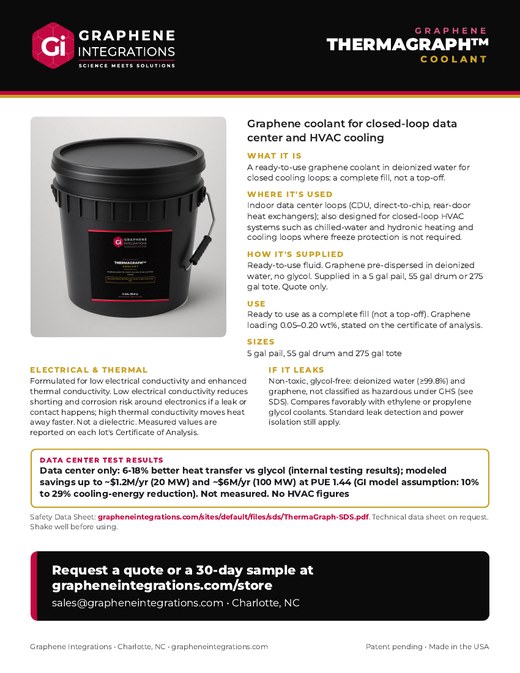
ThermaGraph™ vs. DowFrost LC25
Closed-loop liquid cooling: graphene nanofluid in deionized water.
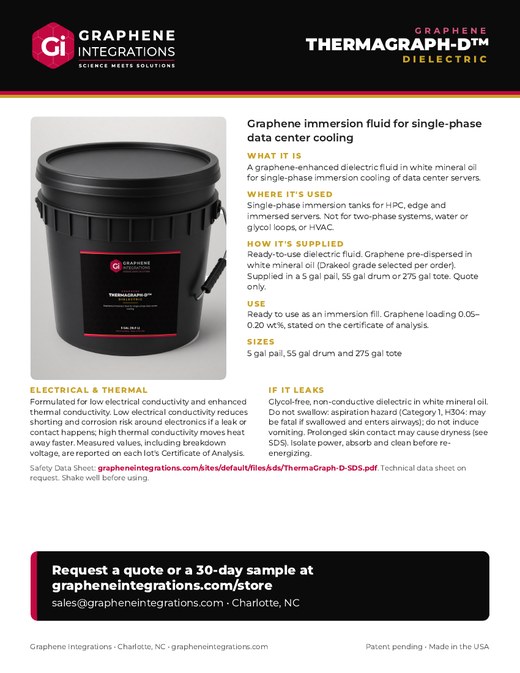
ThermaGraph-D™ vs. Castrol ON
Single-phase immersion: graphene-enhanced Drakeol white mineral oil.
Cooling glossary
Short definitions of the terms used on this page.
- CDU (coolant distribution unit)
- Pumps, controls and a heat exchanger that separate the liquid loop serving the IT equipment from the facility water, and set its flow and temperature.
- TCS (technology cooling system)
- The liquid loop between the CDU and the IT equipment: cold plates, manifolds and rear-door coils.
- Facility water
- The building-side loop that takes heat from the CDUs to chillers, dry coolers or cooling towers.
- Direct-to-chip (D2C)
- Cold plates mounted on processors and other hot components, with coolant flowing through them.
- Rear-door heat exchanger
- A liquid-cooled coil on the back of a rack. Server exhaust air passes through it and the liquid carries the heat away.
- Single-phase immersion
- Servers submerged in a dielectric liquid that stays liquid while it carries heat to a heat exchanger.
- Two-phase immersion
- A fluid that boils on hot components and condenses above them. It is a different system from single-phase immersion.
- PG25
- A mix of 25% propylene glycol and 75% water, often with corrosion inhibitors, used where a loop needs freeze protection.
- Thermal conductivity (k)
- How well a fluid conducts heat when it is not moving, in W/m·K. It is a property of the fluid alone.
- Heat transfer coefficient (HTC)
- How much heat moves between a surface and a flowing fluid, per unit area and per degree of temperature difference, in W/m²·K. It depends on the fluid, the flow and the geometry, so it is measured in a pumped loop.
- ΔT
- A temperature difference, for example between the coolant entering and leaving a cold plate.
- PUE (power usage effectiveness)
- Total facility energy divided by the energy used by the IT equipment. A lower number means less overhead for cooling and power.
- BDV (breakdown voltage)
- The voltage at which a dielectric fluid stops insulating. It matters for immersion fluids that touch live boards.
- wt%
- Percent by weight. ThermaGraph™ carries 0.5–1.5 wt% graphene; ThermaGraph-D™ carries 0.05–0.20 wt%.
- COA and TDS
- The certificate of analysis (measured values for a specific lot, including graphene loading) and the technical data sheet.
- Corrosion coupon
- A small metal or material sample placed in the loop or tank during a pilot and inspected afterward for corrosion or attack.
Is graphene coolant safe if it leaks?
ThermaGraph™ contains only 0.5–1.5% graphene by weight, and ThermaGraph-D™ only 0.05–0.20%. We make the graphene ourselves and supply it only pre-mixed in a liquid carrier, never as a dry powder. Handle leaks and aerosols according to the current SDS and site exposure controls. Published safety reviews identify airborne dust as the main exposure concern for graphene materials (Fadeel et al., ACS Nano 2018).
- Low electrical, high thermal conductivity: ThermaGraph™ is formulated for low electrical conductivity (deionized-water base, graphene at 0.5–1.5 wt%) and enhanced thermal conductivity. It is not a dielectric. ThermaGraph-D™ is formulated as a low-conductivity dielectric with enhanced thermal conductivity. Low electrical conductivity reduces short-circuit and corrosion risk; high thermal conductivity moves heat faster (ThermaGraph™: +6% to +18%, internal testing results). Measured values are on each lot's Certificate of Analysis.
- ThermaGraph™ (water loops): a water-based graphene formulation; consult the current SDS for handling requirements. Its Safety Data Sheet classifies it as not hazardous under OSHA HazCom 2012. Like any water or glycol coolant, it conducts electricity, so standard leak detection and power isolation still apply.
- ThermaGraph-D™ (immersion): graphene in Drakeol white mineral oil, from the same family of oils permitted for certain food uses under 21 CFR 172.878. Like other low-viscosity mineral oils, its SDS carries one warning: an aspiration hazard if swallowed (do not induce vomiting).
- Compared with glycol: most loops today run ethylene or propylene glycol. Ethylene glycol is toxic if swallowed and can damage the kidneys and nervous system (ATSDR). Propylene glycol is far less toxic (ATSDR). ThermaGraph™ contains neither.
- If a leak happens: isolate power to the affected equipment, stop the leak, wear gloves and safety glasses, absorb the fluid, then clean and dry the area before re-energizing. Full steps are in Section 6 of each SDS.
Download the Safety Data Sheets: ThermaGraph™ SDS (PDF) ThermaGraph-D™ SDS (PDF)
Frequently asked questions
ThermaGraph™ is graphene in deionized water for indoor closed loops: CDU, direct-to-chip and rear-door heat exchangers. It's electrically conductive. ThermaGraph-D™ is graphene in Drakeol white mineral oil, formulated as a dielectric for single-phase immersion of live boards. They're separate products and shouldn't be mixed.
No. ThermaGraph™ isn't a top-off into DowFrost LC25 or other inhibited propylene glycol. If the loop holds LC25, drain it first. It also isn't a substitute for LC25's inhibitor package until coupon results from your pilot come back.
No. It's deionized water with no glycol and no freeze package, so its freeze point is 0 °C. It's for indoor, conditioned technology cooling systems only. Loops that need PG25 freeze protection to −10 °C should stay on a glycol fluid.
It's formulated as a dielectric for single-phase immersion of live boards. Breakdown voltage and conductivity are reported on the signed TDS for each lot, and boards shouldn't be energized until that lot's electricals are on the signed sheet. Never immerse live boards in ThermaGraph™, the water-based product.
Request a 30-day sample. We baseline your system, fill or dose, and repeat the measurements at 7, 14 and 30 days, then inspect coupons and filters. You keep the data.
The graphene loading is kept low on purpose (0.5–1.5 wt% in ThermaGraph™, 0.05–0.20 wt% in ThermaGraph-D™) to protect pumps and filters, and in immersion tanks, breakdown voltage. In a 30-day pilot we measure particle count at baseline and at 7, 14 and 30 days, track filter ΔP in immersion tanks, and inspect the filters at the end.
For ThermaGraph-D™ we have seen months of visible suspension, and particle count and filter ΔP are tracked through the 30-day pilot. For ThermaGraph™, particle count is measured at baseline and at 7, 14 and 30 days in your own loop, so you can see how it behaves in your system.
Not yet. The +6% to +18% higher heat transfer coefficient for ThermaGraph™ (the water-loop coolant) against a glycol baseline comes from our internal pumped-loop lab tests. The modeled savings (for example, up to about $1.2M a year for a 20 MW site at PUE 1.44) come from an engineering model, not a field installation. ThermaGraph-D™ heat transfer is reported against the unfilled dielectric on each signed lab sheet. A 30-day pilot in your system is how you get field data, and you keep it.
ThermaGraph™ is a complete fill, graphene already dispersed in deionized water, not a top-off into DowFrost LC25 or other inhibited propylene glycol. If the loop holds LC25, drain it first. Loops that need freeze protection should stay on a glycol fluid.
No. ThermaGraph-D™ is made for single-phase tanks. Two-phase boiling systems need a different product discussion and a different TDS.
It's deionized water with 0.5–1.5% graphene held in the liquid, with no glycol. Its SDS classifies it as not hazardous under OSHA HazCom 2012. Clean up leaks with normal spill practice: power isolated, gloves and safety glasses on, absorb, then dry.
ThermaGraph™ is water-based and conducts electricity, like any water or glycol coolant, so leak detection and power isolation still apply. ThermaGraph-D™ is formulated as a dielectric, and each lot's breakdown voltage and conductivity are reported on its Certificate of Analysis.
No. Our graphene is supplied only pre-mixed in a liquid carrier, never as a dry powder, so a leak releases liquid, not dust.
Request a 30-day sample
Tell us whether you run a closed loop or an immersion tank, and we'll set up a 30-day evaluation in your system. Call Frans Alkemade at (704) 659-3682 or send us a message.
ThermaGraph™ is one of our graphene products. It is made with the same graphene dispersion know-how we use for concrete and lubricants.
Spec sheet summary
- Form: graphene supplied pre-dispersed in a liquid carrier, never as dry flake or powder.
- Carrier options: ThermaGraph™: deionized water, no glycol. ThermaGraph-D™: white mineral oil (dielectric).
- Typical uses: ThermaGraph™ for indoor closed-loop liquid cooling; ThermaGraph-D™ for single-phase immersion cooling.
- Handling: liquid product. Follow the mixing, storage and safety instructions on the spec sheet and SDS supplied with each lot.
Download the Safety Data Sheets: ThermaGraph™ SDS (PDF) and ThermaGraph-D™ SDS (PDF). The full spec sheet is available on request. Request a quote, samples or a spec sheet / SDS.
Data center cooling guides
- ThermaGraph vs ThermaGraph-D: water loop or immersion?
- Graphene coolants for AI data centers
- PG25 alternatives for direct-to-chip cooling
- Single-phase immersion cooling fluid checklist
- Nanofluid coolant additives and heat transfer
- Graphene nanofluid for HVAC chilled water
- Project: graphene coolants for data centers
Graphene case studies: published test results →
From heat-transfer performance to an efficient cooling loop
ThermaGraph™ is a complete water-based fill for suitable closed loops, with 0.5–1.5 wt% graphene in the supplied fluid—not a top-off dose. GI’s +6–18% higher convective heat-transfer coefficient versus a glycol baseline comes from internal pumped-loop tests. It is not independent field validation or an equivalent percentage electricity saving.
Turn that promising thermal result into a plant decision by comparing the same heat load and operating conditions. Log flow, inlet/outlet temperatures, pressure drop, pump, fan and chiller electricity; inspect filters, corrosion coupons and material compatibility. Water-based ThermaGraph is not a dielectric and must not immerse live electronics.
DOE’s liquid-cooling evaluation illustrates system-level metering; it did not test GI fluid. Assess environmental outcomes using measured kWh, the actual electricity mix, fluid manufacture, replacement, transport and disposal. Improved heat transfer is an opportunity to optimize the system, not a measured GI carbon footprint.
Research / measurement reference · Continue with the application guide