


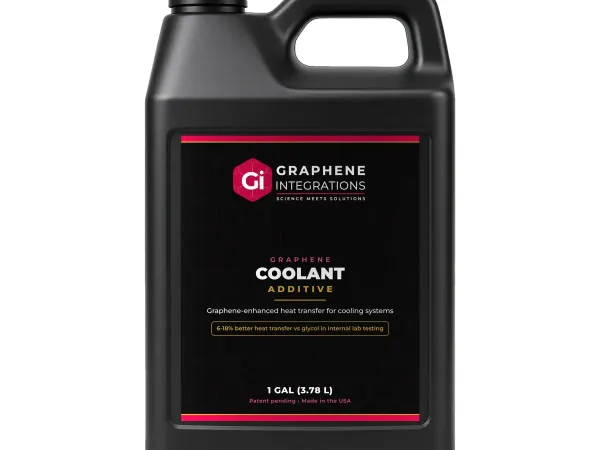
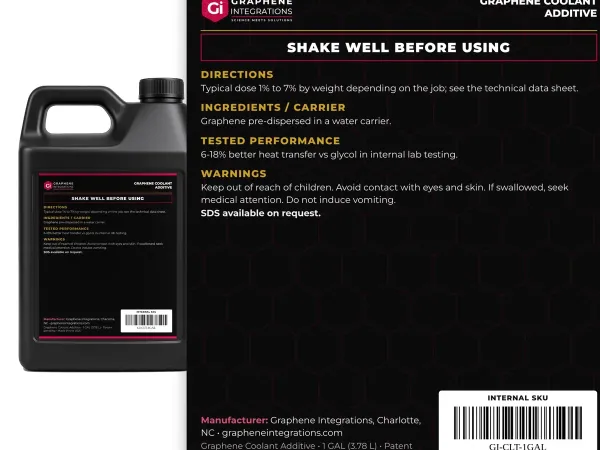
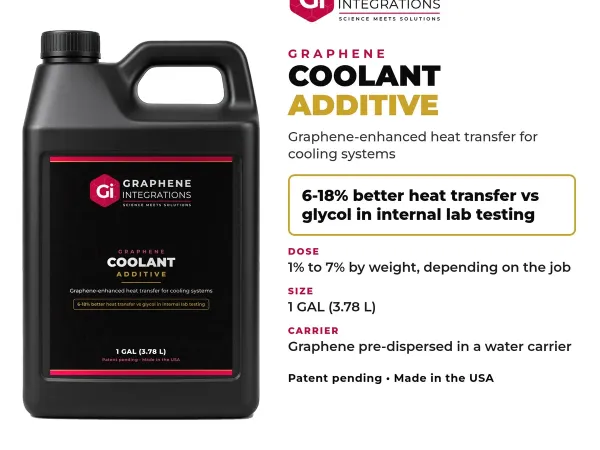
Graphene Coolant Additive
A graphene additive for liquid cooling loops, supplied pre-mixed in a water-based carrier.
- Category
- Lubricant & Fluid Additives
- Application
- Closed-loop liquid cooling, such as data center direct-to-chip and CDU loops. Tested in your system against your own baseline coolant.
- Carrier
- Water-based: graphene pre-dispersed in deionized water.
- Typical dose
- Formulation-specific supplied-additive dose: confirm base fluid, carrier and target graphene content with GI.
- SKU
- GI-CLT-1GAL (1 gal jug)
GI-CLT-5GAL (5 gal pail)
Sizes: 1 gal jug, 5 gal pail
Request a quote for pricing, lead time and the right dose for your job.
Downloads
Patent pending. Made in the USA. Manufacturer: Graphene Integrations, Charlotte, NC.
About this additive
Graphene Coolant Additive is supplied as a liquid formulation ingredient for developers of compatible cooling fluids. Select the carrier and treat rate with GI for your base coolant. This additive is not ready-to-use ThermaGraph and does not inherit its internal heat-transfer result. Pricing is by quote.
Develop a coolant around its actual operating duty
The Graphene Coolant Additive is a formulation ingredient, not the same product as ready-to-use ThermaGraph. Agree the supplied-additive dose and carrier with GI for the chosen base fluid; document the final graphene content separately. A result from another coolant or a graphene sheet is not a finished-fluid specification.
Run the candidate against your existing formulation at the same load and temperature. Measure heat removal alongside viscosity, pumping electricity, pressure drop, corrosion, foaming, filtration and storage stability. Retain the freeze protection and inhibitor performance your application requires.
DOE’s cooling-system evaluation illustrates why energy decisions need equipment-level measurements. A useful environmental comparison includes measured operating energy, fluid manufacture, carrier, maintenance, transport and disposal over the same service duty. It does not turn a thermal-property change directly into a CO₂-saving percentage.
Research / measurement reference · Continue with the application guide
More in Lubricant & Fluid Additives
-

Graphene Motor Oil Additive
A graphene additive for motor oils, supplied pre-mixed in an oil-based carrier so it blends straight into your oil. View product -

Graphene Gear Oil Additive
A graphene additive for gear oils, pre-mixed in an oil-based carrier for heavily loaded gear contacts. View product -

Graphene Hydraulic Fluid Additive
A graphene additive for hydraulic fluids, pre-mixed in an oil-based carrier for pumps, valves and cylinders. View product -

Graphene Grease Additive
A graphene additive for greases, pre-mixed in an oil-based carrier for blending into bearing and industrial greases. View product -

Graphene Concrete Additive
A graphene concentrate for concrete, supplied ready to add so it fits into existing batching and mixing. View product -

Graphene Plastic Additive
A graphene additive for plastics, supplied pre-dispersed in resin for compounding. View product