
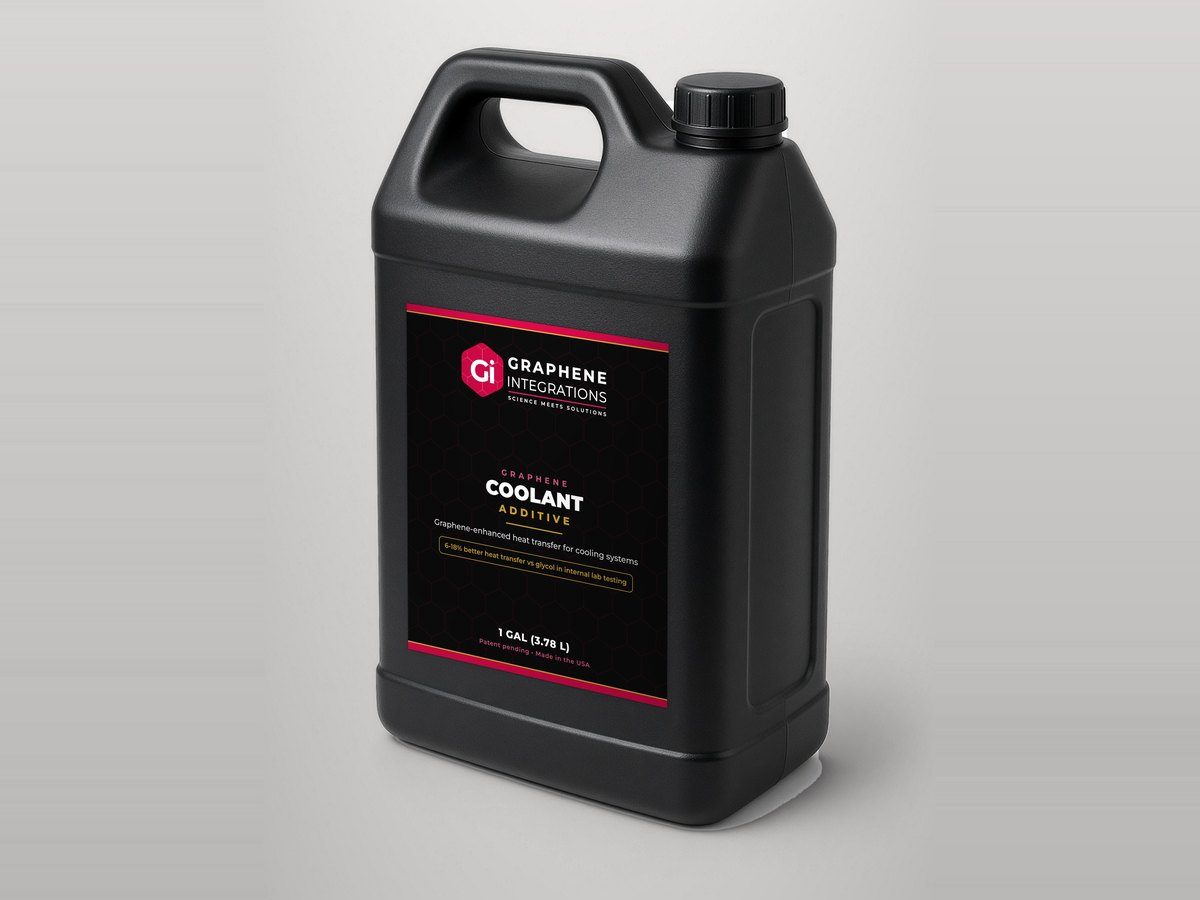
A nanofluid is a base liquid, usually water or a water-glycol mix, carrying a very small amount of finely dispersed solid particles. Engineers have studied nanofluids for decades as a way to help liquids carry more heat without changing pumps, pipes or heat exchangers. Graphene is one of the most studied materials for this because of its very high thermal conductivity. This article explains how our water-based Graphene Coolant Additive is used, what we can and cannot say about results, and how to run a trial in a loop you already operate.
What the additive is
The Graphene Coolant Additive is graphene pre-dispersed in deionized water. It is a general-purpose additive that you add to a coolant or heat transfer fluid. That makes it different from ThermaGraph, our finished, ready-to-fill coolant for data center liquid cooling.
- Applications: engine cooling systems, industrial chillers, process cooling loops and heat exchangers.
- Agree the supplied-additive dose and carrier with GI for your base coolant and operating duty. Document the final graphene content separately; the lubricant 1–7% treat guidance is not a specification for this coolant additive.
- Form: liquid, pre-dispersed. Never a powder, so no dust and no wetting-out step.
- Status: patent pending, made in the USA in Charlotte, NC, no carbon black.
What our lab data shows
The +6–18% higher convective heat-transfer coefficient versus a glycol baseline belongs to internal pumped-loop testing of ready-to-use water-based ThermaGraph. It is not a performance result for this formulation ingredient or for your finished coolant. Compare your actual blend and equipment at matched operating conditions.
In a real loop, results depend on the base coolant, flow regime, temperatures, heat exchanger design and how well the system is maintained. That is why every trial is measured against the customer's own baseline, in the customer's own loop.
Why nanofluids can help, and where they struggle
Heat moves from a hot wall into a flowing liquid through a thin boundary layer. The convective heat transfer coefficient describes how well that happens. Research on nanofluids has looked at how dispersed particles change thermal conductivity and boundary layer behaviour. A review in International Nano Letters summarises the wider literature and also the practical challenges: particle stability, settling, fouling and long-term compatibility. Those challenges are real, and they are why we supply graphene already dispersed and ask customers to sample the fluid during trials.
Where it is being evaluated
- Engine cooling: stationary engines, generator sets and fleets that want to compare a treated coolant with their standard fill.
- Chillers: closed chilled-water or process-water loops where small changes in heat transfer can affect run time.
- Process loops: moulds, extruders, presses and other equipment with a closed cooling circuit.
- Heat exchangers: plate and shell-and-tube units where the coolant side limits performance.
For data center liquid cooling specifically, start with ThermaGraph rather than this additive. ThermaGraph is formulated as a complete fill with a stated graphene loading per lot.
How to dose and mix
- Shake or stir the additive container before measuring.
- Agree the supplied-additive dose and carrier with GI for your base coolant and operating duty. Document the final graphene content separately; the lubricant 1–7% treat guidance is not a specification for this coolant additive.
- Add the additive to the coolant and circulate or mix until uniform.
- Keep a sealed retained sample of the treated coolant for comparison later.
If your coolant already contains corrosion inhibitors or glycol, tell us the product so we can flag compatibility questions before the trial.
A fair loop trial
- Baseline: log inlet and outlet temperatures on both sides of the heat exchanger, flow rate, pump power and load for a steady period.
- Treat: add the additive at the chosen rate and let it circulate until uniform.
- Repeat: log the same points at the same load and settings.
- Watch the fluid: sample at set intervals and check appearance, pH, conductivity and any settling in a still sample.
- Inspect: check strainers and filters after the trial period.
Keep the comparison simple: same load, same settings, one change. If heat transfer improves, decide how you want to use it, for example lower pump speed or more headroom on hot days.
Further reading
Our article on what a graphene dispersion is explains why we never ship graphene as a powder. For data centers, read graphene coolants for AI data centers. For the science of graphene's thermal conductivity, the original measurement in suspended single-layer graphene was published by Balandin and colleagues in Nano Letters.
Read the coolant additive press release, see all graphene products, or request a quote and samples.
Frequently asked questions
What is a nanofluid coolant?
A base liquid such as water carrying a very small amount of finely dispersed particles, studied as a way to help the liquid carry heat.
What heat transfer gain has graphene shown?
The +6–18% higher convective heat-transfer coefficient versus a glycol baseline belongs to internal pumped-loop testing of ready-to-use water-based ThermaGraph. It is not a performance result for this formulation ingredient or for your finished coolant. Compare your actual blend and equipment at matched operating conditions.
How much coolant additive do I use?
Agree the supplied-additive dose and carrier with GI for your base coolant and operating duty. Document the final graphene content separately; the lubricant 1–7% treat guidance is not a specification for this coolant additive.
Is this the same as ThermaGraph?
No. The coolant additive is added to an existing coolant. ThermaGraph is a finished, ready-to-fill coolant for data center liquid cooling.
Can I top up a loop that already contains the additive?
Yes, but top up with the same fluid mix so the concentration stays consistent, and record each top-up in your maintenance log.
Request a quote, samples or a spec sheet
Tell us your material, the property you want to improve, the carrier you use (water, solvent, resin or oil) and your volumes. Pricing and samples are by quote. Call 704-659-3682 or request a quote, samples or a spec sheet / SDS.
Develop a coolant around its actual operating duty
The Graphene Coolant Additive is a formulation ingredient, not the same product as ready-to-use ThermaGraph. Agree the supplied-additive dose and carrier with GI for the chosen base fluid; document the final graphene content separately. A result from another coolant or a graphene sheet is not a finished-fluid specification.
Run the candidate against your existing formulation at the same load and temperature. Measure heat removal alongside viscosity, pumping electricity, pressure drop, corrosion, foaming, filtration and storage stability. Retain the freeze protection and inhibitor performance your application requires.
DOE’s cooling-system evaluation illustrates why energy decisions need equipment-level measurements. A useful environmental comparison includes measured operating energy, fluid manufacture, carrier, maintenance, transport and disposal over the same service duty. It does not turn a thermal-property change directly into a CO₂-saving percentage.
Research / measurement reference · Continue with the application guide


