
Graphene is a single layer of carbon atoms joined in a flat, honeycomb-shaped lattice. It is the thinnest material known: one atom thick. Stack many graphene sheets on top of each other and you get graphite, the material in pencil lead. That simple structure gives graphene an unusual mix of strength, conductivity and barrier properties, which is why it has become one of the most researched materials in the world.
This guide explains what graphene is, which of its properties are well established, the different forms sold as "graphene" (including graphene oxide), what graphene is used for today, and how we use it at Graphene Integrations, a graphene manufacturer in Charlotte, NC.
What is graphene made of?
Graphene is pure carbon. Each carbon atom is bonded to three neighbors, forming a repeating pattern of hexagons, like chicken wire or a honeycomb. These bonds (chemists call them sp² bonds) are among the strongest in nature, and they lie in one flat plane. Above and below the plane there is nothing but a cloud of shared electrons, which is what lets electrons and heat move through the sheet so easily.
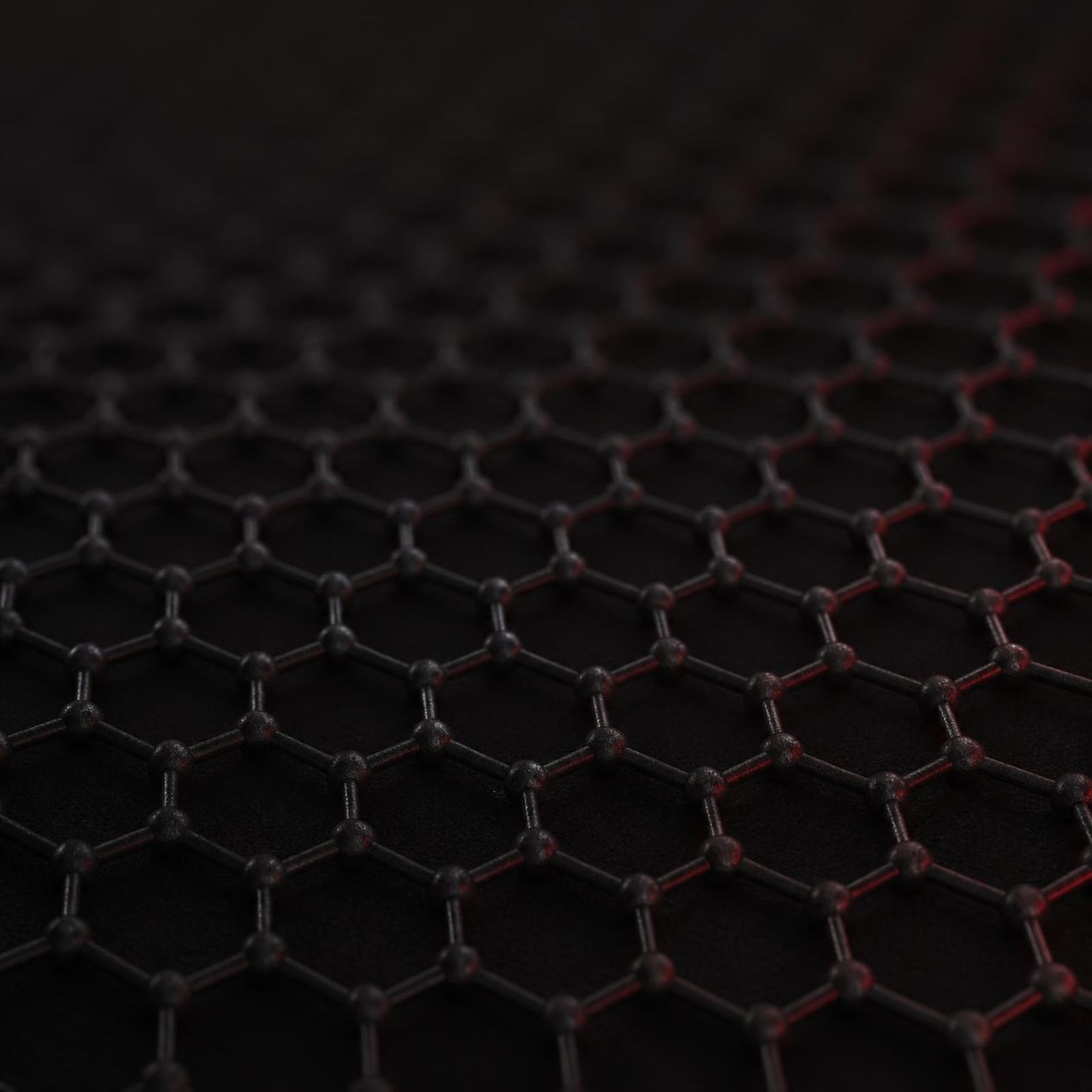
Graphite is made of graphene layers stacked and held together by weak forces. That is why pencil lead leaves marks on paper: thin flakes slide off. Graphene is what you get when you separate those layers down to one. For a side-by-side comparison, see graphene vs graphite.
Who discovered graphene?
Scientists described single-layer graphite in theory for decades, but many doubted a sheet one atom thick could exist on its own. In 2004, Andre Geim and Konstantin Novoselov at the University of Manchester isolated graphene by repeatedly peeling graphite with adhesive tape and measured its electronic properties. The two received the 2010 Nobel Prize in Physics for that work. Since then, research has moved from tiny lab flakes to industrial production of graphene materials by many companies around the world.
Properties of graphene
The figures below come from measurements on high-quality, single-layer graphene in the lab. They are well documented in scientific literature, but they describe a perfect sheet, not a finished product. When graphene is added to a coating, a plastic or concrete, the product does not take on these numbers; what matters is how much the graphene improves the material it is in, and that has to be tested.
- Strength. Pristine graphene has an intrinsic tensile strength of about 130 gigapascals and a stiffness (Young's modulus) of about 1 terapascal, measured by nanoindentation in 2008. That makes it one of the strongest materials ever tested, gram for gram far stronger than steel.
- Thinness and lightness. A single sheet is about one third of a nanometer thick. In theory, one gram of single-layer graphene has a surface area of about 2,600 square meters.
- Electrical conductivity. Electrons move through graphene very quickly, with some of the highest mobilities measured in any material at room temperature. Unlike silicon, graphene has no natural band gap, so it does not switch "off" on its own, which is one reason graphene has not replaced silicon in chips.
- Thermal conductivity. Suspended single-layer graphene has shown thermal conductivity in the range of thousands of watts per meter-kelvin, higher than copper.
- Transparency. A single layer absorbs only about 2.3% of visible light, so it is nearly transparent.
- Barrier. A defect-free graphene sheet is impermeable to gases, even helium. In coatings and plastics, flat graphene platelets can lengthen the path water and oxygen have to travel.
- Flexibility. Graphene can bend and stretch without breaking its bonds, which is why it is researched for flexible electronics and sensors.
The catch is that graphene sheets tend to clump and re-stack back into something closer to graphite. A clumped additive does very little. Spreading graphene evenly through a material is the hard part, and it is the problem we focus on. Our short video series Graphene, Explained covers this in a few minutes.
Forms of graphene, including graphene oxide
"Graphene" on a label can mean several different materials. Terminology standards such as ISO/TS 80004-13 separate single-layer graphene from bilayer and few-layer graphene and from thicker graphite nanoplatelets. When you compare suppliers or products, ask which form you are getting.
- Single-layer graphene films. Grown as continuous sheets, usually on metal foil, and transferred onto other surfaces. Used mainly in research, sensors and electronics.
- Few-layer graphene and graphene nanoplatelets. Small stacks of graphene layers, made in larger volumes. This is the form most used as an additive in coatings, plastics, composites, lubricants and concrete.
- Graphene oxide (GO). Graphene with oxygen-containing groups attached to its surface and edges, usually made by oxidizing graphite and separating the layers. The oxygen groups let graphene oxide disperse easily in water, but they disrupt the carbon lattice, so graphene oxide conducts electricity poorly. It is widely studied for membranes, coatings and composites.
- Reduced graphene oxide (rGO). Graphene oxide that has been treated chemically or with heat to remove much of the oxygen. This restores part of the conductivity, but rGO keeps more defects than pristine graphene.
- Graphene dispersions and concentrates. Graphene already mixed evenly into a liquid carrier such as water, a solvent, a resin or an oil. This is the only form we sell. Read what a graphene dispersion is and why we don't sell powder.
How is graphene made?
There are two broad routes. Top-down methods start with graphite and separate it into thin layers, for example by shear mixing or sonication in a liquid (liquid-phase exfoliation), by electrochemical methods, or by oxidizing it into graphene oxide. These methods make graphene flakes and platelets in volume. Bottom-up methods build graphene from carbon-containing gases, most commonly chemical vapor deposition (CVD) on copper foil, which makes large continuous films for electronics and research.
For industrial use, the details that matter most are flake size, number of layers, purity and defects, and how well the graphene stays dispersed. Raman spectroscopy is a standard way to check whether a material is really graphene rather than ground graphite; our video Is it really graphene? How we check shows how.
What is graphene used for?
Most graphene in real products today works as an additive: a small amount mixed into a material that already works, to improve one or two properties. Here are the main areas, from established products to research.
Graphene coatings and graphene ceramic coatings
"Graphene coating" covers two quite different markets. In car care, graphene ceramic coatings, sprays and detailers add a graphene material to a protective formula to support water beading and gloss. In industrial coatings, graphene platelets are researched for corrosion protection, because flat platelets can slow the movement of water and oxygen through a paint film. Coating results depend heavily on the formulation, so they have to be proven product by product.
Our first client was ITW, the company behind Rain-X and Black Magic. Working with ITW's engineers, we developed four graphene-enhanced car care products that reached store shelves: Rain-X Graphene Spray Wax, Rain-X Graphene Exterior Detailer, Black Magic Intense Graphene Quick Detailer and Black Magic Intense Graphene Tire Shine. Read the ITW case study. For other coatings we supply graphene dispersions in solvents and resins for formulation trials; we don't publish general coating performance claims.
Graphene batteries and energy storage
A "graphene battery" is usually a lithium-ion battery with graphene added to an electrode or used as a conductive additive, not a battery made of graphene. Graphene is researched to help electrodes conduct electricity, support silicon anodes and spread heat, and it is studied for supercapacitors. Results so far depend strongly on the design. Our energy storage work is at the research stage, and we make no battery performance claims.
Graphene concrete
Cement is the glue in concrete and the source of most of its carbon footprint. Graphene is researched as a way to make concrete stronger and more resistant to water. Our graphene concrete additive is a liquid concentrate dosed at 5% of the mix. In independent third-party testing in 2023, it gave a 67% gain in compressive strength and increased water resistance by 25%. Results depend on the mix design, so we trial it in yours. We believe stronger concrete could let designers reach the same strength target with less cement, but that still has to be proven in real mix trials and within building codes. Graphene rebar is in development and is not a product yet.
Graphene composites and plastics
In polymer composites, well-dispersed graphene is researched to make parts stiffer, tougher or more conductive without adding much weight. Working with Advanced Armor Research Group (AARG), we developed graphene-integrated armor composites that were evaluated with V50 ballistic testing at NTS Chesapeake, and we develop graphene polymers for aerospace. Aerospace and defense materials are qualified program by program, and this work is at the development stage.
Graphene lubricants and oils
Graphene's thin, slippery layers are studied as a lubricant additive that helps protect metal surfaces under load. In independent testing at Univar's Houston lab, our graphene lubricant additive reduced wear by up to 42% and raised weld load by 26%. See what the wear and weld load tests show.
Graphene for cooling and heat transfer
Because graphene conducts heat so well, it is researched as an additive for coolants, thermal pastes and heat spreaders. Our ThermaGraph™ coolant (patent pending) is a graphene coolant in deionized water for indoor closed loops. In our internal pumped-loop tests it showed a +6% to +18% higher convective heat transfer coefficient than a glycol baseline; that is lab data, not field data. ThermaGraph-D™ is made for single-phase immersion cooling. See data center coolants.
Electronics, sensors and other research areas
Graphene is researched for transistors, transparent conductive films, flexible electronics, sensors, membranes for water filtration, textiles and medical devices. Many of these are still in research or early development, and medical uses need regulatory approval. Our work in electronics and other areas is research-stage, and we look for partners who want to test graphene in their own materials.
How Graphene Integrations uses graphene
We make graphene in Charlotte, NC, and integrate it into the materials manufacturers already use. Our approach is simple:
- Pre-mixed only. We sell graphene only pre-dispersed in a carrier, such as water, solvents, resins or oils, never as dry flake or powder. That way it arrives evenly mixed and ready to add to your process.
- Fit to your product. We start with your material and your goal, propose a dispersion and dose, and trial it with your team before scale-up.
- Test-backed claims. We publish results only where there is test data, and we say whether it is independent or internal. Where we believe something but have not proven it, we say so.
- Quote-only. Pricing, samples and spec sheets are by quote, because dose and carrier depend on your product.
Browse our graphene products (dispersions, concentrates and additives), see how graphene additives are used in manufacturing, or read how to choose a graphene supplier. When you are ready, request a quote, samples or a spec sheet.