
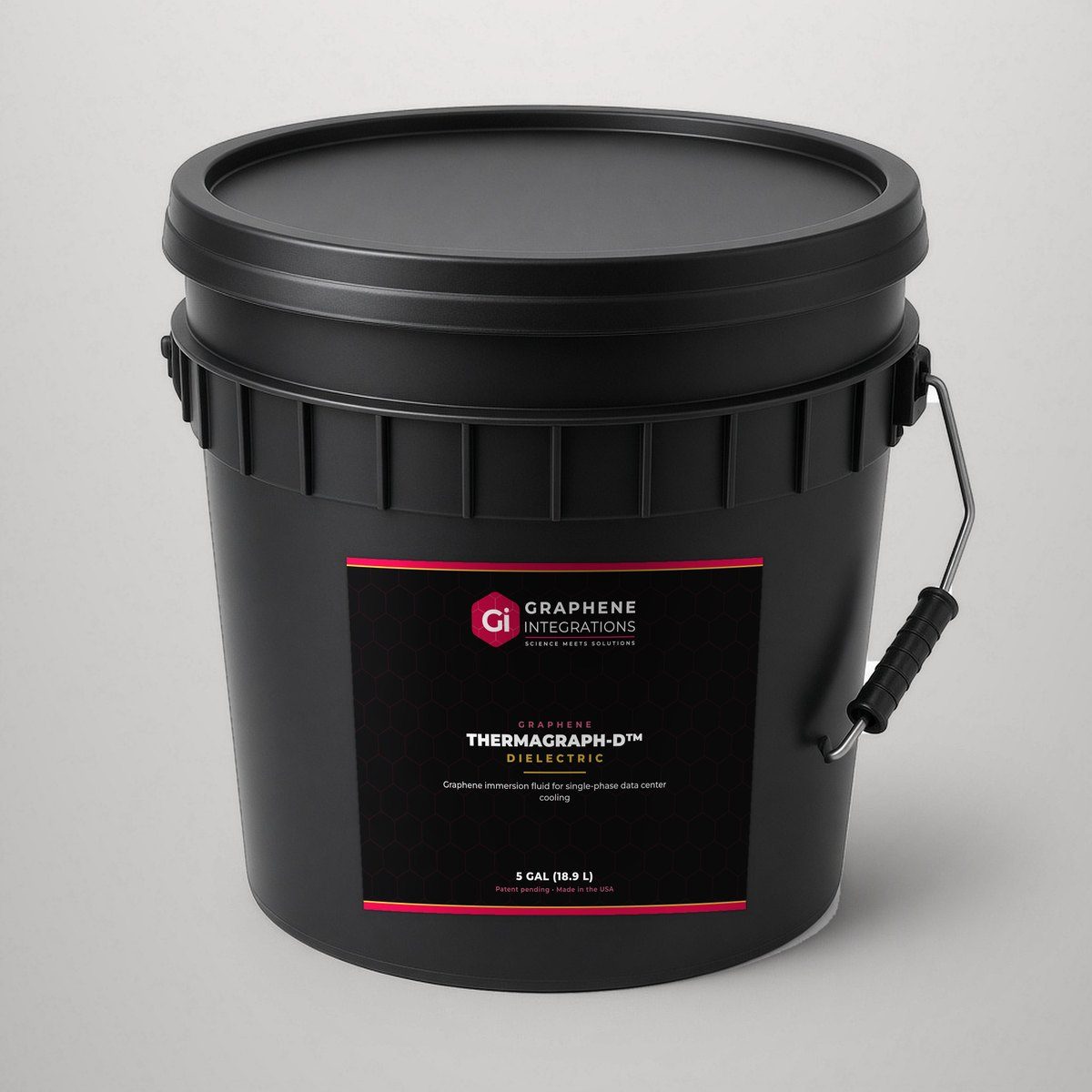
In single-phase immersion cooling, the fluid is the cooling system. Servers sit directly in a tank of dielectric liquid, heat moves from the components into the fluid, and the fluid is pumped through a heat exchanger. That means the fluid has two jobs at once: carry heat and keep electricity where it belongs. This checklist covers what operators and integrators should ask of any single-phase immersion cooling fluid, including our own, ThermaGraph-D.
1. Dielectric strength, per lot
Dielectric breakdown voltage is the voltage at which the fluid stops insulating and an arc forms between test electrodes. It is the first number to check, and it should be checked on every lot, not only on a datasheet sample. Moisture and particles lower breakdown voltage, so how the fluid is packed, stored and handled matters as much as its chemistry.
The Open Compute Project's base specification for immersion fluids is a useful industry reference. It lists recommended properties for immersion fluids, including dielectric strength, relative permittivity, dissipation factor and volume resistivity, and points to standard test methods for each.
2. Conductivity and resistivity
Breakdown voltage tells you about high-voltage events. Volume resistivity and conductivity tell you about the small leakage currents that flow all the time. Ask for both, ask how they were measured, and ask how they change with temperature, since resistivity usually falls as a fluid warms.
3. Viscosity and heat transfer
A lower-viscosity fluid moves more easily over boards and through the heat exchanger, which helps both natural and forced convection in the tank. Specific heat and thermal conductivity determine how much heat each litre can carry. Ask for viscosity at your operating temperature, not only at 40 °C, and compare fluids on the same basis.
4. Materials compatibility
Everything in the tank is wetted: cable jackets, labels, thermal interface materials, gaskets, connectors and plastics. Some materials swell, leach plasticisers or soften in some fluids. Ask for compatibility data, and plan your own soak tests on the specific parts in your servers. This is often the slowest part of an immersion qualification, so start early.
5. Flash point, handling and safety
Ask for flash point, the safety data sheet and handling guidance. Mineral-oil based fluids are a long-established class of dielectric liquids, used in electrical equipment for decades; their handling and fire codes are well understood by facilities teams. Confirm that your site's fire protection plan covers the fluid you choose.
6. Cleanliness and filtration
Particles and water are the enemies of dielectric performance. Ask how the fluid is filtered before shipping, what the container is, and what filtration you need in the tank loop. Plan for periodic sampling.
7. A supplier who will share test methods
Any fluid supplier should tell you which standard each property was tested to, at what temperature, and on which lot. If the answers are vague, the numbers are not much use.
Where ThermaGraph-D fits
ThermaGraph-D is graphene dispersed in Drakeol white mineral oil, made in Charlotte, NC. It is a dielectric fluid for single-phase immersion tanks. It is a separate product from ThermaGraph, our water-based coolant for closed loops, and the two must never be mixed or swapped.
- Carrier: Drakeol white mineral oil.
- Use: single-phase immersion; not two-phase, not water loops.
- Per-lot checks: breakdown voltage and conductivity are checked for each lot.
- Performance data: we have not published performance numbers for ThermaGraph-D yet. When we do, we will say exactly how they were measured.
- Status: patent pending, made in the USA, no carbon black.
Why add graphene to a dielectric oil at all? Graphene has very high thermal conductivity in its single-layer form, and researchers study dilute graphene dispersions as a way to help liquids carry heat. Adding a conductive material to an insulating fluid also raises an obvious question about electrical behaviour, which is exactly why we test breakdown voltage and conductivity lot by lot and why you should verify them in your own tank.
How to evaluate an immersion fluid in your tank
- Bench checks: confirm breakdown voltage, conductivity and viscosity on the lot you received.
- Soak tests: soak samples of your cables, labels, thermal pads and plastics, then inspect for swelling, softening and discoloration.
- Tank baseline: run your current fluid at a fixed IT load and log fluid temperatures, component temperatures, pump power and heat exchanger temperatures.
- Swap and repeat: drain, clean as your tank vendor recommends, fill with the new fluid and repeat the same load profile.
- Sample over time: re-test dielectric properties at agreed intervals.
Our article ThermaGraph vs ThermaGraph-D: water loop or immersion? explains which product fits which system, and graphene coolants for AI data centers covers the bigger picture.
Read the ThermaGraph and ThermaGraph-D press release, see the data center coolants page, or request a quote and a sample.
Frequently asked questions
What is the most important property of an immersion cooling fluid?
Dielectric strength, checked on every lot, together with conductivity. A fluid that does not insulate reliably cannot be used, however well it carries heat.
What is ThermaGraph-D made of?
Graphene dispersed in Drakeol white mineral oil. It is a dielectric fluid for single-phase immersion tanks.
Has ThermaGraph-D published performance numbers?
No. We have not published performance numbers for ThermaGraph-D yet. Breakdown voltage and conductivity are checked for each lot.
Can I use ThermaGraph in an immersion tank?
No. ThermaGraph is water-based and only for sealed loops. Use ThermaGraph-D for immersion, and never mix the two.
Request a quote, samples or a spec sheet
Tell us your material, the property you want to improve, the carrier you use (water, solvent, resin or oil) and your volumes. Pricing and samples are by quote. Call 704-659-3682 or request a quote, samples or a spec sheet / SDS.


