
Press release
The reinforcement project builds on the company's concrete additive work. It is in development, not yet a product, and no performance claims are made.
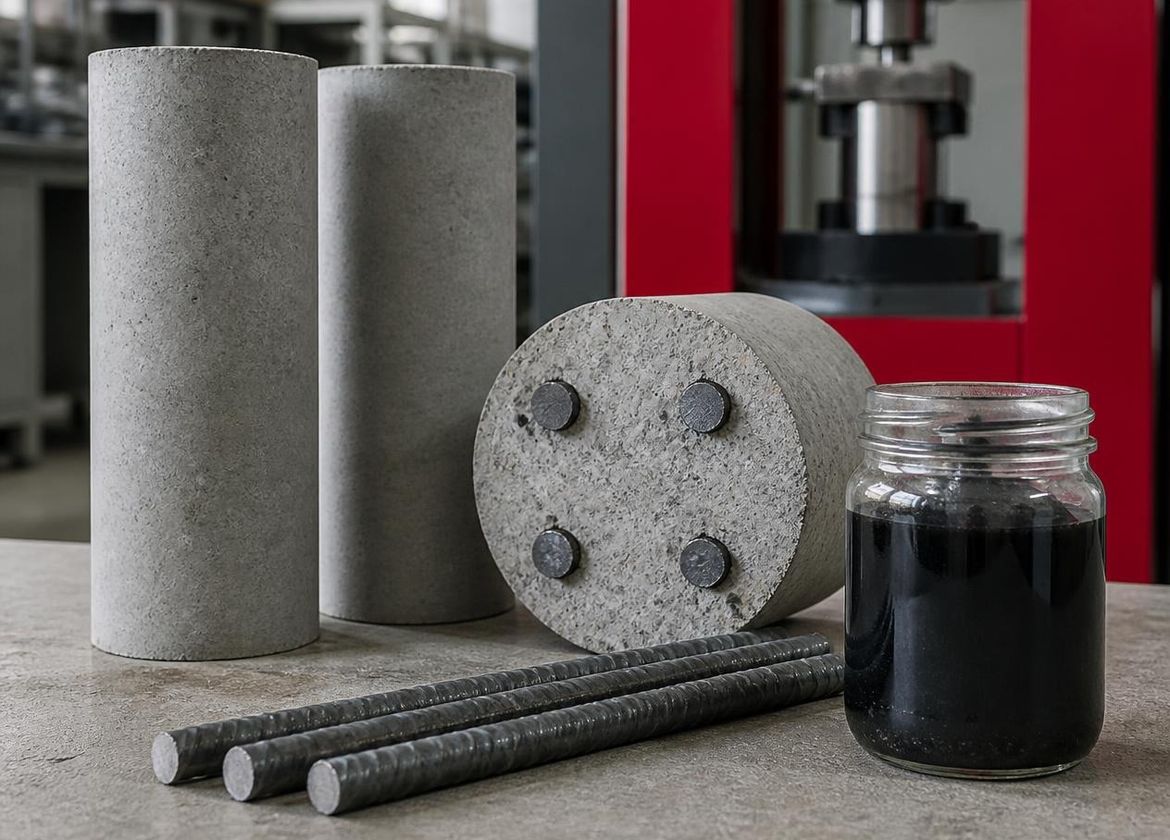
CHARLOTTE, NC — October 23, 2026 — Graphene Integrations today announced that it is developing graphene rebar, a graphene-based reinforcing bar for reinforced concrete construction. Graphene rebar is in development. It is not yet a product, it is not for sale, and its specifications are not final.
Why reinforcement is next
The project grows out of the company's work on NanoTechCrete, its graphene concrete additive. With the additive improving the concrete itself, the natural next question is the reinforcement inside it. Steel rebar can corrode inside concrete over time, and corrosion is a common cause of cracking and repair work in bridges, roads and coastal structures.
“Rebar holds up a lot of what we build in this country, so we're not going to rush it or oversell it. We'll test it the right way, against the codes, and we'll share real results when we have them.”
What the team is working toward
The development goals are reinforcement that is lighter than steel for easier handling, that does not rust, that works with graphene-enhanced concrete as one system, and that can be made in the USA. These are goals, not results. Graphene Integrations has no published test data for graphene rebar yet and makes no claims about its strength, weight, cost or service life compared with steel.
Codes come first
Any reinforcement product must be tested and approved under the codes and standards that apply before it is used in structures, and that work will set the pace of the program. Engineers, contractors and producers who want to take part in testing or development work can register their interest.
Request a quote Follow the graphene rebar project →
About Graphene Integrations
Graphene Integrations is a US graphene manufacturer in Charlotte, NC, making graphene-enhanced additives for coolants, lubricants, concrete and coatings. The company makes graphene and supplies it pre-mixed in water, solvents, resins and oils, never as a dry powder, so manufacturers can add it to products and processes they already run. Its products are patent pending and made in the USA. Learn more about Graphene Integrations.
Media contact
Frans Alkemade
CEO, Graphene Integrations
sales@grapheneintegrations.com
+1 (704) 659-3682
###
Concrete strength and embodied carbon
The additive strength result below is not a rebar test or a demonstrated environmental benefit of the in-development reinforcement.
Cement is the binder in concrete. Its production releases CO₂ through limestone conversion and energy use, as explained by the IEA. That makes cement quantity an important part of a concrete carbon assessment.
GI’s additive achieved +67.7% compressive strength in third-party testing at the tested 5% supplied-additive dose by cement weight, not 5% pure graphene. This validated strength result supports investigating lower-cement mixes; it does not establish how much cement can be removed. Candidate mixes must meet the same required performance.
Conditional example: if 100 kg of Portland cement is actually avoided at the same required performance, gross avoided cement A1–A3 impact is 100 × 0.919 = 91.9 kg CO₂e. The 100 kg is an example assumption, not a reduction demonstrated by GI. The official US industry-average Portland cement EPD, revised July 2026, Table 4, gives 0.919 kg CO₂e/kg using 2019 production data, covering A1–A3, raw materials through manufacturing—not a current-year plant measurement or whole-life concrete footprint. CO₂e means carbon dioxide equivalent.
This is gross avoided cement-production impact, not measured GI net savings. Net savings require matched-performance mix validation and a consistent lifecycle comparison including additive manufacture, carrier, packaging, transport and all changed mix inputs. Unknown additive impacts are not zero. The strength result does not automatically establish cement reduction, longer service life or carbon capture.