
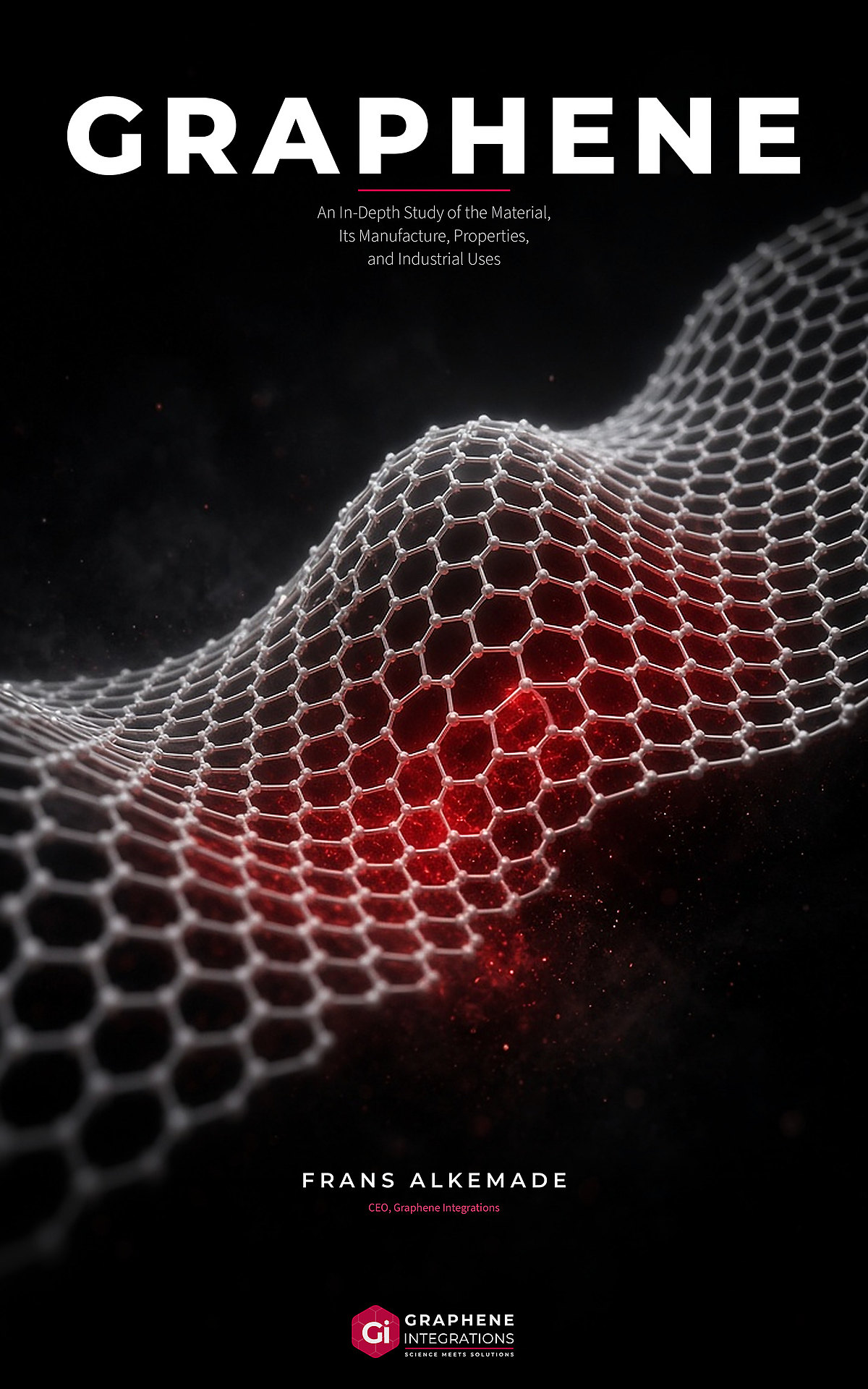
Graphene is one atom thick—and often larger than its hype. From Wallace’s 1947 band theory and Friday-night experiments in Manchester, through a Nature rejection that preceded the 2004 Science paper, Balandin’s Raman thermometer in Riverside, and Lee’s AFM tip at Columbia, this book follows the people and problems that turned a hexagonal sheet of carbon into an industrial material. Written for engineers, buyers, and formulators, it separates landmark laboratory numbers from bulk grades, explains how graphene is made without publishing proprietary recipes, and shows how Graphene Integrations in Charlotte, North Carolina, puts graphene into carriers plants can actually use—coolants, lubricants, concrete, coatings, and composites. Claims stay tested and clearly labeled; safety follows the SDS. Ask better questions. Buy better grades. Test what matters.
Free sample: read the Preface and Chapter 1, "History: From Graphite Theory to the Nobel Prize" (PDF, 17 pages).
Download the free sample chapter (PDF)
The full book is coming soon to Amazon in paperback and Kindle. Librarians, teachers, reviewers and podcast hosts can request a complimentary review copy or an interview through our contact page or at sales@grapheneintegrations.com.
What’s inside
- History: From Graphite Theory to the Nobel Prize
- What Graphene Is
- How Graphene Is Made
- Thermal Properties
- Electrical and Electronic Properties
- Mechanical Properties
- Barrier and Chemical Properties
- Optical Properties
- Dispersions and Integration into Host Materials
- Applications by Industry
- Safety, Health, Environment, and Standards
- Market, Commercialization, and Hype vs Reality
- How Graphene Integrations Works with Graphene
Plus About the Author, Glossary, Bibliography, and Index.
Read an excerpt from Chapter 1
1.7 2004: rejected by Nature, published by Science
The Manchester team, with collaborators in Chernogolovka, Russia, first submitted its results to Nature. Geim later recalled that the manuscript was rejected twice, with one referee judging that it did not constitute a sufficient scientific advance. The team took the work to Science. On 22 October 2004, Novoselov, Geim, Morozov, Jiang, Zhang, Dubonos, Grigorieva and Firsov published "Electric Field Effect in Atomically Thin Carbon Films."
The abstract is worth reading closely. It describes monocrystalline graphitic films "a few atoms thick" that are nonetheless stable under ambient conditions, metallic, and of remarkably high quality. Sticky tape is the folklore. Gated devices are the science.
Buyers inherit a trap from that fame. The celebrated flake on a silicon wafer is not what most industrial dispersions contain. Mobility and crystallinity benchmarks from 2004 set a quality ceiling that few-layer powders and reduced graphene oxide grades rarely claim, and often do not need, for concrete, grease or coolant duty. Confusing the Nobel flake with the drum is how hype is born.
Keep reading: download the free Preface and Chapter 1 (PDF)
Read free chapter-based articles
While the full book is prepared for Amazon, these rewritten articles introduce themes from the book without giving the manuscript away:
- The history and discovery of graphene
- How graphene is made
- Graphene and heat in data centers
- Graphene in concrete and lubricants
About the author

Frans Alkemade is the founder and CEO of Graphene Integrations, a US graphene manufacturer based in Charlotte, North Carolina, and founder/CEO of sister company Nano Technology Chemicals (NTC), a chemical distributor and toll blender.
His path into science runs through Stanford’s physics community: born in Holland, raised in California’s Bay Area after arriving in America at age one, and shaped early by visits to labs where his father worked alongside Dr. Arthur L. Schawlow. Schawlow shared the 1981 Nobel Prize in Physics for contributions to laser spectroscopy (NobelPrize.org; Stanford Physics); as a family account, Frans’s father received credit from Schawlow for help toward that work. A lasting personal tie—including Schawlow’s presence at Frans’s wedding and the wintergreen Life Savers that marked childhood visits—helped turn curiosity into a career in materials and manufacturing.
Before Graphene Integrations, Frans served as Director of Apple iMac Operations, with experience that included meetings with Steve Jobs, a castle dinner in South Korea with Tim Cook and the CEO of LG Electronics, and leading the move of iMac production to China—work he credits with saving Apple more than $750 million in manufacturing when Apple had about $3 billion in the bank. Terry Gou, CEO of Hon Hai (Foxconn), told him that effort would appear in Gou’s personal memoirs. Frans moved to the Carolinas in 2008 and later founded Graphene Integrations in Charlotte, applying a scale-first manufacturing mindset to graphene dispersions and additives for concrete, lubricants, data-center coolants (ThermaGraph™ / ThermaGraph-D™), coatings, and polymer composites, including collaborations with partners such as ITW on graphene car-care products for Black Magic and Rain-X brands.
Contact: sales@grapheneintegrations.com · grapheneintegrations.com
Location: Charlotte, North Carolina
Cite or link to this book
Teachers, librarians, students and writers are welcome to cite the book or add it to a reading list or resource guide.
Suggested citation (APA): Alkemade, F. (2026). Graphene: An in-depth study of the material, its manufacture, properties and industrial uses. Graphene Integrations. https://grapheneintegrations.com/graphene-book
Link for your site or reading list:
<a href="https://grapheneintegrations.com/graphene-book">Graphene by Frans Alkemade (free sample chapter)</a>
Frequently asked questions
Who wrote the book Graphene?
Frans Alkemade, founder and CEO of Graphene Integrations, a US graphene manufacturer, and former Director of Apple iMac Operations.
What does it cover?
Graphene's history from 1947 theory to the 2010 Nobel Prize, what it is, how it is made, its thermal, electrical, mechanical, barrier and optical properties, dispersions, applications by industry, safety and standards, and the market, plus a practitioner's toolkit, reference data and a glossary.
Can I read part of it for free?
Yes. Download the Preface and Chapter 1 as a free PDF.
Who is it for?
Engineers, purchasing managers, formulators, students and anyone who needs to separate laboratory graphene records from the bulk grades sold for coolants, lubricants, concrete, coatings and composites.