
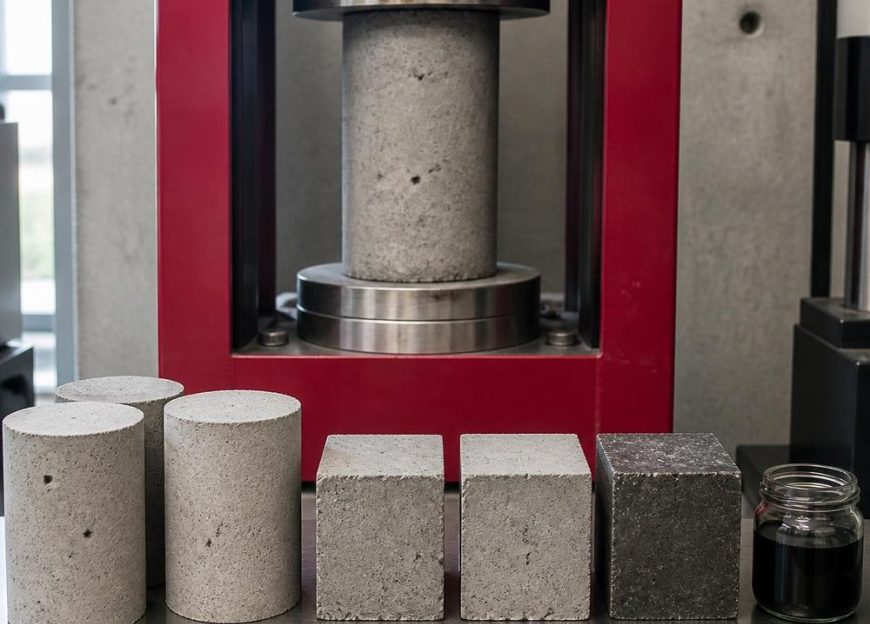
Our graphene concentrate is a concrete additive dosed at 5% of cement weight, for lab samples and plant or truck loads. Reduce mix water by the same weight. In independent third-party testing it gave a 67.7% gain in compressive strength. It is supplied ready to add, so it fits into existing batching and mixing. For background on the material itself, see what is graphene.
Video: Graphene & Green Ep. 3, why concrete cracks and why lasting longer cuts carbon.
What higher compressive strength can mean
Higher compressive strength gives designers more options. Any change to a mix design, or to the amount of concrete in a project, should be confirmed by the project engineer with testing on that mix. Results depend on the cement, aggregates, water-cement ratio and curing.
Water resistance
Beyond strength, concrete with 5% graphene increased water resistance by 25%. Water resistance matters for structures exposed to water and weather, such as bridges, roads and sea walls.
Sea walls and coastal concrete
We have focused our concrete work on applications where strength and water resistance both matter, including concrete sea walls. We work with concrete producers who want to test graphene in their own mixes; long-term field durability still has to be shown project by project.
Next: reinforcement
We are extending our concrete work to reinforcement. See graphene rebar (in development).
Spec sheet summary
- Form: graphene supplied pre-dispersed in a liquid carrier, never as dry flake or powder.
- Carrier options: water-compatible concentrate for adding with the mix.
- Typical uses: ready-mix and precast concrete, tested in your own mix design.
- Handling: liquid product, so there is no dry graphene powder to handle. Follow the mixing, storage and safety instructions on the spec sheet and SDS supplied with each product.
The full spec sheet and SDS are available on request. Request a quote, samples or a spec sheet / SDS.
How to use the graphene concrete additive
| Form | Liquid graphene concentrate, water-compatible |
|---|---|
| Dose | 5% by weight of cement |
| Addition | Ready to add at batching; fits existing batching and mixing |
| Result in independent third-party testing | 67.7% higher compressive strength; 25% increase in water resistance |
| Typical uses | Ready-mix and precast concrete, tested in your own mix design |
Mixing instructions: see how to mix NanoTechCrete, with step-by-step instructions and amounts for 50 lb and 80 lb bags and 1 cubic yard. Printable PDF.
How to run a trial
- Send us your mix design and target properties.
- We supply the concentrate with the spec sheet and SDS.
- Cast and break cylinders against your current mix as the control.
- Your project engineer confirms any mix design change with that testing.
More: graphene dispersions in water, graphene in construction, and the concrete additive press release.
Want the details? Request a summary of the independent test results: 67.7% higher compressive strength at 5% by weight of cement, in independent third-party testing.
Frequently asked questions
How much graphene concrete additive do I use?
Dose at 5% of cement weight, for lab samples and plant or truck loads. Reduce mix water by the same weight. In independent third-party testing that dose gave a 67.7% gain in compressive strength.
Do I need new equipment?
It is supplied ready to add, so it fits into existing batching and mixing.
Will it give the same result in my mix?
Results depend on the cement, aggregates, water-cement ratio and curing. We test with you in your own mix, and any change to a mix design should be confirmed by the project engineer.
Is it made in the USA?
Yes. We make our graphene in Charlotte, North Carolina. See our graphene dispersions and graphene products.
Is graphene concrete additive available in the USA?
Yes. We make it in Charlotte, North Carolina, and supply concrete producers across the US. Pricing is by quote.
Learn more
Request samples or contact us with your mix design and volumes to arrange samples and testing.
Related reading: how a graphene concrete additive works and how to test it in your mix.
Graphene case studies: published test results →
Concrete strength and embodied carbon
Cement is the binder in concrete. Its production releases CO₂ through limestone conversion and energy use, as explained by the IEA. That makes cement quantity an important part of a concrete carbon assessment.
GI’s additive achieved +67.7% compressive strength in third-party testing at the tested 5% supplied-additive dose by cement weight, not 5% pure graphene. This validated strength result supports investigating lower-cement mixes; it does not establish how much cement can be removed. Candidate mixes must meet the same required performance.
Conditional example: if 100 kg of Portland cement is actually avoided at the same required performance, gross avoided cement A1–A3 impact is 100 × 0.919 = 91.9 kg CO₂e. The 100 kg is an example assumption, not a reduction demonstrated by GI. The official US industry-average Portland cement EPD, revised July 2026, Table 4, gives 0.919 kg CO₂e/kg using 2019 production data, covering A1–A3, raw materials through manufacturing—not a current-year plant measurement or whole-life concrete footprint. CO₂e means carbon dioxide equivalent.
This is gross avoided cement-production impact, not measured GI net savings. Net savings require matched-performance mix validation and a consistent lifecycle comparison including additive manufacture, carrier, packaging, transport and all changed mix inputs. Unknown additive impacts are not zero. The strength result does not automatically establish cement reduction, longer service life or carbon capture.