
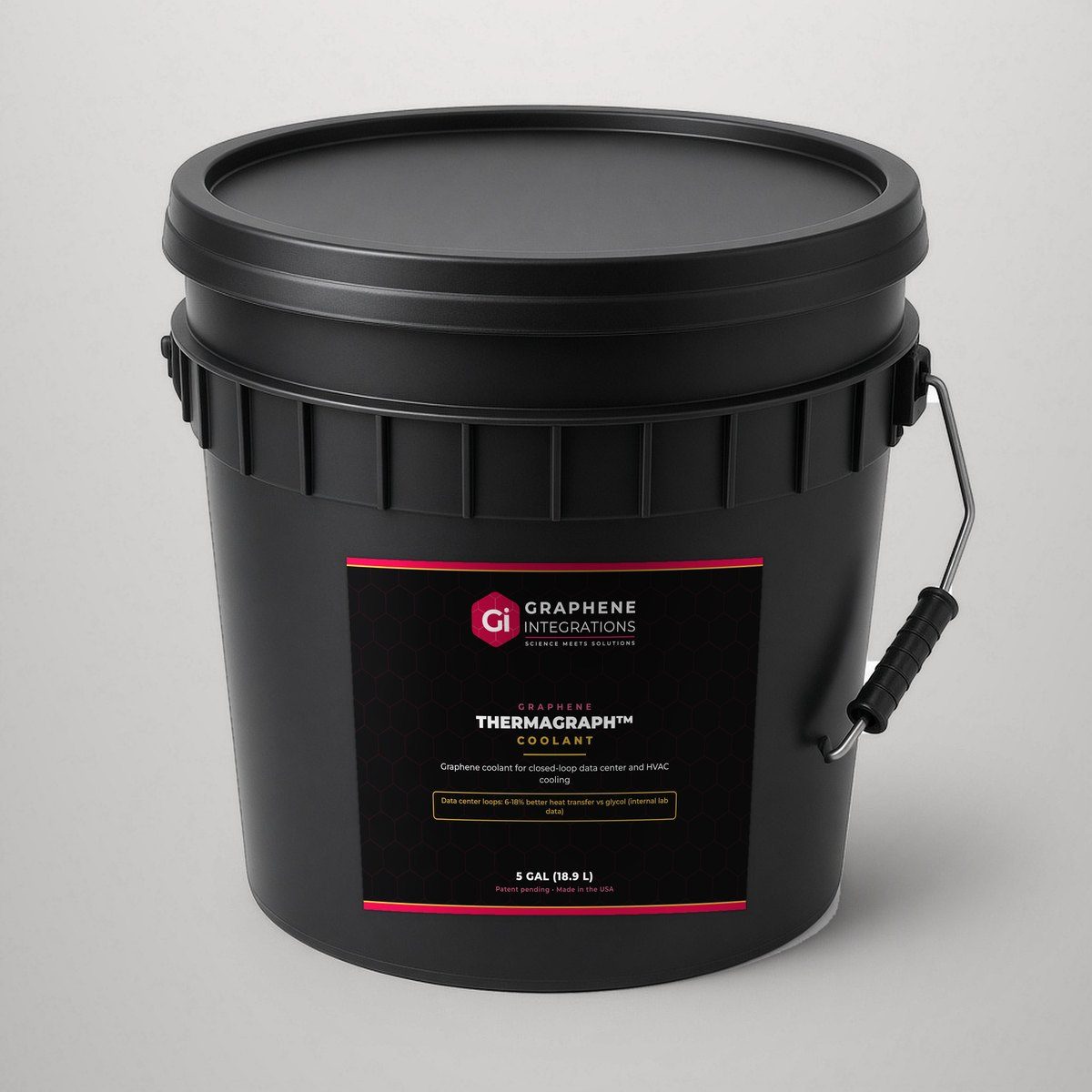
PG25, a mix of about 25% propylene glycol and 75% water, is the default fill in many direct-to-chip and CDU loops. It is a sensible default: it protects against freezing and it usually comes with a corrosion and biocide package. But glycol also makes water a worse heat carrier. If your loop is indoors, closed and never sees freezing temperatures, it is fair to ask whether you are paying a heat transfer penalty for protection you do not need. This article explains when a water-based graphene coolant such as ThermaGraph can be a PG25 alternative, what our lab data shows, and how to test it without guessing.
Why glycol costs you heat transfer
Water is one of the best common heat transfer liquids. Adding glycol lowers the freezing point, but it also lowers the mixture's specific heat and thermal conductivity and raises its viscosity, especially when the fluid is cold. In practice that means a glycol mix carries a little less heat per litre, and the pumps work a little harder to move it. Coolant suppliers publish these property curves, and every cooling engineer who has sized a loop for glycol has seen the derating.
That trade is worth it when freezing is a real risk: outdoor dry coolers, rooftop runs, shipping and storage in winter, or sites where a loop can sit drained and cold. It is less obviously worth it on the technology cooling system (TCS) side of a CDU in a conditioned data hall, where the fluid never leaves the building.
What ThermaGraph is
ThermaGraph is graphene in deionized water. It contains no glycol. The graphene loading is low, 0.05 to 0.20 wt%, and it is stated on the certificate of analysis for each lot. The graphene is made and dispersed by us in Charlotte, NC, and supplied ready to fill. It is never sold as a powder.
- Intended use: indoor, closed copper loops such as CDUs, direct-to-chip cold plates and rear-door heat exchangers, where freeze protection is not specified.
- Freeze point: 0 °C (32 °F), the same as water. If your design needs freeze protection, ThermaGraph is not the right fluid.
- Fill type: a new fill, not a top-off. Glycol loops are drained and flushed first.
- Status: patent pending, made in the USA, no carbon black.
What our data shows, and what it does not
In internal pumped-loop lab tests, ThermaGraph showed a 6% to 18% higher convective heat transfer coefficient than a glycol baseline. That is internal lab data, not field data, and the range reflects different test conditions.
We then put those lab results into an engineering model of a 1 MW data center running at a PUE of 1.30. In that model, the heat transfer gain translated to 20 to 58 kW saved per 1 MW of IT load, from the conservative case to the optimistic case. That figure is modeled, not measured. Your savings depend on how your plant is controlled: whether you take the gain as lower pump speed, warmer supply water, more chiller-free hours or simply more thermal headroom at the chip.
We do not claim a specific PUE change for your site, and we do not compare ThermaGraph to any named commercial coolant. The fair comparison is your own loop, with your own fluid as the baseline.
Where the graphene comes in
Graphene has very high thermal conductivity in its single-layer form, first measured in suspended graphene by Balandin and colleagues in Nano Letters (2008). A dilute dispersion in water does not behave like a sheet of graphene, and nobody should expect bulk-fluid numbers anywhere near that. What a well-dispersed, low-loading nanofluid can do is change heat transfer at the wall of a channel, which is what the convective coefficient measures.
Is your loop a candidate?
Use this as a first screen before you request samples.
- Location: is every part of the loop indoors, in conditioned space, with no risk of freezing in operation, shipping or standby?
- Metals: is the wetted path copper based, as in most cold plates and CDU heat exchangers? Tell us about any aluminium or mixed metals before a trial.
- Loop type: is it a closed TCS loop, separate from the facility water system? ThermaGraph is not for open towers or facility water.
- Filtration: what is the finest filter or microchannel in the path? Share it so we can confirm compatibility.
- Baseline data: can you log supply and return temperatures, flow, pump power and chip temperatures at a fixed load?
If you answered yes to the first three, a trial makes sense. ASHRAE TC 9.9 separates facility water from TCS water and sets different expectations for each; the ASHRAE thermal guidelines reference card summarises the liquid cooling classes (W17 to W+) by facility supply temperature. ThermaGraph sits on the TCS side of the CDU.
How to run a fair PG25-versus-ThermaGraph trial
- Record a baseline on PG25. Hold IT load steady, then log supply and return temperature, flow rate, pressure drop, pump power and chip or cold-plate temperatures for long enough to see a stable picture.
- Drain and flush. Remove the glycol fully and flush with deionized water until conductivity and appearance match the flush water. Mixing ThermaGraph with residual glycol muddies the result.
- Fill with ThermaGraph. Fill and vent as you would for any new fluid. Keep the same pump and valve settings for the first run.
- Repeat the same load profile. Log the same points under the same conditions. Then try your normal control strategy so you can see where the gain shows up.
- Check the fluid. Sample at the start and at agreed intervals. Look at appearance, conductivity and pH, and keep the certificate of analysis with your records.
We send a 30-day sample for this kind of evaluation and help you plan the measurements. You keep the data.
ThermaGraph is not an immersion fluid
Water conducts electricity, so ThermaGraph belongs only in sealed loops that keep the fluid away from electronics. For boards that sit directly in a tank, the separate product is ThermaGraph-D, graphene in white mineral oil. The two should never be mixed or swapped. Our article ThermaGraph vs ThermaGraph-D: water loop or immersion? explains the split, and graphene coolants for AI data centers covers the lab tests in more depth.
Read the ThermaGraph press release, see the data center coolants page, or request a quote and a 30-day sample.
Frequently asked questions
Can I top off a PG25 loop with ThermaGraph?
No. ThermaGraph is a new fill, not a top-off. Drain and flush the glycol first so the trial compares two clean fluids.
Does ThermaGraph protect against freezing?
No. It is water-based with no glycol, so its freeze point is 0 °C (32 °F). Use it only in indoor, closed loops where freeze protection is not specified.
Is the 20 to 58 kW per MW figure measured?
No. It comes from an engineering model of a 1 MW data center at a PUE of 1.30. The 6% to 18% heat transfer figure behind it is internal lab data versus a glycol baseline.
Can ThermaGraph be used for immersion cooling?
No. Use ThermaGraph-D, the white mineral oil product, for single-phase immersion. Never mix or swap the two.
Request a quote, samples or a spec sheet
Tell us your material, the property you want to improve, the carrier you use (water, solvent, resin or oil) and your volumes. Pricing and samples are by quote. Call 704-659-3682 or request a quote, samples or a spec sheet / SDS.


