
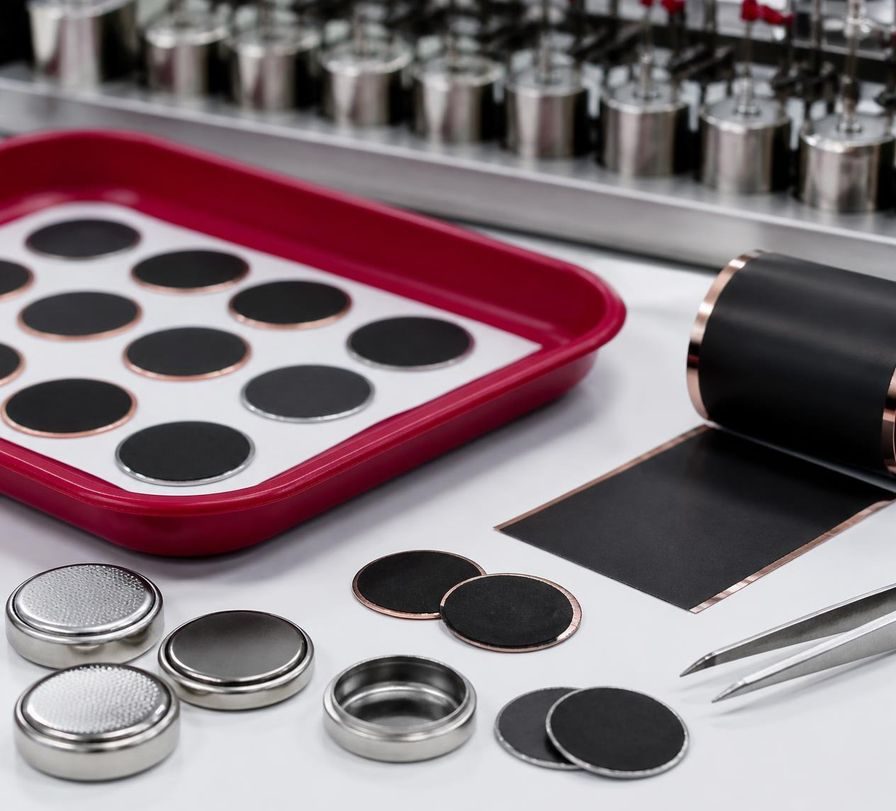
Supercapacitors store energy on the surface of their electrodes, so they benefit from materials with very high surface area and conductivity; batteries store energy through chemical reactions inside the electrode, so graphene there is mainly studied as a conductive additive that helps electrons move through the electrode. Supercapacitors charge and discharge quickly but store less energy than batteries, which is why the two are often used together.
Graphene is one of the most researched materials for both. Its role, the dose and the tests are different in each.
How do supercapacitors and batteries store energy differently?
- Batteries (for example lithium-ion) store energy chemically, as ions move into and out of active materials in the electrodes. They hold more energy per kilogram, but charge and discharge more slowly.
- Supercapacitors (electrochemical double-layer capacitors) store charge electrostatically at the interface between the electrode surface and the electrolyte. They deliver high power and many charge cycles, but less energy.
Why is graphene studied for supercapacitors?
A supercapacitor's capacity depends heavily on the electrode surface the electrolyte can reach. Graphene's very high surface area per gram, combined with conductivity, makes it a strong candidate electrode material. Research also looks at combining graphene with other carbons or pseudocapacitive materials. The challenge is keeping sheets from restacking, which reduces accessible surface area.
Why is graphene studied for batteries?
In lithium-ion electrodes, a small amount of graphene can form a conductive network through the electrode, which research aims to use for higher power, faster charging and longer cycle life. Flexible graphene networks are also studied to help electrodes cope with swelling, for example in silicon-containing anodes, and graphene's thermal conductivity is studied for spreading heat in battery packs. See graphene in energy storage and our conductive additive guide for battery electrodes.
What should developers test?
For battery electrodes, set the additive dose on a clear dry-solids basis, accounting separately for its carrier. Hold active material, binder, coating thickness, loading and compaction comparable, then measure slurry behavior, electrode conductivity, impedance, rate capability, cycle retention and safety in the intended cell chemistry.
For supercapacitor electrodes, measure capacitance, equivalent series resistance, rate performance and cycle stability in the target electrolyte, compared with your current carbon.
What can Graphene Integrations claim today?
We do not yet publish test data for graphene in batteries or supercapacitors. Results depend heavily on cell chemistry, the graphene grade and dispersion quality, so every project starts with testing in your formulation. Our published results are in other materials: +67.7% compressive strength at 5% by weight of cement in independent third-party testing (2023) for concrete, and up to 42% smaller four-ball wear-scar diameter and 26% higher weld load in independent lab testing for our lubricant additive. See case studies.
How is graphene supplied for electrode work?
We supply graphene already dispersed in water, solvents and resins, so developers can add it to their own slurry formulations. Our battery additive is a starting point. Tell us your binder system and solvent, for example water-based or solvent-based slurries, and we will suggest a carrier. See graphene battery: what is real today.
What about "graphene batteries" on the market?
Products marketed as "graphene batteries" are usually conventional chemistries that use graphene in an electrode or for heat management, not batteries made of graphene. Ask what role graphene plays and what data supports the claim; see evaluating graphene-enhanced claims.
Frequently asked questions
Is a graphene supercapacitor a battery?
No. A supercapacitor stores charge electrostatically and delivers high power with less energy storage than a battery.
Can graphene replace lithium in batteries?
No. Graphene is studied as a conductive or structural component of electrodes, not as a replacement for the active chemistry.
Do you publish battery test results?
Not yet. Every project starts with testing in your own formulation.
Do you sell graphene powder for electrodes?
No. We supply graphene pre-dispersed in a carrier matched to your slurry.
Request a quote, samples or a spec sheet
Tell us your material, the property you want to improve, the carrier you use (water, solvent, resin or oil) and your volumes. Pricing and samples are by quote. Call 704-659-3682 or request a quote, samples or a spec sheet / SDS.


