


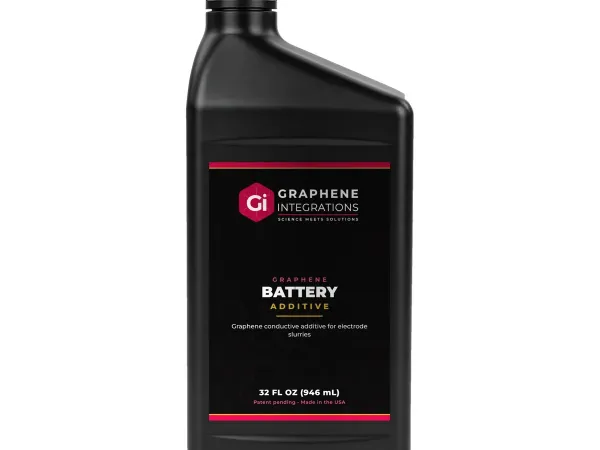
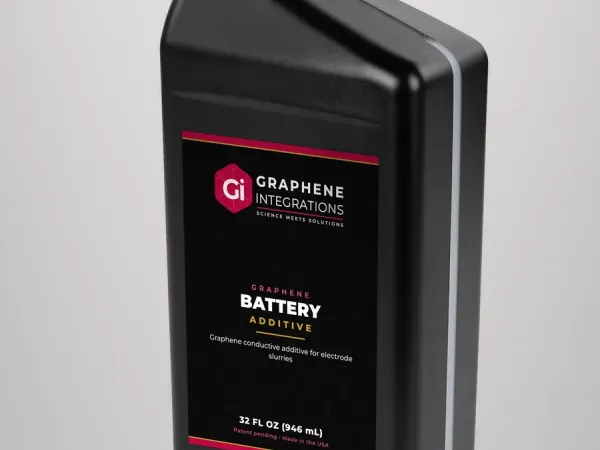
Graphene Battery Additive
A graphene additive for battery electrode development, supplied pre-dispersed for slurry mixing.
- Category
- Energy Storage
- Application
- Electrode slurry development and cell R&D, evaluated against your current electrode formulation.
- Carrier
- Water or solvent dispersion matched to your slurry process.
- Typical dose
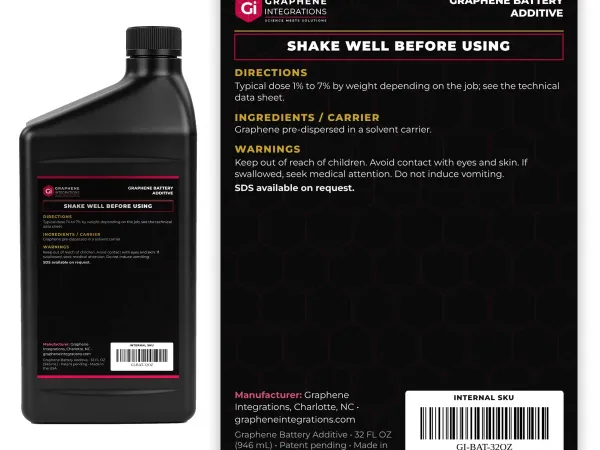
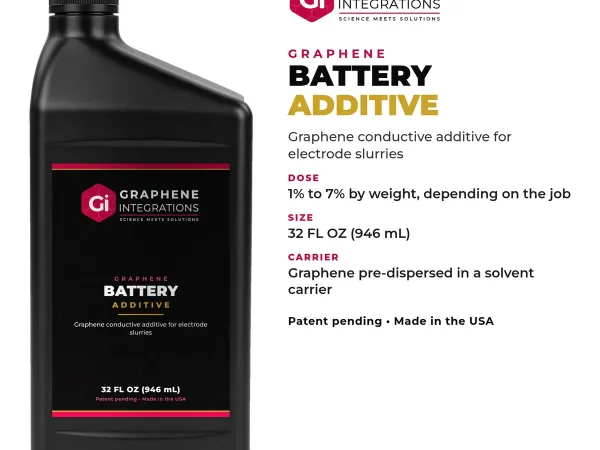
- 1–7% by weight, depending on the application. See the technical data sheet.
- SKU
- GI-BAT-32OZ (32 fl oz bottle)
GI-BAT-1GAL (1 gal jug)
Sizes: 32 fl oz bottle, 1 gal jug
Request a quote for pricing, lead time and the right dose for your job.
Downloads
Learn more — Graphene Battery: What Is Real Today and Where Graphene Helps →
Patent pending. Made in the USA. Manufacturer: Graphene Integrations, Charlotte, NC.
About this additive
Graphene's electrical conductivity makes it a candidate additive in battery electrodes. Electrode performance depends on the active material, binder and process, so this is an R&D additive for evaluation in your cells. Read about our graphene dispersions.
Benefits are evaluated in your formulation, against your own baseline. We suggest a starting dispersion, supply samples by quote, and you test against your current material. See graphene dispersions for the carriers we work with.
Evaluate the electrode before the battery claim
Graphene is investigated as a conductive network within an electrode, not as a replacement for all its active chemistry. Published cathode research links a specific graphene coating architecture to electron and ion transport; that electrode design and its performance are not GI additive results.
Set the supplied-additive dose on a clearly defined dry-solids basis, accounting separately for its carrier. Hold active material, binder, coating thickness, loading and compaction comparable. Measure slurry processing, conductivity, impedance, rate capability, cycle retention and safety using the intended cell chemistry.
Potential resource benefits must follow a cell that meets the same duty and safety requirements. Compare delivered energy over demonstrated service, manufacturing yield, drying energy, electrolyte and other materials, transport and end-of-life. Faster charging or better conductivity alone does not demonstrate a longer-lived or lower-carbon GI battery.
Research / measurement reference · Continue with the application guide
Frequently asked questions
What battery performance results do you publish?
None. Benefits are evaluated in your formulation, in your cells, against your own baseline.
Which electrode processes does it fit?
It is supplied in a water or solvent carrier matched to your slurry process; we confirm the fit before samples.
Is the graphene supplied as a powder?
No. It is supplied pre-dispersed in a carrier, never as dry powder.
How much should I add?
Typical dose: 1–7% by weight, depending on the application. See the technical data sheet.
More graphene products
-

Graphene Motor Oil Additive
A graphene additive for motor oils, supplied pre-mixed in an oil-based carrier so it blends straight into your oil. View product -

Graphene Gear Oil Additive
A graphene additive for gear oils, pre-mixed in an oil-based carrier for heavily loaded gear contacts. View product -

Graphene Hydraulic Fluid Additive
A graphene additive for hydraulic fluids, pre-mixed in an oil-based carrier for pumps, valves and cylinders. View product -

Graphene Grease Additive
A graphene additive for greases, pre-mixed in an oil-based carrier for blending into bearing and industrial greases. View product -

Graphene Coolant Additive
A graphene additive for liquid cooling loops, supplied pre-mixed in a water-based carrier. View product -

Graphene Concrete Additive
A graphene concentrate for concrete, supplied ready to add so it fits into existing batching and mixing. View product