
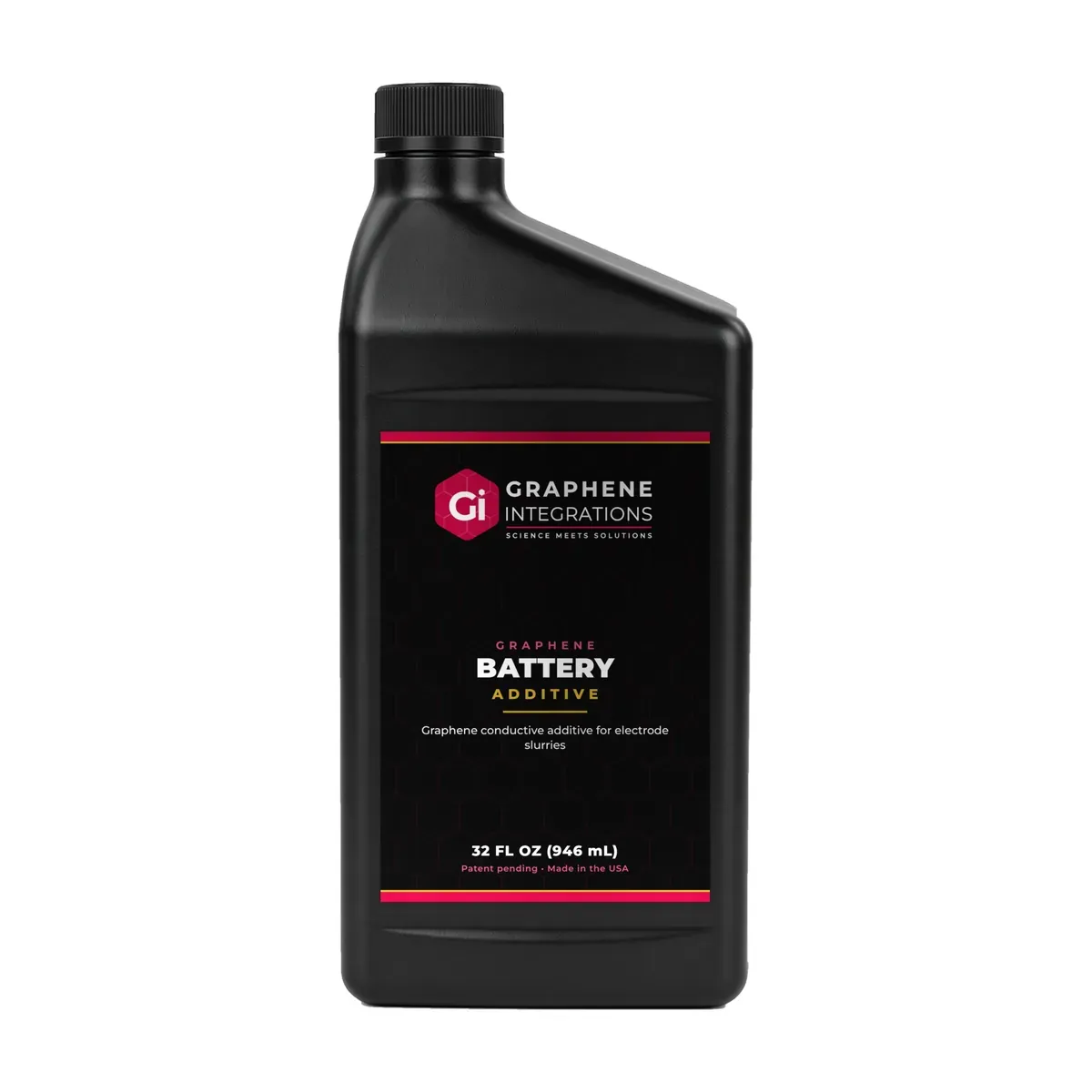
Shop: see sizes, SKUs and the spec sheet for the Graphene Battery Additive in our store, or browse all graphene products.
"Graphene battery" headlines promise phones that charge in minutes and electric cars that never wear out their packs. The reality is more modest and, for battery engineers, more useful. This article explains what people mean by a graphene battery, what is actually on the market, where graphene helps inside a cell today, and how an electrode team can test it.
What is a graphene battery?
The phrase is used for at least three different things:
- Lithium-ion cells with graphene inside, usually as a conductive additive or coating in the electrodes. This is the most common meaning in real products.
- New chemistries built around graphene, such as graphene aluminium-ion cells, which are still in development and customer sampling, not mass production.
- Marketing: power banks and packs labeled "graphene" where the role of graphene is not clear.
Nature Nanotechnology asked the question directly in its editorial "Where is my graphene battery?" (Nature Nanotechnology). The short answer: graphene helps cells, but the all-graphene super battery has not arrived, held back by cost, scale-up and cell-level performance.
Where graphene helps in a cell today
Inside an electrode, active material particles need a path for electrons. Conductive additives such as carbon black and carbon nanotubes provide it. Graphene's thin, wide flakes can bridge many particles at once, which is why it is studied as a conductive additive (Journal of Materials Chemistry A). Research areas include:
- Electrode conductivity and lower internal resistance.
- Rate capability, meaning performance at faster charge and discharge.
- Heat spreading within electrodes.
- Silicon and other high-capacity anodes, where graphene can help hold a conductive network together as particles swell.
Flakes can also restack and block ion paths if they are not well dispersed, so more is not always better. Graphene Integrations does not publish cell test numbers. Each result is evaluated against the customer's current electrode formulation.
How our Graphene Battery Additive works
The Graphene Battery Additive is graphene supplied pre-dispersed for electrode slurry mixing. Because the graphene arrives already separated in a liquid, you skip the dusty powder step and add it like any other slurry component.
- For: electrode slurry development, cell R&D and pilot lines.
- Carrier: water or solvent dispersion matched to your slurry process.
- Dose: typically 1% to 7% by weight, depending on the application.
- Mixing: add at the slurry step we recommend for your process and mix with your normal equipment.
- Made in the USA in Charlotte, NC. Patent pending. No carbon black. Never sold as a powder.
This is a material for battery developers. We do not sell graphene batteries.
Graphene vs. carbon black and nanotubes in electrodes
Carbon black is the standard conductive additive in most lithium-ion electrodes. It is cheap and well understood, but it is made of small round particles that only touch at points. Carbon nanotubes form long-range networks at low loadings and are now common in high-energy cells. Graphene's flat flakes can cover more particle surface and bridge across particles in a different way, and many studies look at combinations of these materials. The right mix depends on the active material, electrode thickness and target rate. Our additives contain no carbon black, so any change you measure comes from the graphene and the carrier.
What is a graphene additive?
A graphene additive is a product that brings graphene into another material at a low dose, the way a pigment or a reinforcing filler does. The graphene is the active part. The carrier around it decides whether it mixes into your product cleanly.
Why a pre-dispersed liquid beats powder. Dry graphene powder is light and dusty, hard to wet out, and its flakes tend to clump back together. Clumps act like defects, so a powder can make a product worse instead of better. Our graphene additives are supplied as liquids with the flakes already separated in a carrier matched to your system, so they mix in with the equipment you already run and there is no fine dust to manage. We never sell powder.
Dosing. Our graphene additives are typically used at 1% to 7% by weight, depending on the job. More is not automatically better, so a trial should bracket two or three doses.
Trialing. Compare against a baseline you already make, change only the additive dose, and run the tests your customers use. Our guide on how to run a graphene additive trial and our guide to choosing a graphene additive go into more detail.
How an R&D team should test it
- Start from a baseline electrode with known data.
- Tell us the active material, binder, solvent or water, and current conductive additive.
- Make the baseline and two or three doses within 1% to 7%, keeping solids and mixing the same.
- Check slurry viscosity and stability, then coating quality and adhesion.
- Measure electrode resistivity, then build cells and run rate, cycling and impedance tests side by side.
For a deeper technical view, read graphene as a conductive additive in battery electrodes, or see our graphene energy storage page.
Frequently asked questions
Are graphene batteries real?
Lithium-ion cells with graphene in the electrodes exist. Batteries built entirely around graphene are still in development.
What does graphene do in a battery?
It is mainly used as a conductive additive or coating in electrodes, where it can help conductivity and rate performance. Results depend on the formulation.
Do you sell graphene batteries?
No. We supply the Graphene Battery Additive for electrode developers.
How much graphene battery additive is used?
Typically 1% to 7% by weight, depending on the application.
Can I buy the Graphene Battery Additive online?
Yes. It is listed in our store. Pricing is by quote.
Get the Graphene Battery Additive
Ready to test graphene in your own product? Go to the Graphene Battery Additive store page for sizes, SKUs, the spec sheet and SDS, or browse the full graphene store. Pricing and samples are by quote. Call 704-659-3682 or request a quote, samples or a spec sheet / SDS.


