
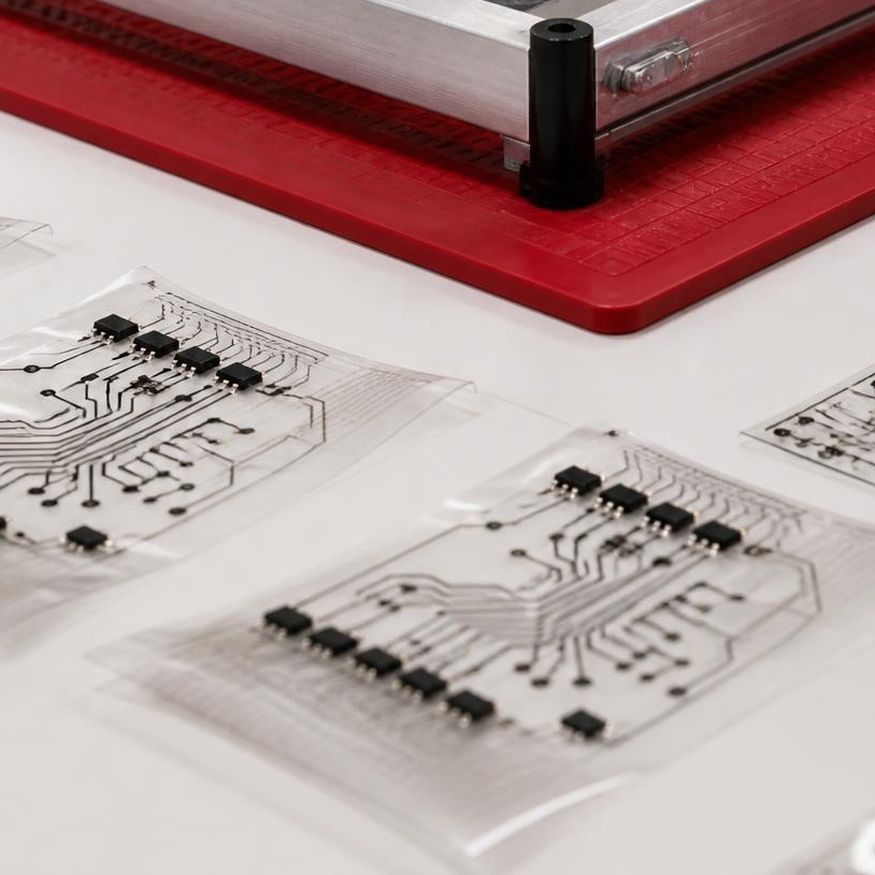
Graphene can make an insulating plastic or coating electrically conductive once enough well-dispersed graphene is present to form a connected network through the material, a point known as the percolation threshold. Below it, the material stays insulating; above it, resistance drops sharply. Whether you reach antistatic, static-dissipative or conductive levels depends on the graphene grade, the dose, the dispersion and the processing, so it has to be measured in your material.
This guide explains the terms, the mechanism and how to set up a test. We do not publish general conductivity results for plastics or coatings; benefits are evaluated in your formulation, against your own baseline.
Why are plastics and coatings normally insulating?
Most polymers have no free charge carriers, so charge builds up on their surfaces. That static can attract dust, cause sparks, damage electronics or create hazards around flammable materials. Conductive fillers give charge a path to move and dissipate.
What do antistatic, static-dissipative and conductive mean?
These terms describe ranges of surface or volume resistivity:
- Antistatic: high resistivity, enough to limit charge build-up.
- Static-dissipative: lower resistivity, letting charge drain in a controlled way, common in electronics handling and ESD packaging.
- Conductive: low resistivity, for shielding, grounding or electrical function.
Exact boundaries are defined in the standards your industry uses, such as ANSI/ESD documents for electronics. Confirm which standard and range apply to your product.
How does graphene create conductivity?
Graphene sheets are highly conductive. When enough sheets touch, or come close enough for electrons to hop between them, they form a network through the material. Graphene's large, thin sheets can form that network at lower loadings than many conventional fillers, provided they are well dispersed rather than clumped. Processing matters: shear, melt temperature and cooling can break or align sheets and change the network. See graphene plastic and graphene for polymer composites.
How should conductivity be tested?
- Make baseline and treated samples with identical processing.
- Test at several doses to locate the percolation region.
- Measure surface and volume resistivity with a recognized method, such as ASTM D257, at controlled humidity and temperature.
- Test several locations and specimens, since conductivity can vary across a molded part.
- Check mechanical properties, color, processing and long-term stability.
Our graphene additive trial guide explains how to keep the comparison fair.
What dose should I start with?
Most of our additives are dosed at 1% to 7% by weight, depending on the job. For conductivity work, a dose ladder across that range helps show where the network forms. Remember that the dose is the supplied additive, which includes its carrier. See our dosing guide.
Which products should I start with?
- Plastic additive, pre-dispersed in resin for compounding.
- Paint additive for coatings.
- 3D printing filament additive for filament makers.
- Resin dispersion and solvent-based dispersion for custom formulations.
Where are conductive and antistatic materials used?
Electronics packaging and trays, fuel-system and powder-handling components, flooring and work surfaces, cleanroom equipment, and shielding enclosures. See graphene in electronics and graphene paint additive for coatings formulators.
What else changes when a material becomes conductive?
Adding enough graphene to form a conductive network can also change stiffness, impact strength, melt flow and surface finish. Check that the part still meets its mechanical and appearance requirements, and test conductivity again after aging, flexing or cleaning if those happen in service. For coatings, check adhesion and film integrity at the dose that reaches your resistivity target.
Frequently asked questions
Does any amount of graphene make a plastic conductive?
No. Conductivity rises sharply only after the percolation threshold is reached, and it depends on dispersion.
Will graphene change the color of my part?
Yes. Graphene is black, so it darkens the material.
Do you publish conductivity data?
No. We do not publish general results for plastics. Benefits are evaluated in your formulation.
Is graphene better than carbon black for conductivity?
It depends on the application. Our additives contain no carbon black; see graphene vs carbon black.
Request a quote, samples or a spec sheet
Tell us your material, the property you want to improve, the carrier you use (water, solvent, resin or oil) and your volumes. Pricing and samples are by quote. Call 704-659-3682 or request a quote, samples or a spec sheet / SDS.


