
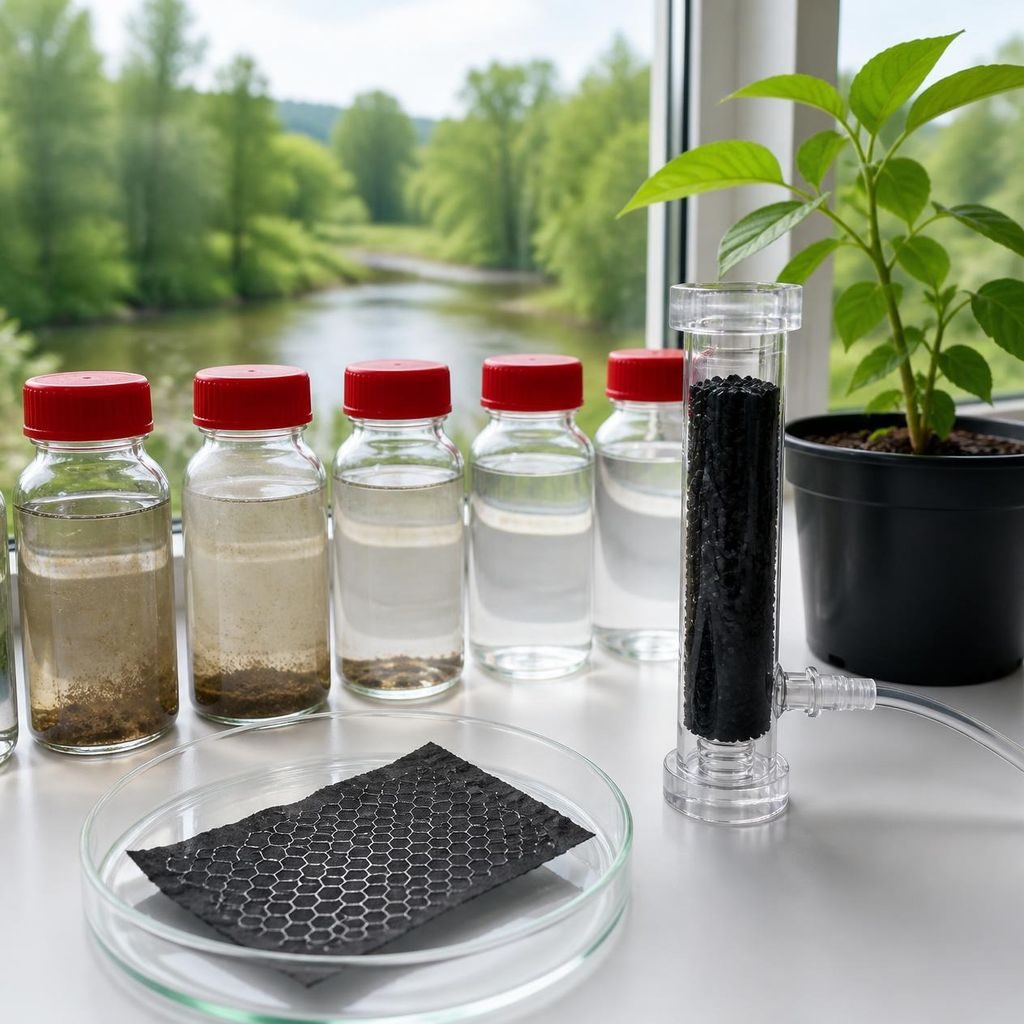
Graphene and related materials, especially graphene oxide, are being researched for water filtration, desalination, oil and solvent spill cleanup, air filtration and pollution sensing, but most of this work is still in research or pilot stages. Developers who want to test graphene in a filter, sorbent or sensor should treat published results as a starting point and plan their own testing with the specific material they will use.
Graphene Integrations supplies graphene already dispersed in water, solvents and resins for developers who want to test it. We do not yet publish test data for filtration or cleanup.
How is graphene being researched for water filtration?
Graphene oxide membranes are the most studied route. Stacked GO sheets form channels between layers, and researchers adjust that spacing to remove salts, heavy metals and organic contaminants, including for desalination. Graphene oxide behaves differently from the exfoliated graphene we produce; see graphene vs graphene oxide vs rGO. Other work coats existing membranes or filter media with graphene materials to change fouling or flow.
Can graphene clean up oil spills?
In lab studies, graphene foams and aerogels absorb many times their own weight in oil and solvents and can be squeezed out and reused. These are research materials made in specialized ways, and scaling them to field use is still being studied.
How is graphene used in air filtration?
Graphene coatings on filter media are studied for capturing fine particles and some gases. The key questions are pressure drop, capture efficiency, durability and whether any particles could be released from the media, which must be assessed for the intended use.
Can graphene help with environmental monitoring?
Graphene's high conductivity and surface area make it sensitive to molecules on its surface, so graphene sensors can detect very low levels of gases and contaminants. Sensor work typically uses carefully controlled graphene films or inks. See graphene in electronics.
What about lower-impact materials?
Stronger or longer-lasting materials can mean less material used or replaced, but any saving has to be confirmed for each application. For concrete, our additive gave +67.7% compressive strength at 5% by weight of cement in independent third-party testing (2023). That supports investigating lower-cement mixes; it does not by itself establish a carbon saving. See concrete and embodied carbon.
How should a filtration or sorbent project start?
- Define the target contaminant and performance metric, such as removal efficiency, flux, capacity or pressure drop.
- Choose a baseline, such as your current membrane, media or sorbent.
- Choose the graphene form and carrier that suits your coating or fabrication route: water, solvent or resin.
- Test under realistic conditions, including real water or air samples, fouling and cleaning cycles.
- Assess release and safety for the intended use and any regulatory requirements, especially for drinking water.
Our graphene additive trial guide explains how to keep the comparison fair.
Where does Graphene Integrations fit?
We manufacture graphene in the USA and supply it pre-dispersed, never as dry powder, so research and product teams can coat, cast or blend it into their own materials. We support testing with samples by quote and scale up when a project works. Contact us through the graphene samples page or see graphene in environmental cleanup and the environmental industry page.
What questions should a filtration developer ask a graphene supplier?
Ask what material is supplied (graphene, graphene oxide or rGO), how it is produced and checked, what carrier it comes in, and whether that carrier is compatible with your membrane, media or sorbent fabrication route. Ask too what documentation comes with each lot, so your results can be traced to the material you tested.
Frequently asked questions
Can graphene filters make seawater drinkable?
Graphene oxide membranes are researched for desalination, but this remains largely at research stage. Commercial desalination relies on established membrane technologies.
Do you sell graphene filters?
No. We supply graphene dispersions that developers can use in their own filter, sorbent or sensor projects.
Is graphene oxide better than graphene for membranes?
Most membrane research uses graphene oxide because its chemistry allows controlled stacking. The right material depends on the design.
Do you publish filtration data?
Not yet. Projects start with testing in your own system.
Request a quote, samples or a spec sheet
Tell us your material, the property you want to improve, the carrier you use (water, solvent, resin or oil) and your volumes. Pricing and samples are by quote. Call 704-659-3682 or request a quote, samples or a spec sheet / SDS.


