
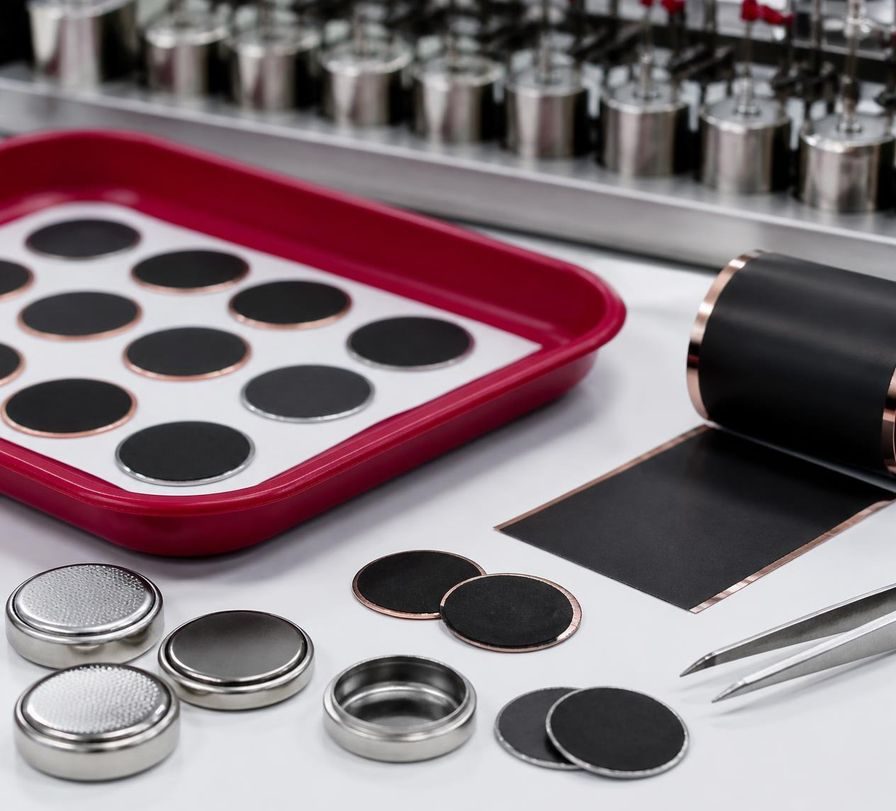
A lithium-ion electrode is mostly active material, the particles that store lithium, held together by a binder. Most active materials do not conduct electricity well on their own, so electrode makers add a small amount of conductive additive to help electrons move between particles and the current collector. Carbon-based conductive additives are standard. Graphene is studied as a conductive additive because thin, flexible sheets can connect many particles at once. This article explains the idea, the practical issues and how R&D teams can evaluate our Graphene Battery Additive.
What a conductive additive does
Think of an electrode as a packed bed of particles. Electrons need a continuous path from every particle to the metal foil. Conductive additives form that network. Common choices include carbon black and carbon nanotubes. They differ in shape: carbon black is made of tiny near-spherical particles that touch at points, nanotubes are long fibres, and graphene is a flat sheet.
The appeal of a sheet is coverage. A thin, flexible graphene flake can drape over several particles and make contact along a line or an area, not just a point. Peer-reviewed work, for example this ACS Applied Energy Materials paper and recent reviews such as this ChemNanoMat review, discusses how graphene and related materials are used in conductive networks, and the trade-offs involved.
The trade-offs
- Dispersion: graphene that restacks or clumps in the slurry forms islands instead of a network. Dispersion quality is often the difference between a good and a poor result.
- Ion transport: flat sheets can, if they lie in the wrong orientation or at high loadings, get in the way of lithium ions moving through the electrode. Loading and morphology matter.
- Slurry behaviour: any new additive can change slurry viscosity and coating quality.
- Chemistry match: results differ between cathodes, anodes and cell formats.
These are the reasons we treat our battery additive as a development material and do not make capacity, cycle-life or charging claims.
What our additive is
- Carrier: graphene pre-dispersed in a water or solvent carrier matched to your slurry process, for example water-based anode slurries or solvent-based cathode slurries.
- Users: R&D teams and pilot lines working on lithium-ion and other battery chemistries.
- Dose: 1% to 7% by weight, depending on the job, with a suggested starting point for each trial.
- Packs: 32 fl oz bottles for lab work and 1 gallon jugs for pilot runs.
- Status: patent pending, made in the USA in Charlotte, NC, no carbon black, never sold as a powder.
Because it arrives pre-dispersed, the additive fits into the slurry mixing step like any other liquid component. There is no dry nanomaterial to weigh or handle in the lab.
Setting up a fair electrode trial
- Fix a baseline recipe. Same active material, binder, solvent, solids content and conductive additive you use today. Record your mixing order and times.
- Decide what you are testing. Graphene as a partial replacement for your current conductive additive, or as an addition to it. These are different experiments.
- Account for the carrier. Our additive brings liquid with it. Adjust the solvent or water you add so solids content matches the baseline.
- Check the slurry. Viscosity, appearance and any signs of settling or agglomerates before coating.
- Coat, dry and calender the same way. Measure coating weight, thickness and density so you compare like with like.
- Measure the electrode. Sheet resistance or through-plane resistance, and adhesion to the foil.
- Build cells and test. Rate capability, impedance and cycling under your standard protocol, with enough cells per group to see real differences.
Electrode resistance is often the quickest signal of whether the conductive network has changed. Cell results take longer and need statistics, so build enough cells.
What we do not claim
We do not publish capacity, cycle-life, energy density or fast-charging claims for our battery additive, and we do not have customer case studies to share. Battery work is careful work. The cells you build and the data you gather are the evidence.
"Nobody should take a supplier's word for what happens inside a cell. We supply the dispersion; the R&D team builds the cells." — Frans Alkemade
Lab handling
Shake the bottle before drawing a sample, weigh additions rather than measuring by volume, and record the lot number in your electrode build sheet. Keep the container closed so the carrier does not evaporate and change the solids content between builds.
Related reading
See our guide to choosing a dispersion carrier, and graphene in electronics.
Read the battery additive press release, see the graphene energy storage page, or request a quote and lab samples.
Frequently asked questions
Why is graphene used as a conductive additive?
Thin, flexible graphene sheets can connect many active particles at once, helping electrons move through the electrode. Dispersion and loading decide how well this works.
Is the graphene battery additive a powder?
No. It is pre-dispersed in a water or solvent carrier matched to your slurry process.
Do you publish capacity or cycle-life results?
No. It is a development material, and every result is measured against the customer's current electrode.
How much do I add?
1% to 7% by weight, depending on the job. Adjust the solvent or water you add so the slurry solids content matches your baseline.
Request a quote, samples or a spec sheet
Tell us your material, the property you want to improve, the carrier you use (water, solvent, resin or oil) and your volumes. Pricing and samples are by quote. Call 704-659-3682 or request a quote, samples or a spec sheet / SDS.


