
To measure heat transfer in a liquid cooling trial, run the current fluid and the candidate fluid at the same heat load, flow rate and inlet temperature, and log flow, inlet and outlet temperatures, pressure drop and electrical power for pumps, fans and chillers. Then compare the heat removed, the temperature rise and the energy used for the same duty, not just a single temperature reading.
A well-designed trial turns a promising lab result into a plant decision, and it protects your equipment while you collect the data.
Why is a controlled comparison needed?
Cooling systems respond to many variables at once: server load, outdoor conditions, flow settings, fouling and control logic. If any of these change between the baseline and the trial, the result can be misleading. Fix as many as you can, and record the rest so you can account for them.
What should be logged?
- Flow rate through the loop or test section.
- Inlet and outlet temperatures at the heat source and heat exchanger.
- Heat load, ideally measured as electrical input to the equipment being cooled.
- Pressure drop across key components, which shows pumping effort.
- Pump, fan and chiller electricity.
- Component temperatures, such as cold plate or chip temperatures, where available.
- Fluid condition: appearance, conductivity, pH and any filter loading.
Use calibrated sensors and log at a consistent interval for long enough to see steady state.
How do I calculate heat removed?
Heat removed is approximately mass flow × specific heat × temperature rise across the load. Use the fluid's actual specific heat and density from its documentation, since a water-based fluid and a glycol mix differ. Compare the heat removed per unit of pumping power and the temperature rise at the same load. Engineers can also estimate the convective heat transfer coefficient at a test section, which is the metric used in our ThermaGraph internal testing.
How should the trial be sequenced?
- Baseline: run the current fluid at defined loads and flows and record the data.
- Prepare the loop: check compatibility of seals, metals and filters with the new fluid. Drain and flush as recommended.
- Fill: use the candidate fluid as directed. ThermaGraph™ is a complete fill, not a top-off.
- Repeat the same test points.
- Monitor over time: inspect filters and corrosion coupons, and check fluid condition at intervals.
What results has ThermaGraph shown?
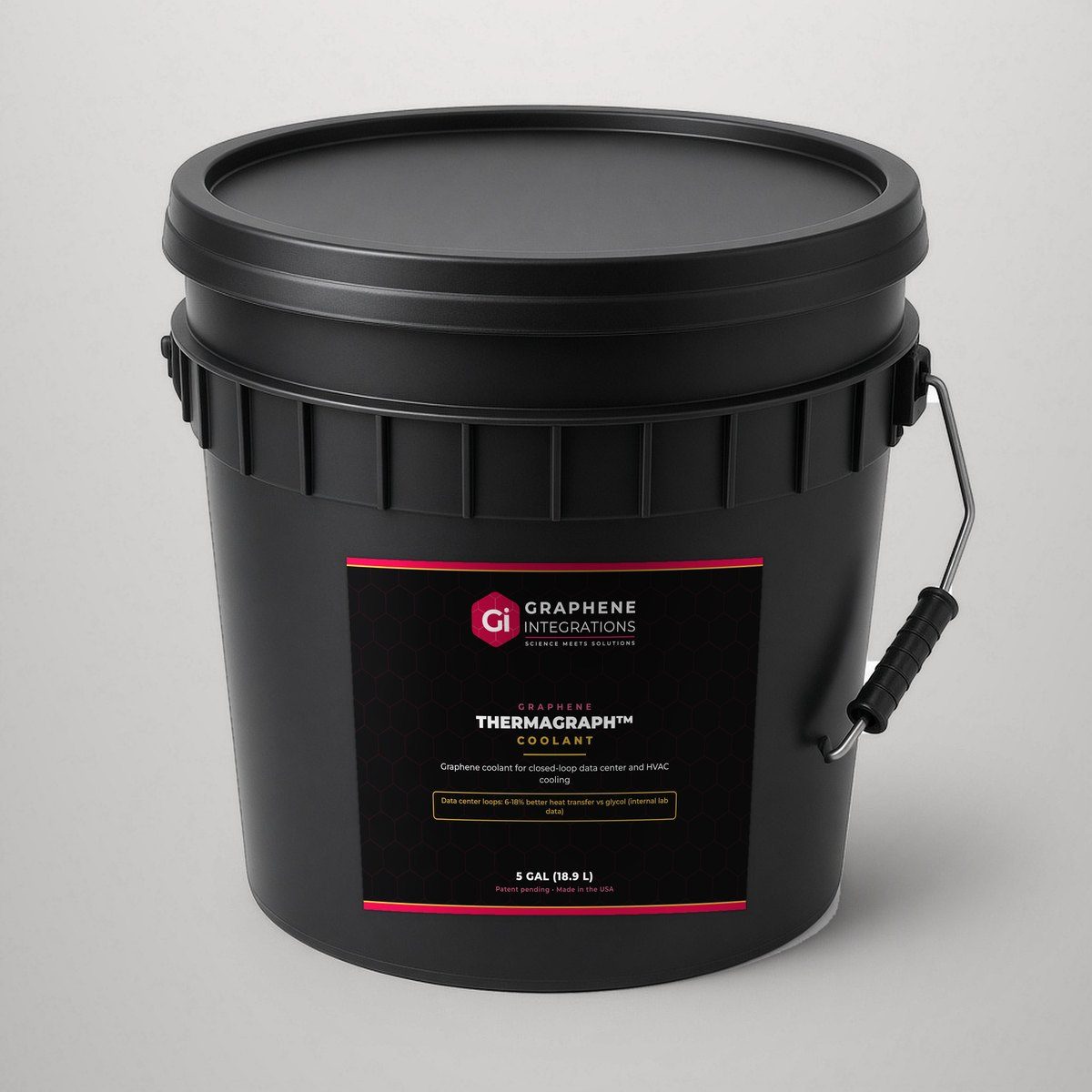
ThermaGraph is graphene in deionized water, with 0.5–1.5 wt% graphene stated on the COA. In our pumped-loop lab tests it showed a +6% to +18% higher convective heat transfer coefficient than a glycol baseline (internal testing results). That is not independent field validation, and it is not an equivalent electricity saving. Your trial establishes what it means in your system. See data center coolants and the coolants case study.
What safety and compatibility checks are needed?
- ThermaGraph is not a dielectric: never immerse live electronics in it.
- It is not a freeze fluid: freeze point 0 °C (32 °F), so use the water version where freeze protection is not required; a glycol build can be made on request where it is.
- Confirm equipment compatibility with the system's manufacturer.
- For immersion systems, use ThermaGraph-D™, graphene in white mineral oil, instead.
Our immersion cooling fluid checklist and PG25 alternative guide cover these choices.
How do I turn the data into a decision?
Compare the candidate and the baseline at the same duty: temperature margins, pumping energy, chiller energy and maintenance observations. If the new fluid gives the same cooling with less energy, or more margin at the same energy, quantify it over the operating year using measured kWh. Include fluid replacement and disposal. Improved heat transfer is an opportunity to optimize the system, not an automatic saving.
Frequently asked questions
How long should a cooling trial run?
Long enough to reach steady state at each test point and to observe fluid condition over time. Agree the duration with your operations team.
Can I compare fluids using chip temperature alone?
Chip temperature is useful, but it depends on load and flow. Log heat load, flow and energy as well.
Can I get a ThermaGraph sample for a trial?
Yes. A 30-day sample can be requested from the ThermaGraph product page.
Is ThermaGraph suitable for HVAC loops?
It is designed for closed-loop HVAC such as chilled-water and hydronic loops where freeze protection is not required.
Request a quote, samples or a spec sheet
Tell us your material, the property you want to improve, the carrier you use (water, solvent, resin or oil) and your volumes. Pricing and samples are by quote. Call 704-659-3682 or request a quote, samples or a spec sheet / SDS.


