
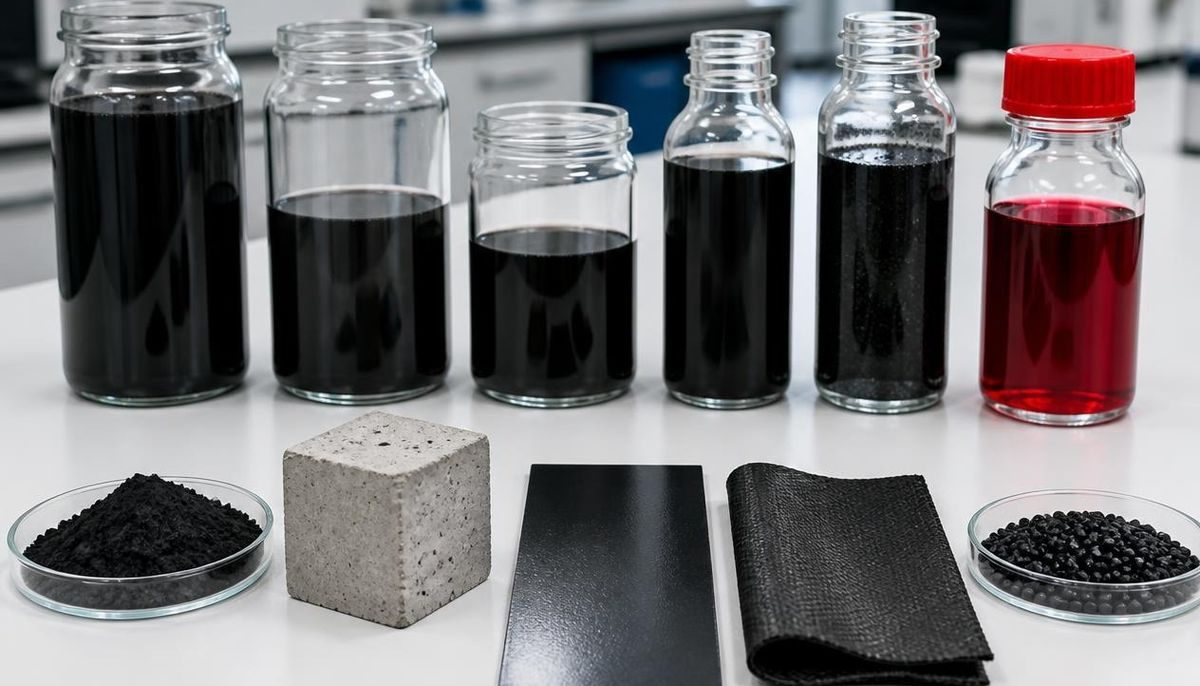
Graphene and carbon black are both forms of carbon, both black, and both used as additives. That is roughly where the similarity ends. Buyers sometimes assume a "graphene" product is just a better carbon black, or that the two are interchangeable. This article explains how they differ in structure, how each is made, what each is used for, and why every Graphene Integrations product contains no carbon black. For a related comparison, see graphene vs graphite.
Structure
Graphene
Graphene is a single layer of carbon atoms arranged in a flat hexagonal lattice. It was first isolated and characterised in 2004 (Novoselov et al., Science). In additives, it is used as thin flakes of one to a few layers, wide compared with their thickness.
Carbon black
Carbon black is made of tiny, roughly spherical particles of carbon fused into clusters called aggregates. Inside each particle, carbon layers are small and disordered compared with graphene. It is produced by partially burning or thermally decomposing hydrocarbons, for example oil or gas, under controlled conditions.
Shape drives behaviour
- Flakes versus spheres: graphene flakes are flat, with a high aspect ratio. Carbon black aggregates are three-dimensional clusters.
- Barrier: flat flakes lying in a film or matrix can lengthen the path for gases and liquids. Spheres do much less of this.
- Networks: both can form conductive networks in polymers. Flakes can contact along lines or areas; spheres touch at points.
- Strength: graphene is among the strongest materials measured as a single sheet (Lee et al., Science, 2008).
What each is used for
Carbon black is a mature, high-volume material. It is the classic reinforcing filler in rubber, a black pigment in inks, coatings and plastics, a UV stabiliser, and a conductive additive in batteries. Its long history means a lot of formulation knowledge exists around it.
Graphene is newer. It is studied and used as an additive in lubricants, coatings, concrete, polymers, rubber, coolants and batteries, where its flat shape, strength and thermal conductivity are designed to add something carbon black does not.
Can graphene replace carbon black?
Sometimes they are used together, sometimes graphene supplements a reduced amount of carbon black, and sometimes they do different jobs entirely. The answer depends on the formulation. That is why our product pages talk about trials against your baseline rather than straight swaps. Our guides for battery electrodes and rubber compounding explain how to set up those comparisons.
Why our products contain no carbon black
We make graphene ourselves in Charlotte, NC, and we do not blend carbon black into our dispersions. There are three reasons:
- Clarity: when you test our additive, you are testing graphene, not a mixture whose effect could come from a conventional filler.
- Honest labelling: a product called a graphene additive should be graphene.
- Formulation freedom: if you already use carbon black, you stay in control of how much and which grade.
Every product is also patent pending, made in the USA and supplied pre-mixed in a carrier, never as a powder.
How to check what you are buying
- Ask the supplier directly whether the product contains carbon black or graphite.
- Ask for characterisation data, such as Raman spectra and layer number. Our article on graphene quality specifications explains what these mean.
- Run an application test with a baseline. If the result looks like your existing filler, it may be.
Handling and dust
Carbon black is usually handled as a fine powder or as pellets, and it is notorious for dust and black residue in plants. Graphene powders can be just as difficult. That is one reason we never sell graphene as a powder. Every product is supplied pre-mixed in water, solvent, resin or oil, so it is added like any other liquid ingredient. For many plants this is a real practical difference, regardless of performance.
Colour
Both materials are black and will darken a formulation. If colour is part of your specification, include it in your trial. Graphene's effect on shade depends on loading and dispersion, just as carbon black's does.
Browse our graphene products, read about our graphene production, or request a quote, samples or a spec sheet.
Frequently asked questions
What is the difference between graphene and carbon black?
Graphene is a flat sheet of carbon atoms; carbon black is clusters of tiny, roughly spherical carbon particles. Their shapes give them different properties as additives.
Do your graphene products contain carbon black?
No. None of our products contain carbon black.
Can graphene replace carbon black?
Sometimes it supplements or partly replaces it, sometimes it does a different job. It depends on the formulation and needs a trial.
How can I check a graphene product is real graphene?
Ask for characterisation data such as Raman spectra and layer number, and run an application test against a baseline.
Is graphene a pigment?
It is black and will darken products, but we supply it as a performance additive rather than as a pigment.
Why does it matter that a graphene additive has no carbon black?
When you test it, the result comes from graphene, not from a conventional filler mixed in. It also leaves you in control of any carbon black in your own formula.
Request a quote, samples or a spec sheet
Tell us your material, the property you want to improve, the carrier you use (water, solvent, resin or oil) and your volumes. Pricing and samples are by quote. Call 704-659-3682 or request a quote, samples or a spec sheet / SDS.


