
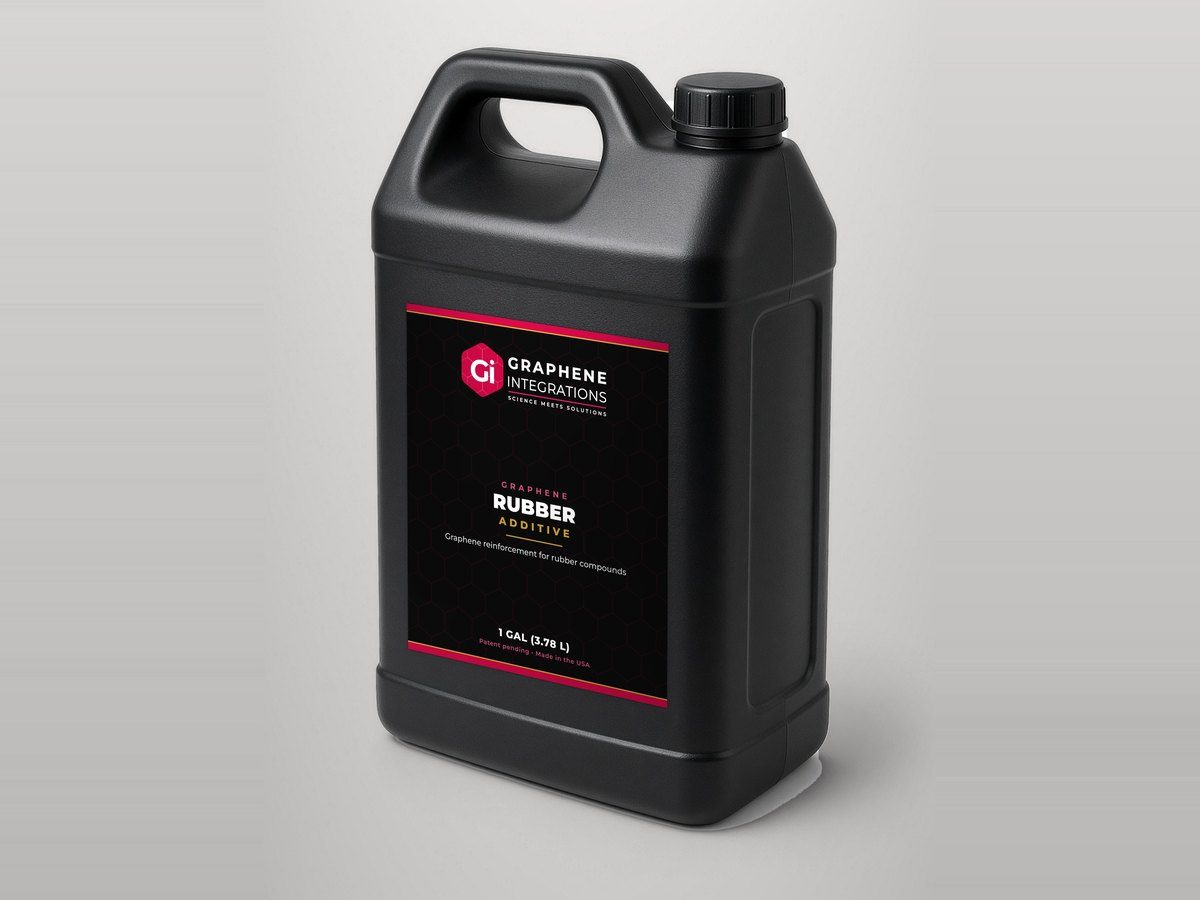
Rubber compounding is a mature craft. A good compounder can tell you how a recipe will behave from the mixing curve alone. So when a new filler comes along, the questions are practical: what does it do in my compound, how does it go into my mixer, and what will it do to cure and processing? This article answers those questions for graphene, and for our Graphene Rubber Additive in particular.
Why compounders look at graphene
Rubber compounds rely on reinforcing fillers to resist abrasion, tearing and heat build-up. Graphene is of interest for a few reasons:
- Reinforcement: graphene is one of the strongest materials measured (Lee et al., Science, 2008), and thin, high-aspect-ratio flakes can interact with a large area of polymer.
- Heat dissipation: graphene conducts heat very well, which is of interest in parts that build up heat as they flex, such as belts and tire compounds.
- Barrier: flat flakes can slow gas permeation, relevant for inner liners, hoses and seals.
- Static control: at suitable loadings, graphene can contribute to electrical conductivity.
These are things graphene is designed to help with. We do not publish performance numbers for rubber. Every compound is compared with the customer's current one.
What the additive is
- Carrier: pre-dispersed in a carrier matched to your compound, so there is no dry graphene powder on the mill or in the internal mixer.
- Applications: belts, hoses, seals, gaskets, molded and extruded goods and tire compounds.
- Dose: 1% to 7% by weight, depending on the job, with a suggested starting rate for each trial.
- Status: contains no carbon black, patent pending, made in the USA in Charlotte, NC.
To be clear: our additive contains no carbon black. That does not mean it replaces carbon black in your recipe. Whether graphene can reduce, supplement or sit alongside your existing filler system is exactly the kind of question a trial answers.
Getting it into the compound
Dry nanomaterials are difficult in rubber. They float, they dust, and they need a lot of shear to break up. A pre-dispersed additive goes in more like a process oil or a liquid masterbatch component. Tell us your polymer (natural rubber, SBR, NBR, EPDM, others), your mixing equipment and your mixing sequence, and we will match the carrier and suggest when in the cycle to add it.
A compound trial plan
- Pick a reference compound with a full data set: Mooney viscosity, cure curve, physical properties and any application tests.
- Decide the experiment. Graphene added on top of the current recipe, or graphene with a reduced amount of an existing filler. Run them as separate series.
- Mix side by side. Same batch size, fill factor and mixing sequence. Record mixing energy and dump temperature.
- Check processing. Mooney viscosity and scorch, then the cure curve on a rheometer. Graphene can affect cure, so compare cure times before you compare properties.
- Test physicals. Tensile, elongation, modulus and hardness, then tear and abrasion. Use the same specimen preparation as your baseline.
- Test what the part needs. Heat build-up, compression set, fluid resistance, permeation or conductivity, depending on the application.
- Look at dispersion. Cut a cured sample and check for specks or agglomerates.
Mistakes to avoid
- Changing two things at once. If you add graphene and change the cure package in the same trial, you will not know what moved the result.
- Too few loadings. One loading tells you little. Two or three around the starting rate show a trend.
- Ignoring cure. Compare properties at equivalent cure states, not at the same time and temperature if the cure curves differ.
What we do not claim
We do not claim abrasion, tear, rolling resistance or durability numbers for rubber compounds made with our additive, and we do not have customer case studies to share. Your rheometer and your test lab will tell you whether it earns a place in the recipe.
"Rubber people will mix a batch, cure it and pull it apart. That's the right way to judge any filler, including ours." — Frans Alkemade
Handling in the mixing room
Stir or shake containers before use, weigh additions for each batch and record the lot number on the batch card. Because the additive is a liquid, there is no fine powder to escape during charging, which also keeps the mixing room cleaner.
Related reading
See how to choose a graphene dispersion carrier, our guide for plastics compounders, and graphene in the automotive industry.
Read the rubber additive press release, see the graphene polymers and elastomers page, or request a quote and samples.
Frequently asked questions
What does graphene do in rubber?
It is studied as a reinforcing additive that can help with abrasion, tear, heat dissipation and barrier. Results depend on the compound; we do not publish numbers for rubber.
Does the additive contain carbon black?
No. It contains no carbon black and is pre-dispersed in a carrier matched to your compound.
How much graphene rubber additive do I use?
1% to 7% by weight, depending on the job. We suggest a starting rate for each compound.
Will graphene change my cure?
It can. Run a rheometer cure curve on the treated compound and compare properties at equivalent cure.
Request a quote, samples or a spec sheet
Tell us your material, the property you want to improve, the carrier you use (water, solvent, resin or oil) and your volumes. Pricing and samples are by quote. Call 704-659-3682 or request a quote, samples or a spec sheet / SDS.


