
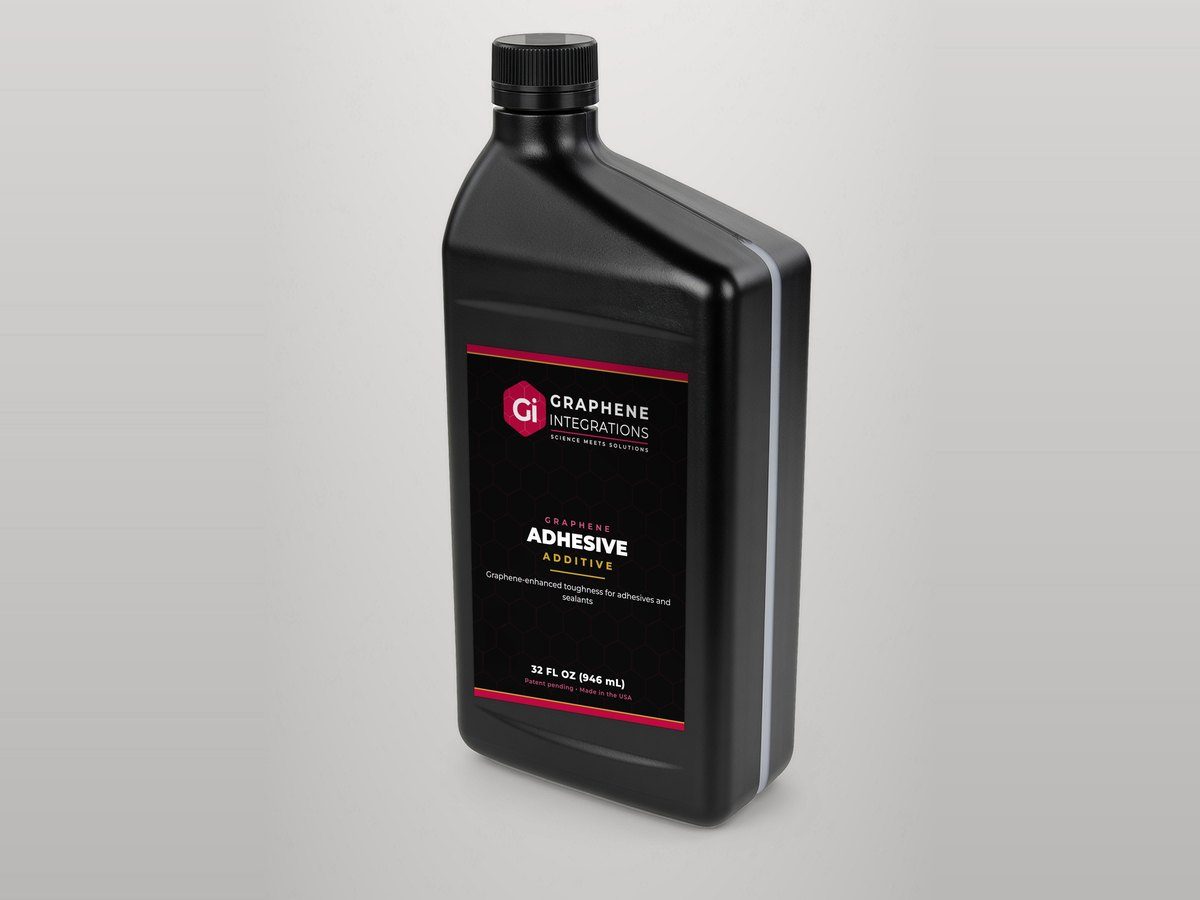
Sealant and caulk formulators can evaluate graphene as an additive by blending a pre-dispersed graphene concentrate into an existing formula at two or three doses and comparing rheology, cure, adhesion, movement capability and durability against the unmodified product. The goal is to learn whether graphene improves a property your customers value without hurting extrusion, tooling or shelf life.
Our adhesive additive is supplied pre-dispersed, and most of our additives are dosed at 1% to 7% by weight, depending on the job.
Why are formulators interested in graphene for sealants?
Graphene's flat sheets are studied for barrier effects, which can slow the passage of water and gases through a polymer, and for mechanical reinforcement of the polymer network. In sealants, that interest translates into questions about weathering resistance, tear strength, cohesion and moisture resistance. We do not publish general results for sealants, so benefits must be shown in your formulation, against your own baseline.
Which sealant chemistries can be tested?
Common sealant families include silicones, polyurethanes, silyl-modified polymers (hybrids), acrylics, butyls and polysulfides. Each has a different continuous phase and cure mechanism. Water-based acrylics need a water-compatible dispersion; moisture-cure systems need a carrier that brings in as little water as possible. Tell us the chemistry and we will suggest a carrier; see choosing a graphene dispersion carrier.
How should the additive be dosed?
Start with two or three levels in the 1% to 7% range we suggest for your system. Account for the carrier, especially in moisture-cure products where extra water or solvent can change cure and skin time. Our dosing guide explains how to build a dose ladder.
What should be tested?
- Rheology: extrusion rate, slump or sag, and tooling behavior.
- Cure: skin time, tack-free time and depth of cure.
- Mechanical properties: tensile strength, elongation, tear strength and hardness.
- Adhesion: peel or tensile adhesion to the substrates you sell into, with and without primer.
- Movement capability: joint movement tests relevant to your market.
- Durability: water immersion, heat aging and weathering exposure.
- Shelf life: storage stability in the cartridge or sausage.
Compare every result to a fresh baseline batch made the same day.
What processing issues should I watch for?
Any added particle can change viscosity and thixotropy. Watch for higher extrusion force, changes in surface finish, or color change from the black graphene. Graphene products are dark, so they suit black or dark sealants more easily than clear or white ones. Mix until uniform and check for streaks. See our dispersion stability guide.
How is this different from structural adhesives?
Structural adhesives, such as epoxies, are evaluated mainly for bond strength and toughness, while sealants are evaluated for movement, sealing and weathering. The trial approach is similar; our guide to graphene in epoxy and structural adhesives covers that side.
Which markets use sealants that might benefit?
Construction joints and glazing, automotive and transportation assembly, industrial equipment and marine applications. See graphene in construction and our coatings and adhesives store category.
How should a sealant trial be documented?
Record the base formula, every raw material lot, the graphene additive lot and dose, mixing order, mixing time, batch temperature and packaging date. Keep retained cartridges from each batch for later shelf-life checks. Test baseline and treated batches side by side on the same day with the same substrates and conditioning. If a result looks promising, repeat it before scaling up, because a single good batch can hide normal variation.
Frequently asked questions
Will graphene change the color of my sealant?
Yes. Graphene is black, so it darkens the product. It is easiest to use in black or dark grades.
Can graphene be used in moisture-cure sealants?
It can be tested, but choose a carrier that adds as little water as possible and check cure carefully.
Do you publish sealant test data?
No. Benefits are evaluated in your formulation, against your own baseline.
How is the additive supplied?
Pre-dispersed in a carrier, never as dry powder. Samples are available by quote.
Request a quote, samples or a spec sheet
Tell us your material, the property you want to improve, the carrier you use (water, solvent, resin or oil) and your volumes. Pricing and samples are by quote. Call 704-659-3682 or request a quote, samples or a spec sheet / SDS.


