
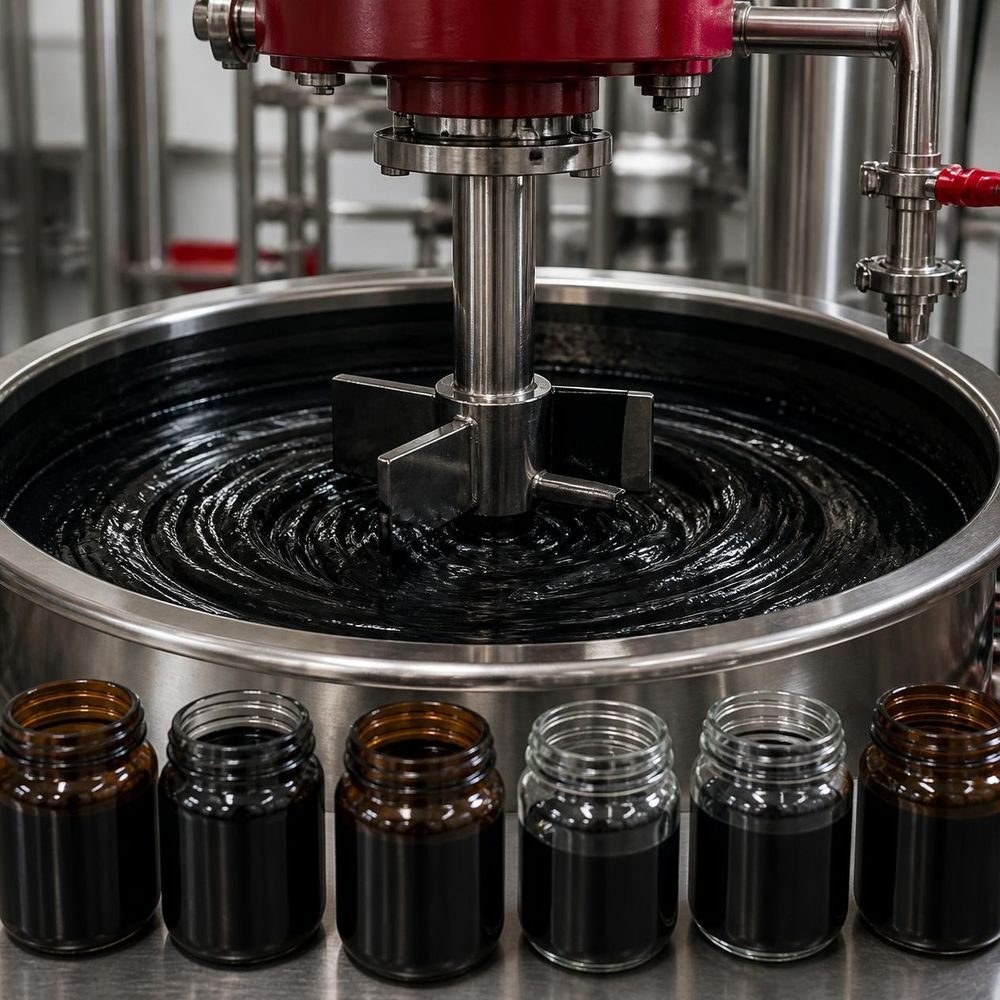
Once you decide to try graphene in a product, the first practical question is not how much. It is: in what? Graphene does not mix into most materials on its own, so we supply it already dispersed in a liquid carrier. Choosing the right carrier is the single biggest factor in whether the graphene stays spread out in your product or clumps. This article walks through the four carrier families we make, water, solvent, resin and oil, and how to pick one. If you are new to the idea, start with what is a graphene dispersion (and why not powder).
The rule: match the carrier to your continuous phase
Every formulation has a continuous phase, the liquid or melt that everything else is spread through. In a latex paint it is water. In an epoxy it is the resin. In a motor oil it is the base oil. A graphene dispersion works best when its carrier is the same as, or fully compatible with, that continuous phase. If the carrier fights your formula, the graphene comes out of dispersion and you lose the benefit you were testing for.
Water-based graphene dispersions
Typical uses: water-based coatings and paints, textile finishes, concrete (our NanoTechCrete is water-compatible), coolants and heat transfer fluids, and water-based battery electrode slurries.
- Advantages: low odour, no solvent handling, easy clean-up, fits many existing water-based processes.
- Watch for: pH and salts in your formula, other dispersants or surfactants that may compete, and freeze exposure in storage and shipping.
A graphene dispersion in water is our most common request. If your process already runs on water, start here.
Solvent-based graphene dispersions
Typical uses: solvent-borne coatings and primers, some adhesives, and solvent-based electrode slurries.
- Advantages: can match a specific solvent system exactly, which matters for film formation and drying.
- Watch for: tell us your exact solvent or blend. A "close" solvent may not be close enough. Follow your usual solvent safety, ventilation and emissions rules.
Resin-based graphene dispersions
Typical uses: thermoset composites, epoxy, polyurethane and acrylic adhesives, plastic compounding, 3D printing filament compounding and resin-based coatings.
- Advantages: the graphene goes in as part of the resin, so there is no extra liquid to remove and no new chemistry in the final part.
- Watch for: viscosity of the dispersion versus your neat resin, cure behaviour, and pot life. Tell us your resin and hardener system.
Oil-based graphene dispersions
Typical uses: lubricants, motor and gear oils, hydraulic fluids, greases and dielectric fluids.
- Advantages: blends like any other oil additive. Our lubricant products are graphene integrated into oleic acid and monomer; ThermaGraph-D uses white mineral oil.
- Watch for: base oil type (mineral, synthetic, ester), the additive package already present, and filtration.
Questions we ask before recommending a carrier
- What is the product, and what property do you want to improve?
- What is the continuous phase: water, which solvent, which resin, which oil?
- How do you mix today: paddle, high shear, kettle, extruder, mill?
- At what temperature and for how long?
- Are there other dispersants, surfactants or fillers in the formula?
- What volumes are you looking at for a trial and then for production?
With those answers we can usually suggest a carrier and a starting dose. Most of our additives are dosed at 1% to 7% by weight, depending on the job. Concrete is the exception: NanoTechCrete is dosed at 5% by weight of cement.
How dispersion quality is described
Graphene materials vary widely, from single layers to stacks that behave more like fine graphite. International standards bodies have worked to define the terms and the measurements. ISO/TS 21356-1 sets out methods for the structural characterisation of graphene from powders and dispersions, such as layer number, lateral size and Raman measurements. When you compare suppliers, ask which of these properties they measure and how. Our guide how to choose a graphene supplier has a list of questions.
Why we never sell powder
Dry graphene powder tends to stack and clump, it is hard to wet out, and it is a fine dust to manage on a plant floor. Dispersing it well needs equipment and know-how most manufacturers do not want to build. We make the graphene and disperse it ourselves in Charlotte, NC, so you receive it ready to add. Every product is patent pending, made in the USA and contains no carbon black.
Custom carriers
If your system is not water, a common solvent, a standard resin or a common oil, ask anyway. Custom dispersions are a normal part of our work. We will be straightforward if we do not think a carrier will be stable in your process.
See the graphene dispersions page for the full range, read the press release on our graphene production, or request a quote and samples.
Frequently asked questions
What is the best carrier for a graphene dispersion?
The one that matches the continuous phase of your product: water for water-based systems, your solvent, your resin, or your base oil.
Do you sell graphene dispersion in water?
Yes. Water-based dispersions are our most common request, used in coatings, textiles, coolants, concrete and water-based slurries.
How much graphene dispersion do I add?
Most of our additives are dosed at 1% to 7% by weight, depending on the job. Concrete is dosed at 5% by weight of cement.
Can I buy graphene powder instead?
No. We only supply graphene pre-mixed in a carrier, never as a dry powder.
Request a quote, samples or a spec sheet
Tell us your material, the property you want to improve, the carrier you use (water, solvent, resin or oil) and your volumes. Pricing and samples are by quote. Call 704-659-3682 or request a quote, samples or a spec sheet / SDS.


