
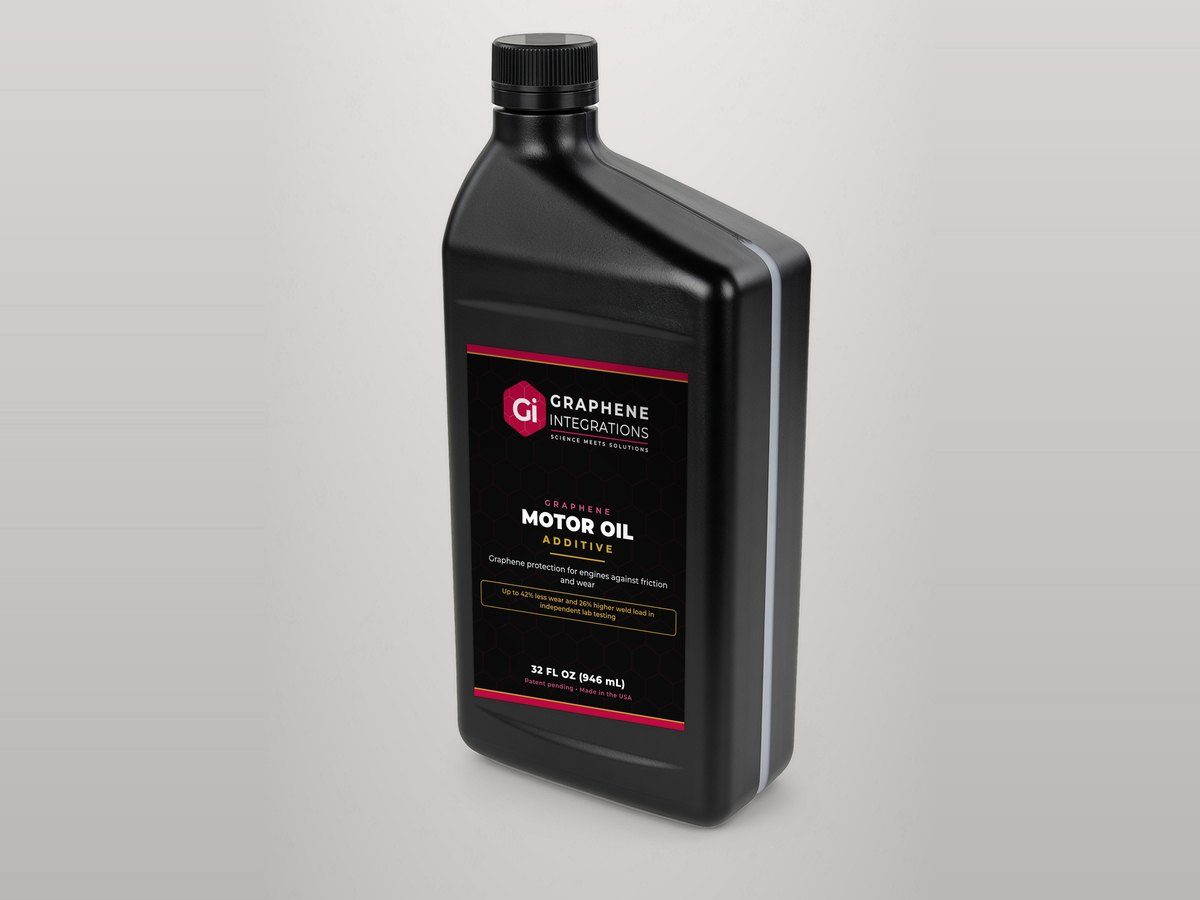
Search for "graphene oil additive" and you will find big promises. This article is the opposite: what our graphene motor oil additive is, what it was tested for, what those tests mean for an engine oil formulator, and how to evaluate it in your own oil. It is written for oil blenders and for fleet, marine and small-engine oil programs, which are the people we supply.
What the additive is
Our Graphene Motor Oil Additive is graphene integrated into oleic acid and monomer. The graphene is already dispersed in that oil-compatible carrier, so it pours into a finished motor oil or into your own additive package with the equipment you already run. There is no dry powder to handle and no special mixing step. Shake the container, weigh the dose, blend and test.
- Dose: 1% to 7% by weight, depending on the job. We suggest a starting treat rate for each trial.
- Base oils: made for gasoline and diesel engine oils; other carriers are available on request.
- Status: patent pending, made in the USA in Charlotte, NC, no carbon black.
The test results
The additive uses the same chemistry as our graphene lubricant additive. In independent testing at Univar's Houston lab, that additive delivered up to 42% smaller four-ball wear-scar diameter and a 26% higher weld load compared with the lubricant without graphene.
What wear and weld load tell a formulator
Both numbers come from four-ball style bench tests. Three steel balls are clamped in a cup of lubricant and a fourth ball is rotated against them under load.
- Wear is judged by the size of the scars left on the balls after a fixed run. The common method for lubricating fluids is ASTM D4172. A smaller scar means the oil kept the surfaces apart better.
- Weld load is the load at which the balls seize and weld together, measured with an extreme-pressure method such as ASTM D2783. A higher weld load means the oil keeps protecting metal under heavier load.
These tests are useful for comparing formulations side by side. They are not engine tests, and they do not predict oil drain intervals, fuel economy or engine life on their own.
What we do not claim
You will see fuel-economy and horsepower claims for graphene oil products in the market. We do not make them. We do not publish fuel-economy, oil-life or field claims for this additive, and we have no customer case studies to quote yet. The honest starting point is bench data on wear and weld load, and your own testing from there.
Why graphene, in plain terms
Graphene is a sheet of carbon one atom thick. Stacked layers slide over each other easily, a property that makes graphite a long-established solid lubricant. The idea behind a graphene oil additive is that very thin layers can sit in the contact zone between metal surfaces and help keep them apart when the oil film is under stress, such as at start-up or under heavy load. How much of that shows up in a finished oil depends on the base oil, the detergent and dispersant package, and the anti-wear chemistry already in the formula. That is why every evaluation has to be run in the blender's own oil.
How to run a blender trial
- Pick a baseline. Choose an oil you make and know well, with existing bench data.
- Choose two or three treat rates. Within the 1% to 7% range, bracket the starting rate we suggest. More is not automatically better.
- Blend carefully. Shake the additive, weigh the dose and blend at your normal temperature and time. Record the batch numbers.
- Check compatibility first. Look at appearance, viscosity and any storage stability checks you normally run, before spending on tribology.
- Run the same bench tests on both oils. Four-ball wear and EP, plus any tests your customers or specifications require.
- Decide on the data. If the treated oil earns its place, we scale up and supply. Pricing is by quote.
Motor oil versus the other lubricant products
We make separate additives for gear oils, hydraulic fluids and greases, all based on the same graphene chemistry. The motor oil additive is the one tuned for engine oil blending. For background on the test program itself, read graphene lubricant additive: wear and weld load tests, and for why we never ship powder, see what is a graphene dispersion.
"We would rather hand a blender a bench result they can repeat than a claim they can't." — Frans Alkemade
Read the motor oil additive press release, see the graphene lubricant additive page, or request a quote and samples.
Frequently asked questions
What is in the graphene motor oil additive?
Graphene integrated into oleic acid and monomer, supplied pre-mixed so it pours into finished oil or an additive package. It is never sold as a powder.
What results has it shown?
The same chemistry gave up to 42% smaller four-ball wear-scar diameter and a 26% higher weld load than the lubricant without graphene, in independent testing at Univar's Houston lab.
Does it improve fuel economy?
We do not make fuel-economy, oil-life or horsepower claims. The published results are bench wear and weld load tests.
How much do I add?
Typically 1% to 7% by weight, depending on the job. We suggest a starting treat rate for each trial.
Request a quote, samples or a spec sheet
Tell us your material, the property you want to improve, the carrier you use (water, solvent, resin or oil) and your volumes. Pricing and samples are by quote. Call 704-659-3682 or request a quote, samples or a spec sheet / SDS.
Translate bench protection into a formulation trial
GI’s lubricant additives use graphene integrated into oleic acid and monomer. The 1–7% by-weight treat-rate guidance concerns the supplied additive; agree the dosing basis and carrier for your formulation rather than treating it as neat-graphene content.
Independent four-ball testing at Univar’s Houston lab found up to 42% smaller wear-scar diameter and 26% higher weld load in the tested carrier-fluid blends. These are useful anti-wear and extreme-pressure results, not a measured reduction in engine friction, fuel consumption or maintenance. They do not validate every finished oil or grease.
Compare the finished formulation with its own baseline: viscosity, additive-package compatibility, oxidation, filtration and the relevant wear/load tests. For grease, also check thickener compatibility and consistency; for hydraulics, check air release and pump behavior. Demonstrate any resource benefit with actual oil consumption, replacement parts, drain intervals and energy under matched duty, including additive production and end-of-life in the environmental balance.
Research / measurement reference · Continue with the application guide


