
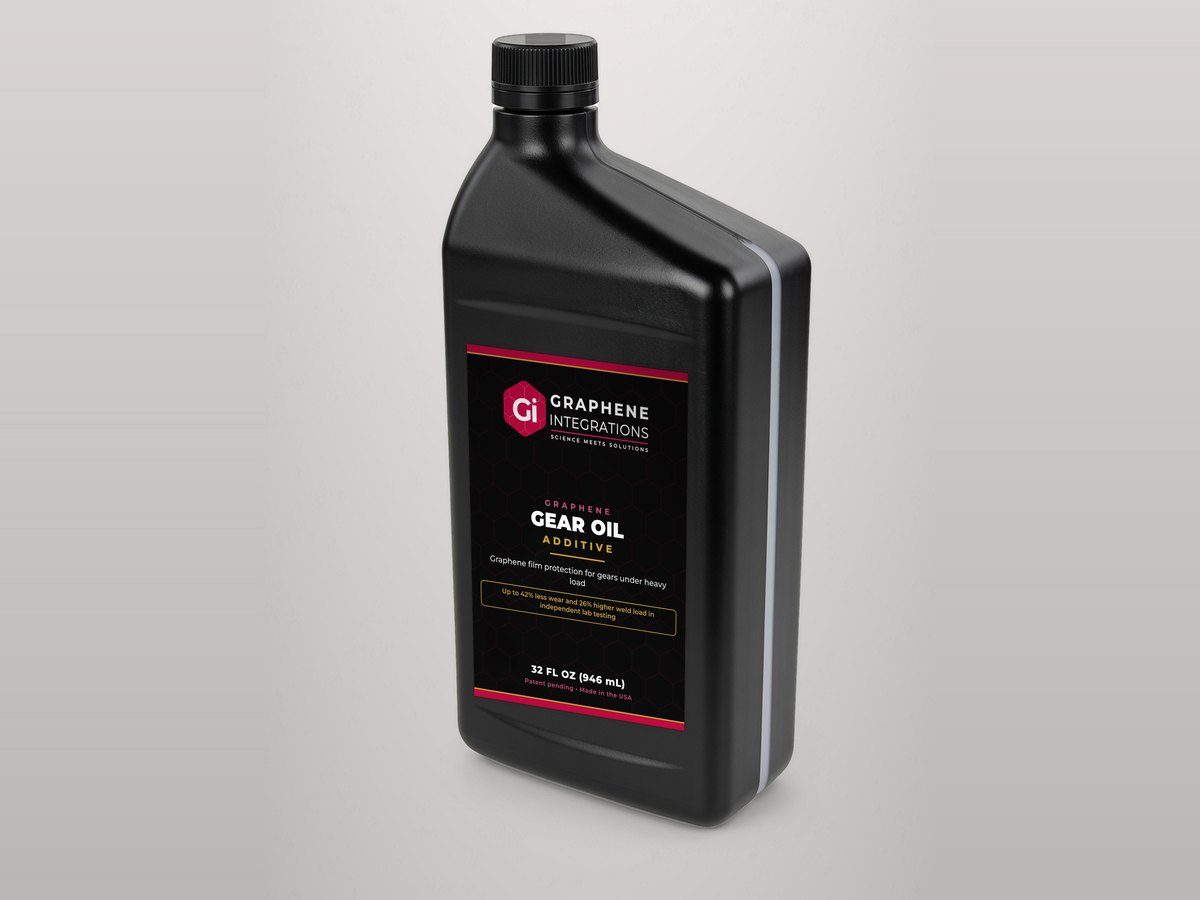
Gear oils live under conditions that would shred most lubricant films. Meshing teeth in a hypoid differential or an industrial gearbox see very high contact pressures and a mix of rolling and sliding. When the film breaks down, surfaces scuff, then weld and tear. That is why gear oils are judged on extreme-pressure (EP) performance, and why our graphene gear oil additive is built around a weld load result. This article explains the test, what the number means, and how a formulator should trial the additive.
Extreme pressure in a gearbox
In a lightly loaded bearing, a full oil film separates the surfaces. In heavily loaded gear contacts, the film can thin to the point where surface peaks touch. Formulators handle this boundary regime with EP and anti-wear chemistry, typically sulfur and phosphorus compounds that react with the metal surface to form a protective layer. The goal is to stop scuffing and welding under shock loads and peak torque.
A graphene additive works on a different principle. Graphene layers are very thin and slide over each other easily. The idea is that they can sit in the contact and help keep loaded surfaces apart. It is a physical mechanism that sits alongside the chemistry already in the oil, not a replacement for it.
What the test showed
The gear oil additive is based on our graphene lubricant additive. In independent testing at Univar's Houston lab, that additive raised weld load by 26% and gave up to 42% less wear compared with the lubricant without graphene.
How the weld load test works
The four-ball EP method for lubricating fluids, ASTM D2783, presses a rotating steel ball against three stationary balls in a cup of lubricant. Each run is short, about ten seconds, and the load is stepped up run by run until the balls weld together. The weld point is that load. The method also reports a load-wear index, which reflects how well the lubricant protected the balls on the way up.
A 26% higher weld load means the treated lubricant carried noticeably more load before the test surfaces seized. For a gear oil formulator, that is a meaningful screen. It is still a bench test. It does not replace gear rig testing, and it does not on its own tell you how a gear set will behave over a service life.
Where the additive is aimed
- Automotive differentials, final drives and manual transmissions
- Industrial gear drives and enclosed gearboxes
- Off-highway and agricultural axles and drives
In every case, the additive goes into a gear oil you already make. We do not sell a finished gear oil and we do not publish field claims, oil-life claims or efficiency numbers for gearboxes.
Blending it in
The graphene arrives pre-mixed: graphene integrated into oleic acid and monomer. Other base oils are available on request if your formulation calls for one. Typical dosing is 1% to 7% by weight, depending on the job. Shake the container, weigh the dose, blend at your normal temperature and check that the oil is uniform. Because the graphene is already dispersed, there is no dust and no high-shear step to add to your process.
A practical trial plan for gear oil
- Baseline: use a current gear oil with known four-ball and any rig data.
- Treat rates: test the suggested starting rate plus one rate on either side, within 1% to 7%.
- Compatibility: check appearance, viscosity, foaming and any seal compatibility tests your specifications need, before running EP tests.
- EP and wear: run four-ball weld and wear on treated and untreated oil from the same base batch.
- Next stage: if the bench data is promising, move to the gear rig or field programme you would use for any new additive.
Keep everything else constant. If you change the EP package at the same time as adding graphene, you will not know which change moved the result.
Common questions from formulators
Formulators often ask whether graphene can let them cut back on sulfur-phosphorus EP chemistry. That is a reasonable question, and the only way to answer it is with testing in a specific formulation. We have not published data on reduced-EP formulations, so we do not claim it. Another common question is filtration. Tell us the finest filter in the systems your oil goes into, and we will confirm the trial makes sense before you start.
For the full background on our lubricant test programme, read graphene lubricant additive: wear and weld load tests. For engine oils, see our guide to the graphene motor oil additive. A peer-reviewed example of the wider research on graphene-family additives in lubricants is this Tribology International study; results in the literature vary with the material and the oil, which is another reason to test in yours.
Read the gear oil additive press release, or request a quote and samples.
Frequently asked questions
What is weld load in a gear oil test?
The load at which the steel test balls seize and weld in a four-ball extreme-pressure test such as ASTM D2783. A higher weld load means the lubricant protects metal under heavier load.
What did the graphene additive show?
A 26% higher weld load and up to 42% less wear than the lubricant without graphene, in independent testing at Univar's Houston lab.
Does it replace EP additives?
Not on the evidence we have. It works alongside the chemistry in the oil. Any reduction in EP package would need testing in your own formulation.
How is it supplied?
Pre-mixed: graphene integrated into oleic acid and monomer, dosed at 1% to 7% by weight depending on the job. Never as a powder.
Request a quote, samples or a spec sheet
Tell us your material, the property you want to improve, the carrier you use (water, solvent, resin or oil) and your volumes. Pricing and samples are by quote. Call 704-659-3682 or request a quote, samples or a spec sheet / SDS.


