
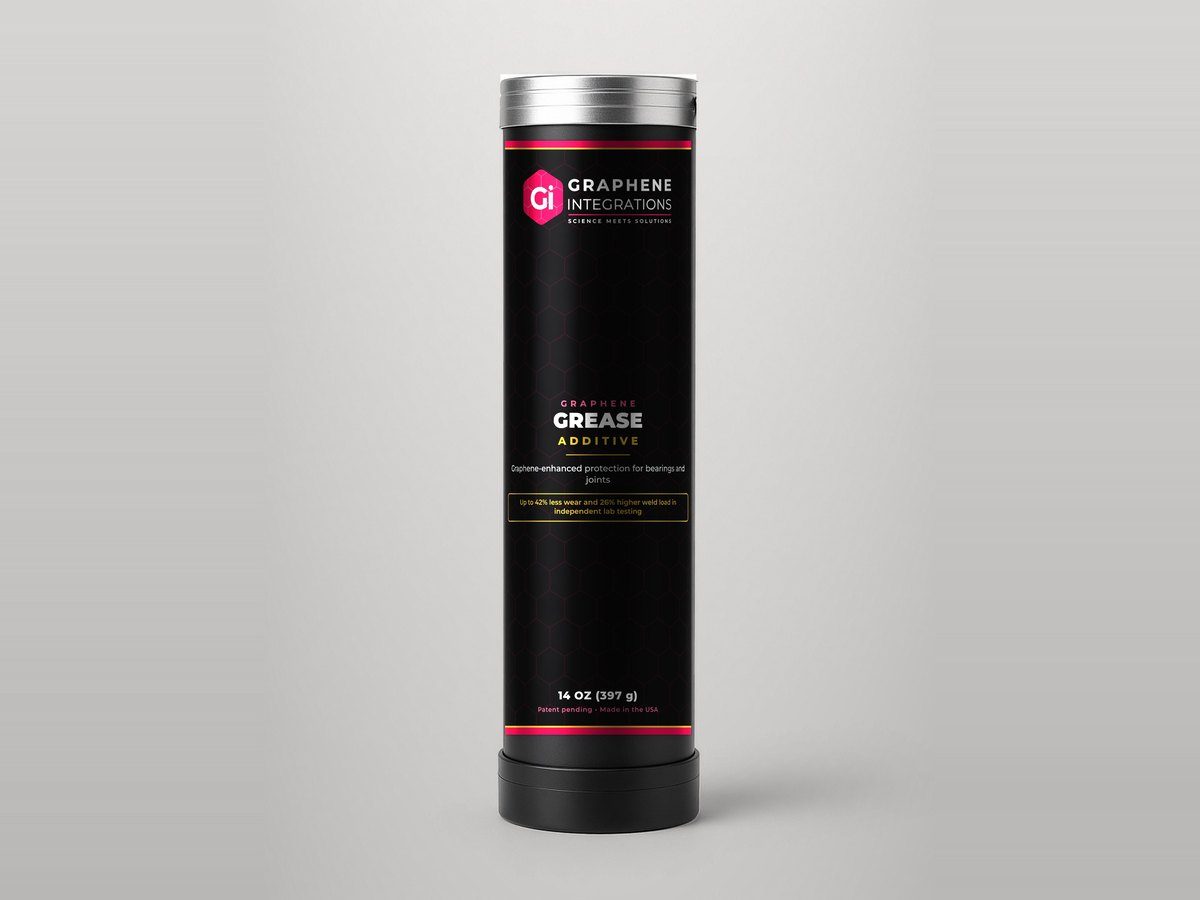
"Graphene grease" can mean two different things. Sometimes it is a finished grease sold to end users. Sometimes it is a grease made by a manufacturer who has added graphene during production. Our product is the second kind of ingredient: a graphene grease additive for grease makers. This article explains how it is blended, what the lab results mean, and how to test it against a grease you already make.
What grease has to do
Grease is a base oil held in a thickener, plus additives. The thickener, such as a lithium, lithium complex, calcium sulfonate or polyurea soap, holds the oil in place so it stays in a bearing, pin or bushing that would lose a liquid lubricant. Grease often works where parts move slowly under heavy load, with shock loads and long intervals between re-lubrication. That puts a lot of the job in the boundary regime, where surfaces come close enough to touch.
Solid lubricants such as molybdenum disulfide and graphite have long been used in greases for exactly those conditions. Graphene belongs to the same family as graphite: it is a single layer of the carbon sheets that make graphite slippery. The idea of a graphene grease additive is to put very thin, easily sliding layers into the contact zone.
What the lab test showed
Our Graphene Grease Additive is based on our graphene lubricant additive. In independent testing at Univar's Houston lab, that additive showed up to 42% less wear and a 26% higher weld load than the lubricant without graphene.
For greases specifically, the extreme-pressure four-ball method is ASTM D2596, which reports weld point and a load-wear index. Our published numbers are for the lubricant additive; when you test the additive in your grease, D2596 and your usual wear tests are the right tools for a direct comparison.
How the additive goes into the kettle
The graphene is supplied pre-mixed: graphene integrated into oleic acid and monomer. It goes into the grease kettle with the base oil and thickener during manufacture, so it is distributed through the grease structure rather than stirred into a finished product.
- Dose: 1% to 7% by weight, depending on the job. We suggest a starting rate for each grease.
- Greases: bearing, chassis and industrial greases.
- Formats: a 14 oz cartridge for small trials and 5 gallon pails for production, with bulk on request.
- Status: patent pending, made in the USA in Charlotte, NC, no carbon black, never sold as a powder.
Why the carrier matters
Dry graphene powder is hard to spread evenly through a grease, and it is a dust to manage in the plant. Because our graphene is already dispersed in an oil-compatible carrier, it mixes like any other liquid additive. Our article what is a graphene dispersion (and why not powder) goes into this in more detail.
A test plan for grease makers
- Pick a reference grease. Choose one with a full set of existing data: penetration, dropping point, four-ball EP and wear, and any customer tests.
- Make side-by-side batches. Same base oil, thickener and additive package, with and without graphene. Add the graphene at the same point in the process each time.
- Check structure first. Measure worked penetration and dropping point. If the graphene changes the grease structure, adjust before spending on tribology.
- Run EP and wear. Four-ball EP (D2596) and your usual wear test on both batches.
- Look at stability. Check oil separation and appearance after storage.
- Field trial. If the bench data is good, run a controlled field trial on equipment with a known re-lubrication history.
Performance depends on the thickener, base oil and additive package. A result in a lithium complex grease does not automatically carry over to a calcium sulfonate grease, so test each family you care about.
What we do not claim
We do not claim longer re-lubrication intervals, bearing life or temperature limits for graphene grease. We have published bench results for the lubricant additive and nothing else, and we have no customer case studies to share yet. If your testing shows a benefit, that data is yours.
"Grease makers already know their kettles. Our job is to give them graphene that blends like any other liquid, and honest data to start from." — Frans Alkemade
Related reading
See graphene lubricant additive: wear and weld load tests for the test background, and our guides to the hydraulic fluid additive and the gear oil additive.
Read the grease additive press release, or request a quote and a trial cartridge.
Frequently asked questions
What is graphene grease?
A grease that contains graphene, usually added during manufacture. Our product is a pre-mixed graphene additive that grease makers blend in at the kettle.
What results has the graphene additive shown?
The lubricant additive it is based on gave up to 42% less wear and a 26% higher weld load than the lubricant without graphene, in independent testing at Univar's Houston lab.
When is the additive added?
During grease manufacture, with the base oil and thickener, at 1% to 7% by weight depending on the job.
Which test should I use for grease?
Four-ball EP for greases is ASTM D2596. Run it with and without graphene on batches made the same way.
Request a quote, samples or a spec sheet
Tell us your material, the property you want to improve, the carrier you use (water, solvent, resin or oil) and your volumes. Pricing and samples are by quote. Call 704-659-3682 or request a quote, samples or a spec sheet / SDS.


