
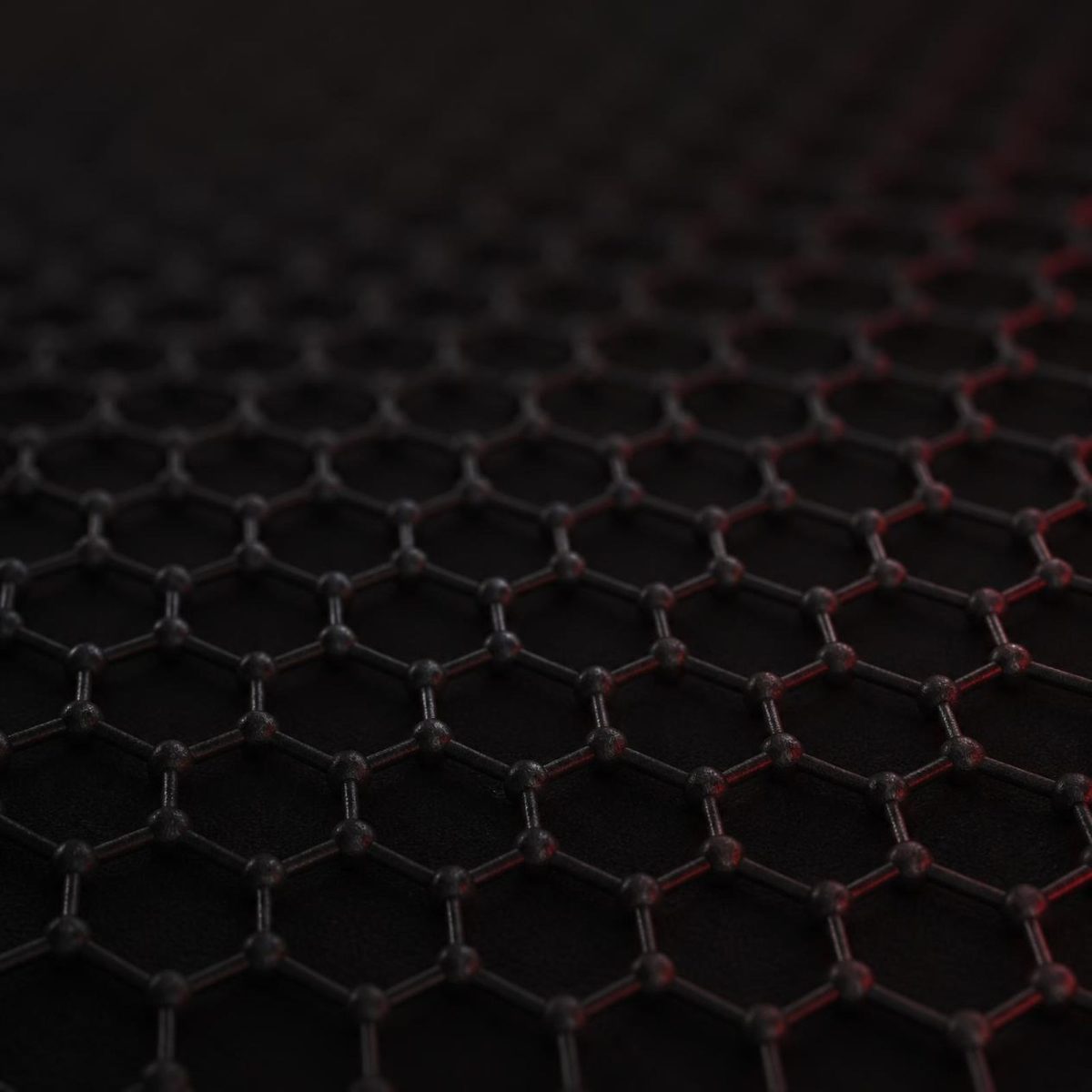
Graphene is a sheet of carbon atoms in a hexagonal lattice, with few defects and high electrical and thermal conductivity. Graphene oxide (GO) is graphene that has been heavily oxidized, so it carries oxygen groups that make it easy to disperse in water but make it a poor electrical conductor. Reduced graphene oxide (rGO) is GO with many of those oxygen groups removed again, which restores some conductivity, though not the structure of pristine graphene.
The three are often grouped together as "graphene materials", but they behave differently in a product. A result measured with one should not be assumed for another.
How is each material made?
- Graphene can be grown as a film, for example by chemical vapor deposition, or produced in bulk by exfoliating graphite into thin sheets. Graphene Integrations produces graphene by exfoliation and keeps it stably suspended in a carrier using a proprietary solution. Read how we make graphene and how graphene is made.
- Graphene oxide is made by oxidizing graphite with strong chemical oxidizers, then separating the oxidized layers in water.
- Reduced graphene oxide is made by treating GO chemically or thermally to remove much of the oxygen.
How do their properties differ?
| Property | Graphene | Graphene oxide | Reduced graphene oxide |
|---|---|---|---|
| Oxygen content | Low | High | Reduced, not zero |
| Electrical conductivity | High | Low (largely insulating) | Partly restored |
| Ease of dispersion in water | Needs a carrier or dispersant | Disperses readily | Harder than GO |
| Lattice defects | Few | Many | Many remain |
The oxygen groups on GO are useful for chemistry: they let it bond with polymers and form membranes. But they interrupt the carbon lattice that gives graphene its conductivity.
Which one is used in which applications?
- Graphene is studied and used for conductivity, thermal transfer, barrier properties and mechanical reinforcement in coatings, lubricants, polymers, concrete and fluids. See graphene products.
- Graphene oxide is widely researched for membranes and water filtration, biomedical research and as a precursor for other materials. Our page on environmental cleanup notes that most of that work is still at research or pilot stage.
- Reduced graphene oxide appears in research on conductive inks, sensors and electrodes.
Why can't results be transferred between them?
Published papers often use graphene oxide or rGO and report impressive numbers. Those materials differ in chemistry, defects, sheet size and dispersion from an exfoliated graphene dispersion. A strength or conductivity result for GO in one study does not tell you what a different graphene grade will do in your product. That is why our own results are always tied to a specific product and test: for example, our concrete additive's +67.7% compressive strength at 5% by weight of cement in independent third-party testing (2023), described on the graphene concrete additive page.
What should a buyer ask a supplier?
- Is the material graphene, graphene oxide or reduced graphene oxide?
- How was it produced, and how is quality checked (for example, by Raman spectroscopy)?
- In what form is it supplied: dry powder or pre-dispersed in a carrier?
- Which results were measured with this exact product, and by whom?
Our graphene quality specifications guide and how to choose a graphene supplier go further.
Which does Graphene Integrations supply?
We supply graphene made by exfoliation in the USA, already dispersed in water, solvents, resins or oils, never as dry flake or powder. In 2020, our graphene was analyzed by Raman spectroscopy at three independent facilities in the USA, Spain and China. We do not sell graphene oxide. Browse the store or read what a graphene dispersion is.
Frequently asked questions
Is graphene oxide the same as graphene?
No. Graphene oxide carries many oxygen groups that make it disperse easily in water but greatly reduce its electrical conductivity.
Is reduced graphene oxide as good as graphene?
Reduction restores some conductivity, but defects remain, so rGO generally does not match pristine graphene's properties.
Which is better for a coating or lubricant?
It depends on the property and the formulation. Test the specific product in your material against your own baseline.
Does Graphene Integrations sell graphene oxide?
No. We supply exfoliated graphene pre-dispersed in a carrier matched to your process.
Request a quote, samples or a spec sheet
Tell us your material, the property you want to improve, the carrier you use (water, solvent, resin or oil) and your volumes. Pricing and samples are by quote. Call 704-659-3682 or request a quote, samples or a spec sheet / SDS.


