
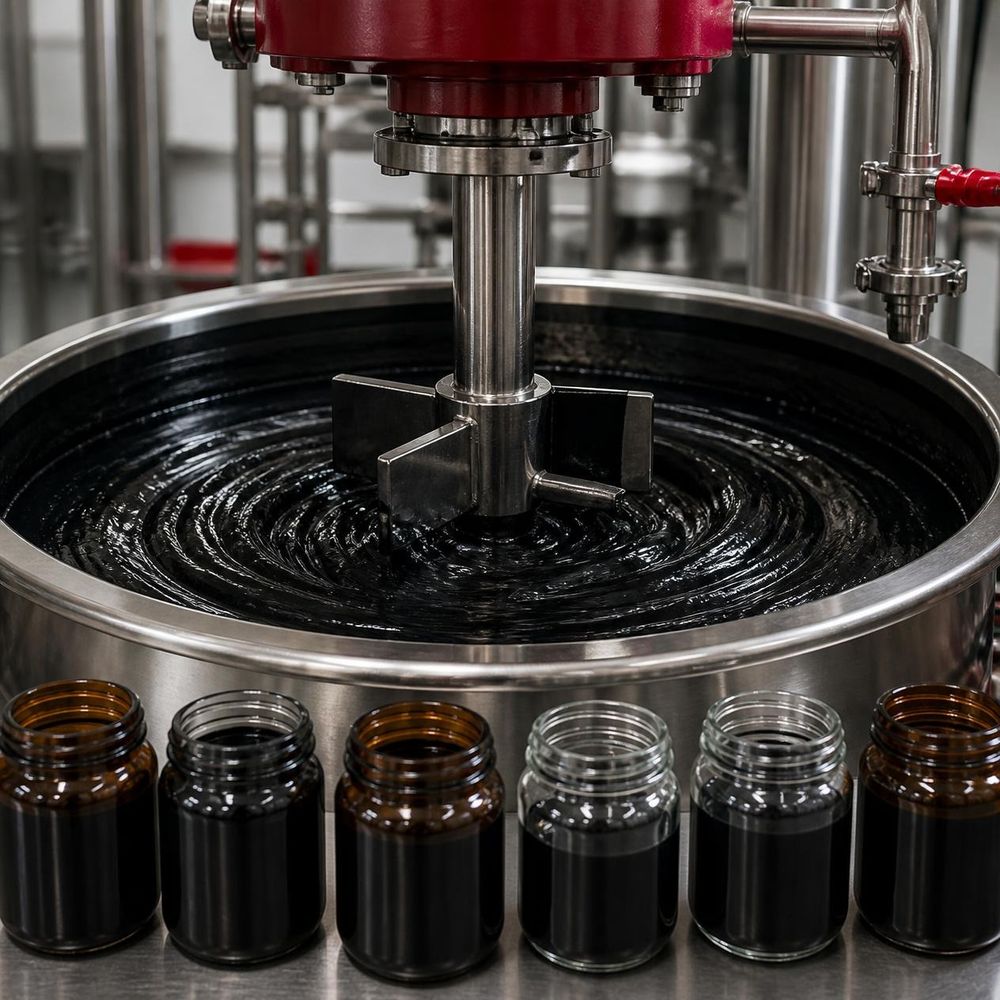
Graphene Integrations makes graphene in Charlotte, NC and delivers it the way manufacturers can actually use it: already dispersed in water, solvents, resins or oils. This page explains what graphene is, how we produce and stabilize it, how we check quality, and how a project moves from a sample to production.
- Made in the USA: produced in Charlotte, NC.
- Ready to integrate: supplied pre-dispersed, never as dry powder.
- Independently checked: Raman analysis at three independent facilities in 2020.
- Proven in use: results in concrete, lubricants, coolants and consumer products.
1. What graphene is
Graphene is a single layer of carbon atoms in a hexagonal lattice, known for its strength and its thermal and electrical conductivity. What is graphene? · Graphene vs graphite
2. How we manufacture graphene
We make graphene in the USA, in Charlotte, NC. In 2020, our graphene was analyzed by Raman spectroscopy at three independent facilities in the USA, Spain and China. Read the 2020 announcement
Graphene Integrations produces graphene by exfoliation, then uses a proprietary solution to keep that graphene stably suspended in a carrier chemical. Customers receive graphene already dispersed in water, solvents, resins, or oils — ready to integrate — rather than as a dry powder. Process parameters and the composition of our proprietary suspension package are confidential. Independent Raman analysis in 2020 (labs in the USA, Spain, and China) supports the quality of our graphene; application results are on our case studies page.
How we check quality: graphene quality specifications, layers and Raman.
3. Partners
Partners we have worked with include ITW and a DoD contractor. Graphene integration partners · Case studies
4. How we integrate graphene
We supply graphene already dispersed in water, solvents, resins and oils, never as dry flake or powder. You tell us what you make, we suggest a dispersion and starting dose, your team tests it against its own baseline, and if it works we scale up. Graphene dispersions · How to run a graphene additive trial
Why we supply graphene pre-dispersed
Treat-rate guidance must match the product: ThermaGraph is a complete water-based fill containing 0.5–1.5 wt% graphene; ThermaGraph-D is a complete white-mineral-oil immersion fill containing 0.05–0.20 wt% graphene. These are graphene contents of supplied fluids, not top-off doses. Lubricant guidance is 1–7% by weight of the supplied additive. For other dispersions, agree a formulation-specific supplied-additive dose with GI; there is no universal range. The +67.7% concrete strength result remains tied to the tested 5% supplied-additive dose by cement weight.
5. What we sell
Graphene products: concrete additive, lubricant additive, data center coolants, coatings and polymer composites.
Results from our graphene
The process is only worth something if the graphene performs in a real product. Selected results:
- Concrete: a 67.7% gain in compressive strength at 5% by weight of cement, in independent third-party testing. Graphene concrete additive
- Lubricants: up to 42% smaller four-ball wear-scar diameter and a 26% higher weld load in independent lab testing, using a Sylfat™ tall oil fatty acid carrier. Graphene lubricant additive
- Data center coolants: ThermaGraph showed heat transfer gains of 6% to 18% in internal testing. Data center coolants
- Consumer products: four graphene-enhanced car care products developed with ITW reached store shelves. Case studies
Frequently asked questions
Where is your graphene made?
In the USA, in Charlotte, NC.
Do you sell dry graphene powder?
No. We supply graphene already dispersed in water, solvents, resins or oils so it can be mixed into your process evenly.
How is graphene quality verified?
In 2020 our graphene was analyzed by Raman spectroscopy at three independent facilities in the USA, Spain and China. See our quality specifications guide.
Can you share your process details?
Process parameters and the composition of our proprietary suspension package are confidential. We are happy to discuss how a dispersion fits your product.
Which industries do you serve?
Construction, lubricants, data centers, coatings, polymers, automotive and more. See industries.
How do I start?
Request samples, run a trial against your own baseline, and we scale up if the results hold.
Explore more
- All graphene products
- Graphene dispersions
- Case studies
- Industries we serve
- Industry associations
- About Graphene Integrations
- Store
For concrete applications, explore strength-tested mixes and embodied carbon, including a conditional cement-production calculation—not a measured GI carbon saving. Explore the concrete and embodied-carbon guide.
Choose evidence for the product you are developing
Match the evidence to the application: a lubricant wear-scar result, a water-loop heat-transfer result and a concrete strength result answer different questions. Compare your own formulation at the required performance, then measure energy, material use and service needs, including additive and carrier impacts.
Application testing and environmental assessment · Lubricant test evidence · ThermaGraph / ThermaGraph-D · Concrete and embodied carbon