
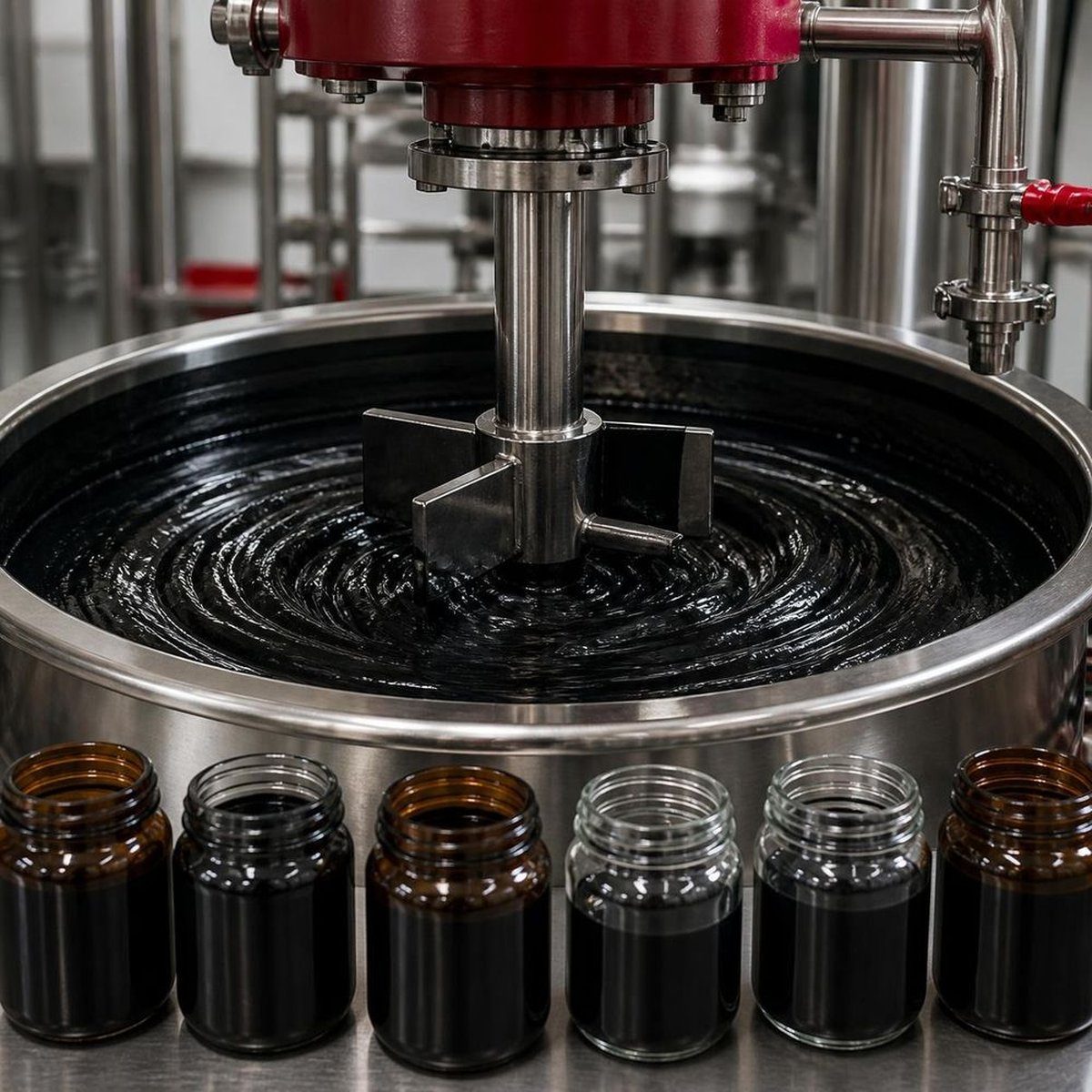
Ask three suppliers how they make graphene and you may hear three honest answers that still talk past each other. One peels graphite with shear and solvents. One grows a film on copper. One flashes waste carbon into turbostratic sheets. All of them can be right—and all of them can sell something that will not behave like a Nobel-prize monolayer on oxidized silicon. The manufacturing route decides flake thickness, defect density, lateral size, residual chemistry, and whether you receive a film, a powder, or a liquid that a plant can pour.
This article walks the main industrial families without publishing anyone’s proprietary recipes. It ends where Graphene Integrations stands publicly: exfoliation plus a proprietary suspension, supplied already dispersed in carriers manufacturers can use.
Two families: top-down and bottom-up
Top-down methods start with graphite (or graphite oxide) and separate or reduce layers. Bottom-up methods build graphene from carbon-containing precursors—most famously chemical vapor deposition (CVD) on metal foils. Reviews such as Backes et al. in 2D Materials (2020) map the tradeoffs at length (DOI 10.1088/2053-1583/ab1e0a). Buyers do not need every variant. They need to know which family they are buying and what that family can never be.
Mechanical and liquid-phase exfoliation
Mechanical cleavage with adhesive tape is how Manchester isolated the devices that made graphene famous—but tape is not a plant. Industry needs volume. Hernandez et al. (2008) showed high-yield graphene production by liquid-phase exfoliation of graphite in Nature Nanotechnology—ultrasound or shear in solvents or surfactant systems that separate layers and keep few-layer sheets dispersed (DOI 10.1038/nnano.2008.215). Strengths: scalability and compatibility with inks, coatings, and masterbatches. Limitations: broad thickness and size distributions, residues, and electronic quality below CVD monolayers.
Years later, Jonathan Coleman’s group at Trinity College Dublin pushed the intuition into a household parable: turbulent shear in a kitchen blender with water and detergent could produce few-layer flakes at rates that made scale-up conversations serious. The blender is not a plant design. It is proof that the bottleneck is delivering shear above a critical rate and then stabilizing what you peel. Buyer questions remain: solvent or surfactant system, centrifuge cut, concentration, sedimentation stability, and Raman metrics.
Electrochemical exfoliation
Apply potential to a graphite electrode in electrolyte; intercalation and gas evolution pry layers apart. Parvez et al. demonstrated solution-processable electrochemical routes in ACS Nano (2013) and aqueous-salt systems in the Journal of the American Chemical Society (2014) (DOI 10.1021/nn400576v; DOI 10.1021/ja5017156). Reviews place electrochemical exfoliation among promising scalable top-down paths, with tradeoffs in oxidation, electrolyte cost, and flake-size control.
Oxide routes: Hummers’ grandchildren
Hummers’ 1958 oxidation and its improved variants still dominate many academic composite papers because graphene oxide disperses in water (DOI 10.1021/ja01539a017). Reduction yields reduced graphene oxide (rGO)—useful, defective, and not a pristine monolayer in disguise. Strong oxidizers demand chemical-plant discipline; finished powders still need nanomaterial handling controls. If a data sheet says “graphene” but the process story is classic GO chemistry, ask for Raman, oxygen content, and the reduction method before you treat it as a Balandin-grade thermal filler.
CVD on copper: films, not drums
Li et al. (2009) grew large-area uniform graphene films on copper foils in Science (DOI 10.1126/science.1171245). Methane or another precursor decomposes on hot metal; carbon nucleates as graphene; transfer—or use on metal—enables devices. Copper’s low carbon solubility favors monolayer growth under the right conditions. Continuous films suit transparent conductors and sensors. They are usually the wrong mental model for a concrete admixture or a lubricant additive. Additive markets mostly stayed with powders and liquids even as industrial labs pushed CVD for electronics research.
Flash graphene and other newcomers
Flash Joule heating—“flash graphene”—from waste carbons, associated with James Tour’s group at Rice and reported in Nature (2020), showed gram-scale bottom-up synthesis of turbostratic graphene (DOI 10.1038/s41586-020-1938-0). New routes keep arriving. Each one still has to answer the same purchasing questions: layer distribution, residual chemistry, dispersion stability, lot-to-lot Raman, and whether the grade matches the application.
How Graphene Integrations describes its process
Graphene Integrations works in the top-down family. We make graphene in Charlotte, NC by exfoliation, then use a proprietary suspension so customers receive graphene already dispersed in water, solvents, resins, or oils—never as dry powder. Independent Raman analysis in 2020 at facilities in the USA, Spain, and China supports the quality of our graphene; application results live on our case studies page.
Typical dosing ranges for our products: about 0.5% to 1.5% for ThermaGraph closed-loop coolant, 0.05% to 0.20% for ThermaGraph-D immersion concentrate, and 1% to 7% for lubricant additives. The +67.7% compressive-strength concrete result is tied to 5% by weight of cement in independent testing. See how we make graphene, graphene dispersions, and quality specifications, layers and Raman for more.
What buyers should demand on a data sheet
Regardless of route, a serious graphene grade should arrive with more than a marketing adjective. Ask for Raman fingerprints that speak to layer number and defect density, a statement of lateral size or particle-size distribution, residual metals or surfactants if relevant, and evidence that the dispersion stays suspended over the storage window you need. For films, ask about transfer method and substrate. For powders and liquids, ask whether the grade is monolayer-rich, few-layer, graphene oxide, or reduced graphene oxide—and refuse to let those words collapse into one SKU name.
ISO vocabulary documents such as ISO/TS 80004-13:2024 exist precisely so purchasing language can keep up with laboratory language. They will not invent performance for you. They will keep a conversation honest when one party says “graphene” and means a CVD monolayer while the other means a few-layer nanoplatelet in oil.
Charlotte’s role in that map is practical. Graphene Integrations does not sell dry flake into a hopper and wish the plant luck. The company makes graphene in the USA and ships it the way manufacturers already move chemistry: as a liquid ready to integrate. That choice will not make every lab headline true in every plant. It does remove the hardest handling step before a trial even starts.
The manufacturing fork is a full chapter in the upcoming book Graphene by Frans Alkemade—coming soon to Amazon. Related reading: history of graphene discovery · graphene products · request samples.


