
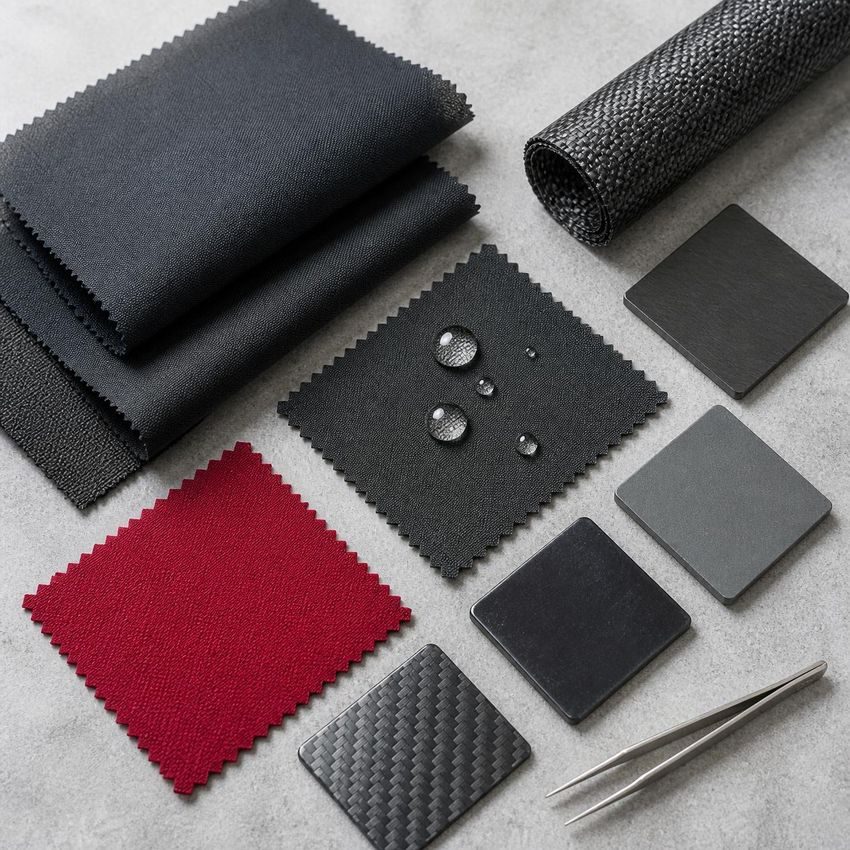
Most people meet graphene in textiles through a jacket or a sports garment. Behind that product is a finishing step: a pad bath, a knife coating or a laminate where graphene was added to the fabric. This article is for the mills and finishers who run those lines. It covers how graphene goes into a finish, what it is designed to help with, and how to test our Graphene Textile Additive. For the wider picture of graphene and fabrics, see our earlier article on graphene's integration into textiles.
Where graphene goes in textile processing
- Pad finishing: fabric runs through a bath containing the finish, is squeezed between rollers and then dried and cured. The additive is mixed into the bath.
- Coating: a paste or coating, often polyurethane or acrylic, is applied by knife or roller to one side of the fabric. The additive goes into the coating compound.
- Lamination and membranes: graphene can be included in a film or adhesive layer bonded to the fabric.
- Printing: conductive or functional inks can carry graphene onto selected areas.
Fibre spinning, where graphene is built into the fibre itself, is a separate route that needs the fibre producer's process. Our additive is aimed at finishes and coatings.
What graphene is designed to help with
- Heat management: graphene conducts heat very well, which is why it is explored in fabrics that spread or move body heat.
- Static control: at suitable loadings, graphene can help a coated fabric dissipate static charge.
- Durability: graphene's strength makes it a candidate for abrasion-resistant coatings.
- Barrier: in coatings and membranes, flat flakes can slow the passage of gases and liquids.
These are things graphene is designed to help with, not guaranteed results. We do not publish performance numbers for textiles; each trial is compared with the customer's current fabric. Graphene itself was first isolated in 2004 (Novoselov et al., Science), and textile uses are still an active area of development.
What the additive is
- Carrier: water-based or resin dispersion matched to the finishing process.
- Uses: fabric finishing, coated textiles, technical and performance fabrics.
- Dose: 1% to 7% by weight, depending on the job.
- Status: patent pending, made in the USA in Charlotte, NC, no carbon black, never sold as a powder.
Because it is a liquid dispersion, it goes into the bath or coating compound like other finishing chemicals. There is no dry graphene to handle on the line.
Process watch points
- Bath stability: check that the graphene stays dispersed over the length of a run. Stir or recirculate as you would for other pigments.
- Compatibility: binders, softeners, fluorine-free repellents and crosslinkers can interact. Tell us the full recipe.
- Pick-up: wet pick-up controls how much additive ends up on the fabric. Record it.
- Cure: keep drying and curing temperatures and times the same as your baseline.
- Colour and hand: graphene is black and can grey light shades. Check hand (feel) and drape as well as performance.
A finishing trial plan
- Choose a fabric and a finish you already run, with existing test data.
- Run a control and two or three loadings on the same fabric lot, same day, same line settings.
- Test before washing: the property you care about, such as thermal behaviour, surface resistance or abrasion, plus colour and hand.
- Wash and retest. Durability to laundering is where many finishes fail. Test after the number of washes your customers expect.
- Check rub-off. Crocking tests show whether graphene transfers from the fabric.
- Review the results against your control, then decide whether to adjust loading, binder or cure.
What we do not claim
We do not claim warmth, cooling, anti-static, durability or wash-fastness numbers for fabrics finished with our additive, and we have no customer case studies to share. Your wash, wear and hand tests decide what it is worth, and any product claims on a finished garment should come from your own testing.
"Finishers already have the lines and the recipes. Our part is graphene that drops into the bath and stays put." — Frans Alkemade
Scaling from lab to line
Lab pads and small coating tables are a good start, but bath behaviour over a long production run can differ. Before a full order, run a short production trial and take samples from the start, middle and end of the run. Test each for add-on, colour and performance to make sure the finish stays consistent across the batch.
Related reading
See how to choose a graphene dispersion carrier and our coatings formulator's guide.
Read the textile additive press release, see the graphene fabric page, or request a quote and samples.
Frequently asked questions
How is graphene added to fabric?
Usually through a finish or coating: mixed into a pad bath, a coating compound or a laminate adhesive, then applied and cured on existing lines.
Will graphene survive washing?
That depends on the binder, cure and loading. Test after the number of washes your customers expect.
How much graphene textile additive is used?
1% to 7% by weight, depending on the job, in a water-based or resin carrier matched to your process.
Does graphene change fabric colour?
Yes. Graphene is black and can grey light shades, so check colour and hand alongside performance.
Request a quote, samples or a spec sheet
Tell us your material, the property you want to improve, the carrier you use (water, solvent, resin or oil) and your volumes. Pricing and samples are by quote. Call 704-659-3682 or request a quote, samples or a spec sheet / SDS.


