
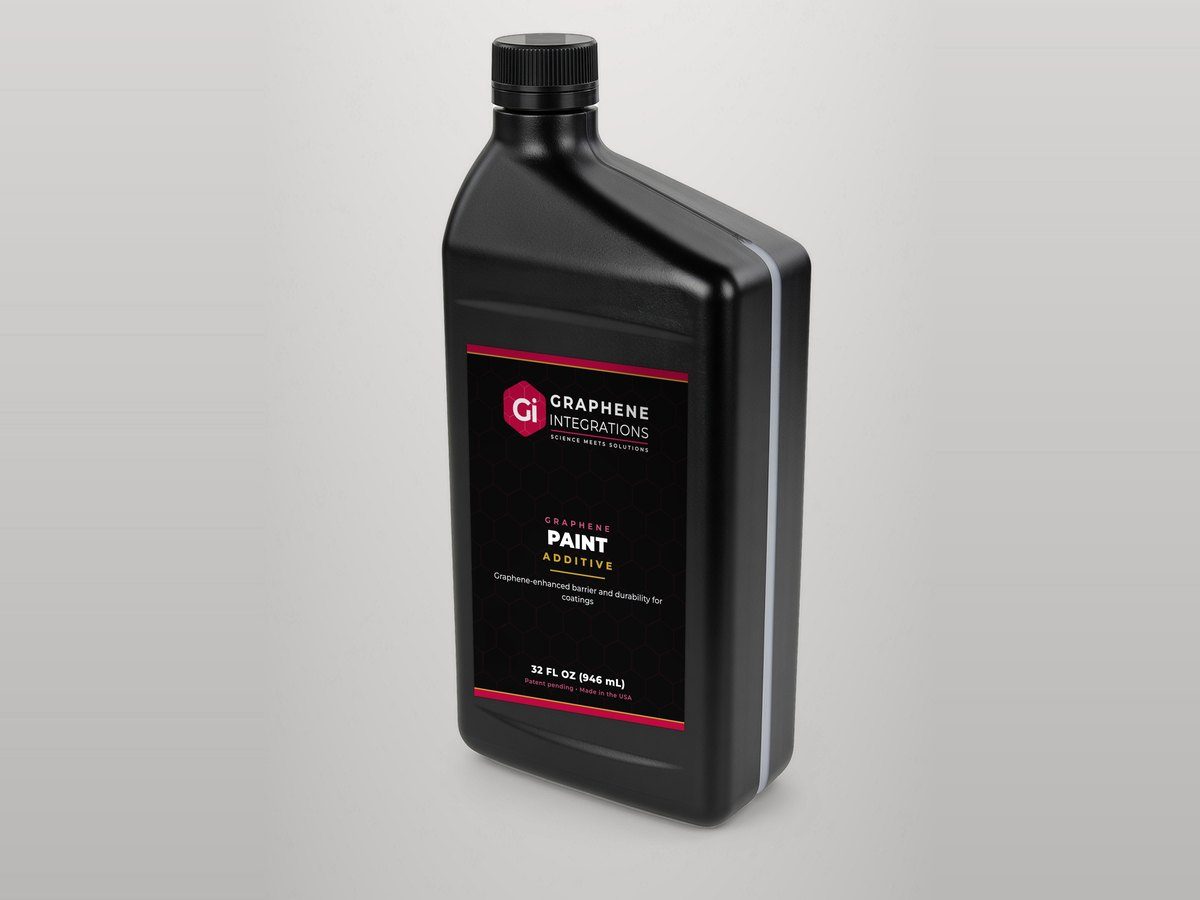
Graphene has become one of the most researched additives in coatings, mainly because of one property: a perfect graphene sheet does not let even small gas molecules through. This article explains why that matters for paint, why real coatings are more complicated than a perfect sheet, how our Graphene Paint Additive is supplied, and how a coatings formulator should test it.
The barrier idea
In 2008, researchers showed that a single, defect-free graphene membrane was impermeable to standard gases, including helium (Bunch et al., Nano Letters). That result sparked a large body of work on graphene as a barrier material.
In a paint film, graphene is not one continuous sheet. It is many small, thin flakes spread through the binder. The idea is that well-dispersed flakes, lying roughly parallel to the surface, make the path for water, oxygen and salts through the film longer and more winding. A longer path can slow the moisture and ions that drive corrosion and blistering. This is often called a "tortuous path" effect, and it is the same reason platelet pigments such as micaceous iron oxide are used in protective coatings.
Why results vary
Reviews of graphene anti-corrosion coatings, such as this one in Coatings (MDPI), point out that the barrier benefit depends on dispersion quality, flake orientation, adhesion and film integrity. Poorly dispersed graphene can create defects instead of closing them. That is why dispersion, not just the graphene itself, decides whether a graphene coating works.
What our additive is
The Graphene Paint Additive is graphene pre-dispersed in the carrier your coating already uses: solvent, water or resin. We match the carrier to your system so the graphene stays mixed.
- Coatings: architectural paints, protective and industrial coatings, primers and sealers.
- Dose: 1% to 7% by weight, depending on the job.
- Method: add to the coating and mix until uniform with your normal equipment.
- Status: patent pending, made in the USA in Charlotte, NC, no carbon black, never sold as a powder.
We do not publish performance numbers for coatings. Results are measured against each customer's own baseline coating.
What graphene can help with in paint
Formulators typically evaluate graphene for:
- Barrier and corrosion protection in primers and protective coatings on steel.
- Moisture resistance in sealers and exterior coatings.
- Scratch and wear resistance, building on graphene's strength.
- Thermal or electrical conductivity in specialty coatings, which usually needs higher loadings and a careful formulation.
Each of these is something graphene is designed to help with, not a guaranteed result. Your test panels will tell you which ones show up in your system.
How to test it in a coating
- Pick a baseline. Use a current coating with known performance data.
- Tell us the system. Binder, solvent or water, pigment volume concentration, and how you disperse today.
- Make side-by-side batches. Add the additive at two or three rates within 1% to 7%. Keep everything else identical.
- Check the liquid paint. Viscosity, appearance, fineness of grind and storage stability.
- Check the film. Appearance, gloss, colour and adhesion. Cross-hatch tape adhesion is a common first check.
- Run exposure tests. Salt spray, humidity, immersion or weathering, whichever your customers use, on baseline and treated panels prepared the same way.
Prepare substrates the same way for every panel. Surface preparation affects corrosion results more than almost any additive, so inconsistent prep can hide or fake a difference.
Colour
Graphene is black. At typical additive loadings it will darken or grey a white or pastel tint. It is easiest to evaluate first in primers, dark colours and clear-to-dark protective systems.
What we do not claim
We do not claim specific salt spray hours, corrosion ratings, lifetime or coverage for coatings made with our additive, and we have no customer case studies to share. Those numbers belong to the formulator who runs the tests.
Handling on the production floor
The additive arrives as a liquid in 32 fl oz bottles, 1 gallon jugs or 5 gallon pails. Shake or stir the container before use, since some soft settling in storage is normal. Add it at the let-down stage or the point we recommend for your system, and mix until the batch is uniform. Because there is no dry graphene to wet out, you do not need to change your dispersion equipment, and there is no fine dust to manage. Keep a retained sample of every trial batch so you can check storage stability later.
Related reading
For carrier choice, read graphene dispersion in water, solvent, resin or oil. For the wider picture, see how graphene additives are used in manufacturing.
Read the paint additive press release, see the graphene coatings page, or request a quote and samples.
Frequently asked questions
What does graphene do in paint?
Well-dispersed graphene flakes are designed to lengthen the path that moisture and ions take through a film, which can help barrier and corrosion protection. Results depend on the formulation.
Will graphene change the colour of my paint?
Yes. Graphene is black and will darken light colours. Primers and dark coatings are the easiest place to start.
How much graphene paint additive do I use?
1% to 7% by weight, depending on the job, in a carrier matched to your coating.
Do you publish salt spray results?
No. We do not publish coating performance numbers. Each trial is measured against the customer's own baseline.
Request a quote, samples or a spec sheet
Tell us your material, the property you want to improve, the carrier you use (water, solvent, resin or oil) and your volumes. Pricing and samples are by quote. Call 704-659-3682 or request a quote, samples or a spec sheet / SDS.


