
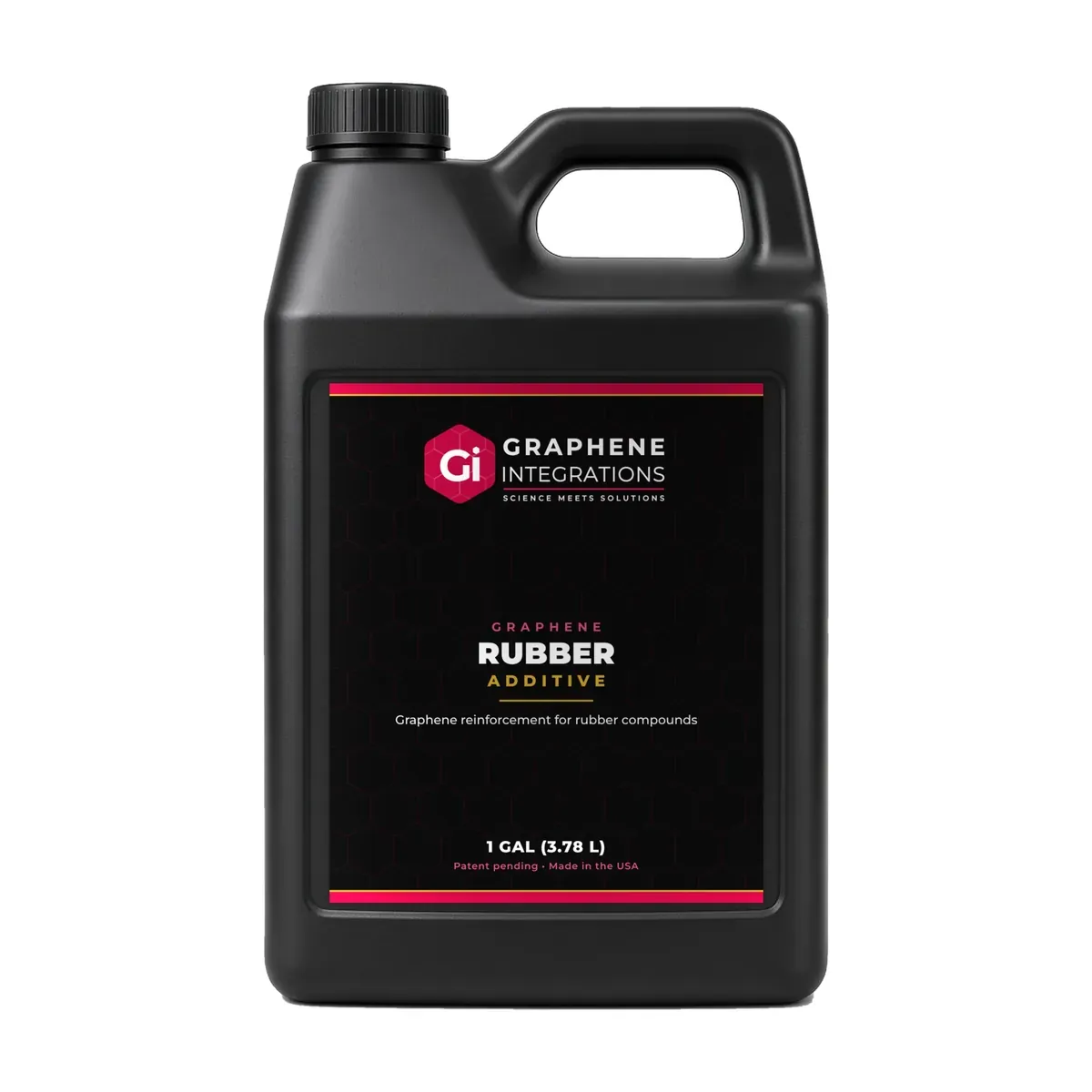
Shop: see sizes, SKUs and the spec sheet for the Graphene Rubber Additive in our store, or browse all graphene products.
"Graphene rubber" is a rubber compound with graphene added as a filler. You will see it on bike tires, shoe soles and industrial products, and in a growing body of research on tires, seals and conductive elastomers. This article explains what graphene rubber is, what graphene can do in a rubber compound, what makes it hard to get right, and how a compounder can add graphene without handling powder.
What is graphene rubber?
Rubber products are rarely just rubber. Tires, belts and hoses contain fillers such as carbon black and silica that give the compound its strength and wear resistance. Graphene rubber adds graphene to that mix, either alongside the usual fillers or to replace part of them. The base can be natural rubber, SBR, NBR, EPDM or another elastomer.
What graphene can do in rubber
Reviews of graphene rubber nanocomposites describe several possible gains when the graphene is well dispersed (review; Polymers):
- Reinforcement: higher modulus and better tensile and tear properties, often at low loadings.
- Abrasion resistance for treads, belts and soles.
- Gas barrier, useful for inner liners and seals.
- Electrical and thermal conductivity, for antistatic or heat-dissipating parts.
Researchers also study graphene as a partner to carbon black and silica in hybrid filler systems. Graphene Integrations does not publish test numbers for rubber. Each result is evaluated against the customer's current compound.
Why it is hard to get right
The main challenge is the same in every review: getting graphene evenly spread through a very viscous compound and bonded to the rubber. Clumped graphene does not reinforce well. Graphene can also change cure behaviour and the way the filler network responds to strain, so cure curves and dynamic properties need to be checked, not assumed (Rubber Chemistry and Technology).
How our Graphene Rubber Additive works
The Graphene Rubber Additive is graphene supplied pre-dispersed in a carrier matched to your compound. You add it during mixing like any other ingredient, without dry powder to dust or wet out.
- For: tire, belt, hose, seal and other industrial rubber compounds.
- Carrier: matched to your compound; see the technical data sheet.
- Dose: typically 1% to 7% by weight, depending on the application.
- Mixing: add in the internal mixer or on the mill at the stage we recommend for your compound, then mix and cure as normal.
- Made in the USA in Charlotte, NC. Patent pending. No carbon black. Never sold as a powder.
Graphene vs. carbon black and silica
Carbon black and silica are proven, low-cost reinforcing fillers, and graphene is not a reason to throw them out. Most research looks at graphene as a partner: a small amount of graphene alongside the existing filler system, or replacing a part of it. Because graphene flakes are so thin and wide, a few parts per hundred can have an effect that would take far more of a conventional filler, but only if they are well dispersed and bonded to the rubber. That is why the comparison has to be made in your compound, with your mixing, against your current numbers. Our additives contain no carbon black, so any change you measure comes from the graphene and the carrier.
What is a graphene additive?
A graphene additive is a product that brings graphene into another material at a low dose, the way a pigment or a reinforcing filler does. The graphene is the active part. The carrier around it decides whether it mixes into your product cleanly.
Why a pre-dispersed liquid beats powder. Dry graphene powder is light and dusty, hard to wet out, and its flakes tend to clump back together. Clumps act like defects, so a powder can make a product worse instead of better. Our graphene additives are supplied as liquids with the flakes already separated in a carrier matched to your system, so they mix in with the equipment you already run and there is no fine dust to manage. We never sell powder.
Dosing. Our graphene additives are typically used at 1% to 7% by weight, depending on the job. More is not automatically better, so a trial should bracket two or three doses.
Trialing. Compare against a baseline you already make, change only the additive dose, and run the tests your customers use. Our guide on how to run a graphene additive trial and our guide to choosing a graphene additive go into more detail.
How to evaluate it in your compound
- Choose a current compound with known data as the baseline.
- Tell us the elastomer, the filler system and the property you want to move.
- Mix the baseline and two or three doses within 1% to 7%, with the same mixing and cure conditions.
- Run cure curves first, since graphene can shift scorch and cure time.
- Test hardness, tensile, tear, abrasion, compression set and any dynamic or ageing tests your customers specify.
Where graphene rubber is used
Tire treads and inner liners, conveyor and power transmission belts, hoses, gaskets and seals, footwear and antistatic rubber parts are the most common targets. Graphene is black, so it fits naturally into compounds that already use carbon black.
For compounding detail, read how to evaluate a graphene rubber additive, or see the graphene polymer composites page.
Frequently asked questions
What is graphene rubber?
A rubber compound that contains graphene as a filler, alone or together with carbon black or silica.
What does graphene do in rubber?
Research shows well-dispersed graphene can help reinforcement, abrasion resistance, gas barrier and conductivity. Results depend on the compound.
How much graphene rubber additive do I add?
Typically 1% to 7% by weight, depending on the application.
Does graphene affect cure?
It can. Run cure curves on the baseline and the treated compound before other tests.
Can I buy the Graphene Rubber Additive online?
Yes. It is listed in our store. Pricing is by quote.
Get the Graphene Rubber Additive
Ready to test graphene in your own product? Go to the Graphene Rubber Additive store page for sizes, SKUs, the spec sheet and SDS, or browse the full graphene store. Pricing and samples are by quote. Call 704-659-3682 or request a quote, samples or a spec sheet / SDS.


