


Graphene Rubber Additive
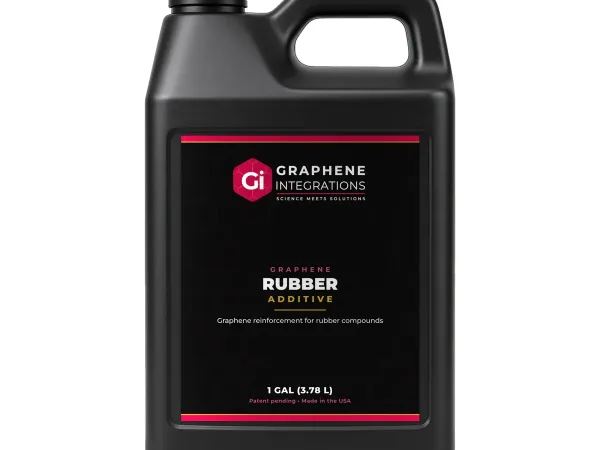
A graphene additive for rubber compounds, supplied pre-dispersed for mixing into your compound.
- Category
- Polymers & Composites
- Application
- Tire, belt, hose and other industrial rubber compounds, evaluated against your current compound.
- Carrier
- Carrier matched to your compound; see the technical data sheet.
- Typical dose
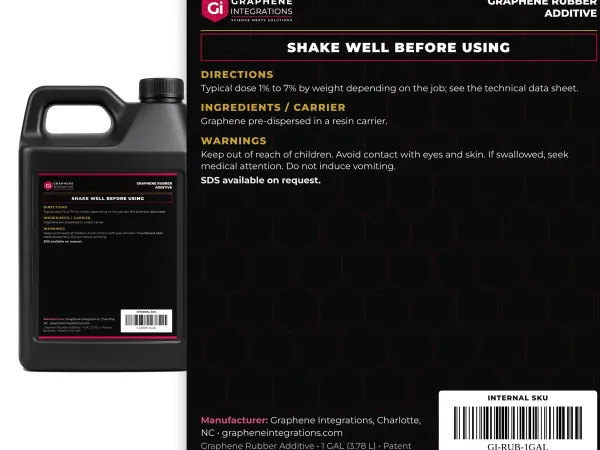
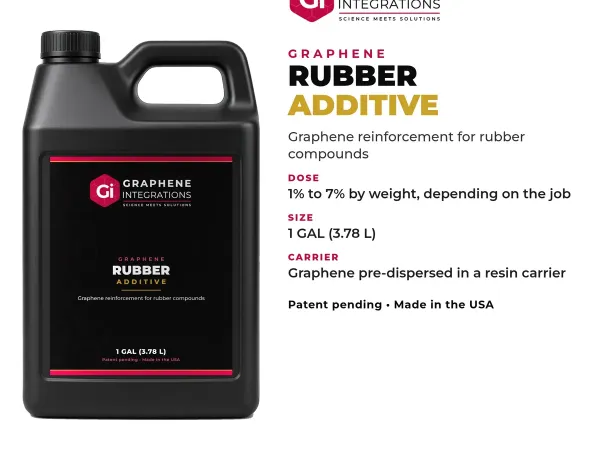
- 1–7% by weight, depending on the application. See the technical data sheet.
- SKU
- GI-RUB-1GAL (1 gal jug)
GI-RUB-5GAL (5 gal pail)
Sizes: 1 gal jug, 5 gal pail
Request a quote for pricing, lead time and the right dose for your job.
Downloads
Learn more — Graphene Rubber: What Graphene Does in Tires, Belts, Hoses and Seals →
Patent pending. Made in the USA. Manufacturer: Graphene Integrations, Charlotte, NC.
About this additive
Rubber compounds balance wear, grip, heat build-up and processing. Graphene is evaluated in rubber as a reinforcing additive. We supply it pre-dispersed so it goes into your mixing process without loose powder. See also graphene in polymers and composites.
Benefits are evaluated in your formulation, against your own baseline. We suggest a starting dispersion, supply samples by quote, and you test against your current material. See graphene dispersions for the carriers we work with.
Assess the whole rubber compound under cyclic duty
A graphene rubber additive is evaluated within the existing filler, elastomer and cure system. Published graphene-oxide/natural-rubber fatigue work illustrates why dispersion and cyclic behavior matter; graphene oxide is a different material and its results are not GI rubber performance data.
Confirm the supplied-additive dose and carrier against the compound recipe. Compare cure behavior, viscosity, hardness, tensile and tear properties, abrasion, fatigue and heat build-up under the intended loading. Retain the sealing, grip or flexibility requirements that make the part useful.
Longer replacement intervals or lower operating losses are opportunities to test, not automatic outcomes. Build the resource comparison from measured part life, scrap, processing energy and any operating-energy change, with additive/carrier production and disposal included. A bench property does not directly establish tire fuel savings or a product-specific CO₂ reduction.
Research / measurement reference · Continue with the application guide
Frequently asked questions
What results can you share for rubber?
We do not publish general rubber results. Benefits are evaluated in your formulation, against your own compound.
Is it suitable for tire compounds?
It is intended for evaluation in tire and industrial rubber compounds; suitability is confirmed by testing in your compound.
Is the graphene supplied as a powder?
No. It is supplied pre-dispersed in a carrier, never as dry powder.
How much should I add?
Typical dose: 1–7% by weight, depending on the application. See the technical data sheet.
More in Polymers & Composites
-

Graphene Plastic Additive
A graphene additive for plastics, supplied pre-dispersed in resin for compounding. View product -

Graphene 3D Printing Filament Additive
A graphene additive for 3D printing filament makers, pre-dispersed in resin for compounding. View product -

Graphene Textile Additive
A graphene additive for textiles, pre-dispersed for fabric finishes, coatings and fiber development. View product -

Graphene Motor Oil Additive
A graphene additive for motor oils, supplied pre-mixed in an oil-based carrier so it blends straight into your oil. View product -

Graphene Gear Oil Additive
A graphene additive for gear oils, pre-mixed in an oil-based carrier for heavily loaded gear contacts. View product -

Graphene Hydraulic Fluid Additive
A graphene additive for hydraulic fluids, pre-mixed in an oil-based carrier for pumps, valves and cylinders. View product