



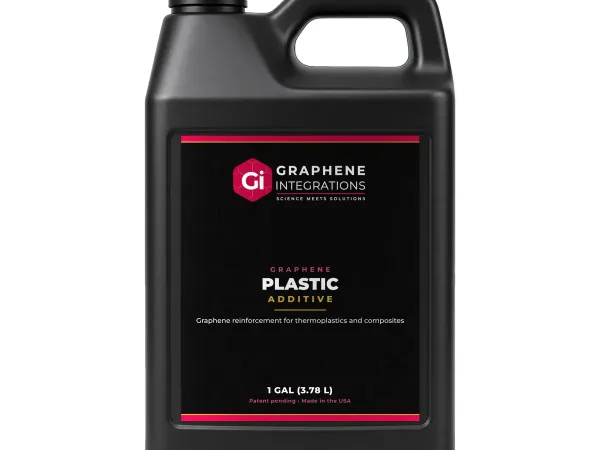
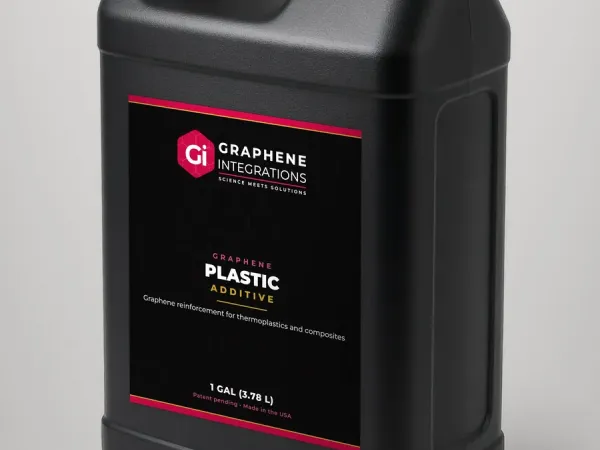
Graphene Plastic Additive
A graphene additive for plastics, supplied pre-dispersed in resin for compounding.
- Category
- Polymers & Composites
- Application
- Thermoplastic and thermoset compounds where you want to evaluate mechanical or barrier properties against your baseline.
- Carrier
- Resin dispersion matched to your polymer.
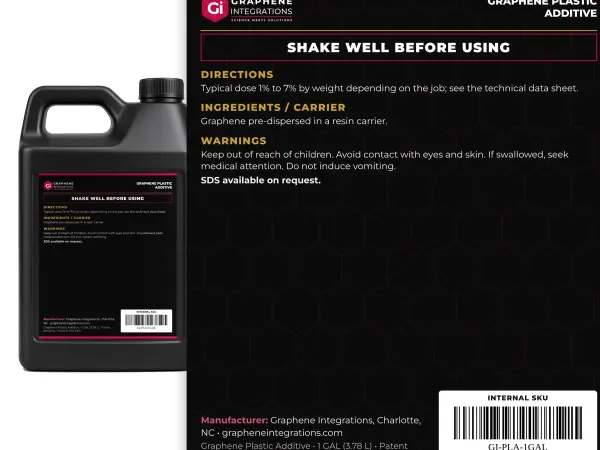
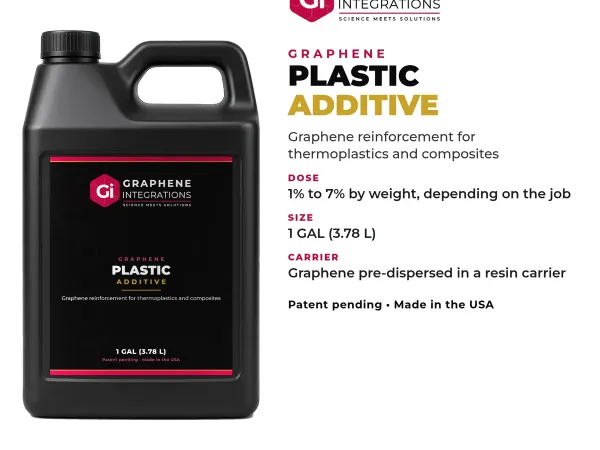
- Typical dose
- 1–7% by weight, depending on the application. See the technical data sheet.
- SKU
- GI-PLA-1GAL (1 gal jug)
GI-PLA-5GAL (5 gal pail)
Sizes: 1 gal jug, 5 gal pail
Request a quote for pricing, lead time and the right dose for your job.
Downloads
Learn more — Graphene Plastic: How Graphene Is Added to Plastics and What It Can Change →
Patent pending. Made in the USA. Manufacturer: Graphene Integrations, Charlotte, NC.
About this additive
Graphene is added to a polymer to work on properties such as stiffness and toughness. We supply it already dispersed in resin, so it goes into your compounding process as a liquid concentrate. Learn about our work in graphene polymer composites.
Benefits are evaluated in your formulation, against your own baseline. We suggest a starting dispersion, supply samples by quote, and you test against your current material. See graphene dispersions for the carriers we work with.
Match material performance before claiming material efficiency
Graphene offers a route to investigate reinforcement and thermal or electrical networks in a polymer. Primary epoxy research shows how matrix interaction and filler structure affect performance; different grades, polymers and processing cannot be assumed to reproduce those results.
Select the supplied-additive dose for the actual resin and process. Compare equivalent parts or coupons using the same conditioning, geometry and test direction, recording dispersion, viscosity, cure or melt behavior and relevant mechanical properties. A structural or armor application still needs its own qualification.
Potential material efficiency requires a design that meets the same requirements—not simply a stronger coupon. Track accepted-part mass, production yield, processing energy and repair or replacement, then include additive, carrier, transport and end-of-life. Improved material properties alone do not establish lightweighting, recyclability or a measured GI carbon saving.
Research / measurement reference · Continue with the application guide
Frequently asked questions
What improvement should I expect?
We do not publish general results for plastics. Benefits are evaluated in your formulation, against your own baseline.
How is it supplied?
Pre-dispersed in a resin carrier matched to your polymer, never as dry powder.
How much should I add?
Typical dose: 1–7% by weight, depending on the application. See the technical data sheet. Ask us for a starting loading for your trial.
Can I get a sample?
Yes. Samples are available by quote for evaluation in your compound.
More in Polymers & Composites
-

Graphene Rubber Additive
A graphene additive for rubber compounds, supplied pre-dispersed for mixing into your compound. View product -

Graphene 3D Printing Filament Additive
A graphene additive for 3D printing filament makers, pre-dispersed in resin for compounding. View product -

Graphene Textile Additive
A graphene additive for textiles, pre-dispersed for fabric finishes, coatings and fiber development. View product -

Graphene Motor Oil Additive
A graphene additive for motor oils, supplied pre-mixed in an oil-based carrier so it blends straight into your oil. View product -

Graphene Gear Oil Additive
A graphene additive for gear oils, pre-mixed in an oil-based carrier for heavily loaded gear contacts. View product -

Graphene Hydraulic Fluid Additive
A graphene additive for hydraulic fluids, pre-mixed in an oil-based carrier for pumps, valves and cylinders. View product