
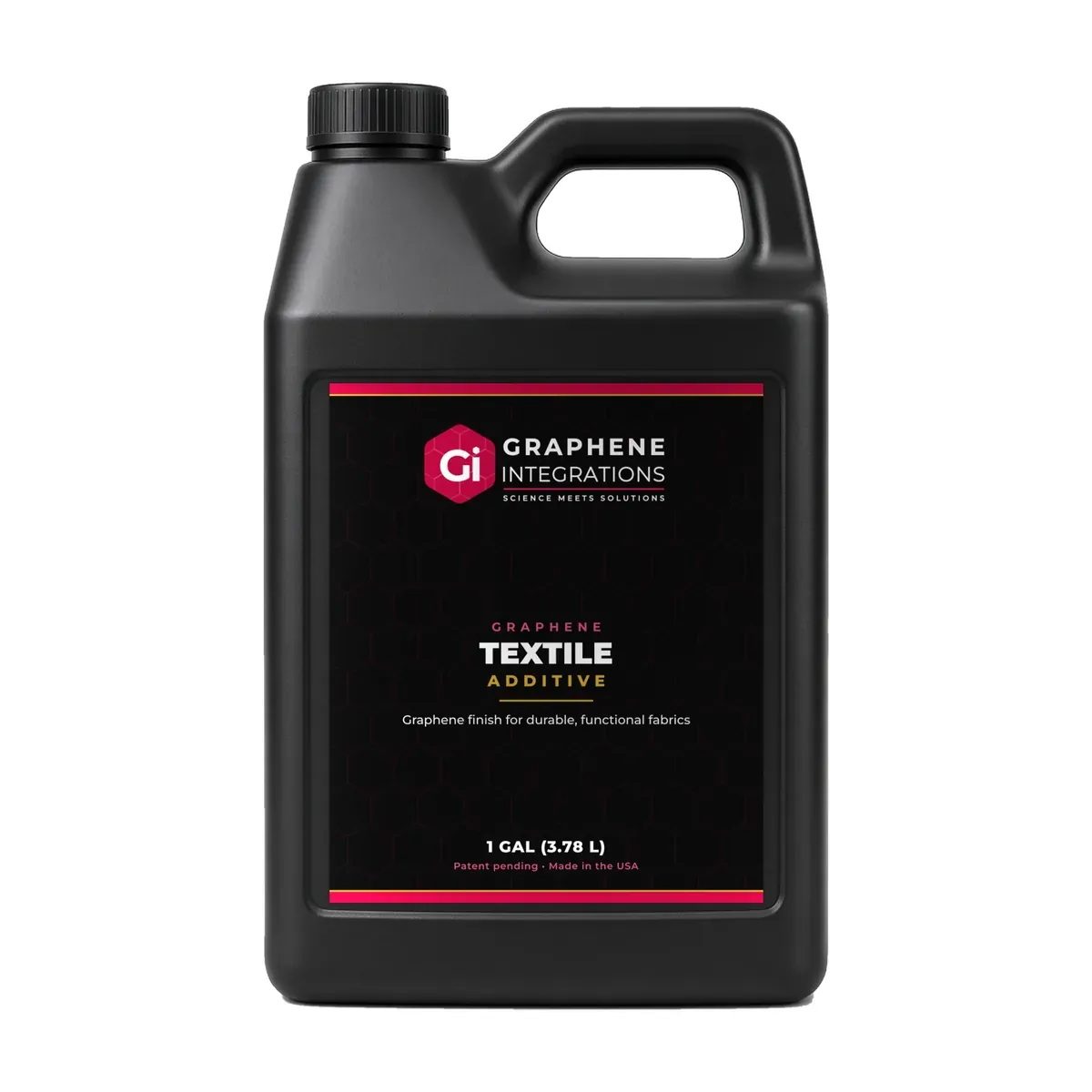
Shop: see sizes, SKUs and the spec sheet for the Graphene Textile Additive in our store, or browse all graphene products.
Graphene textiles have moved from the lab into jackets, sportswear, bedding and technical fabrics. Brands use graphene for heat spreading, static control, conductive "smart" fabrics and tougher coatings. This article explains what a graphene textile is, what graphene can add to a fabric, the main ways it is applied, and how a mill or coater can add graphene without handling powder.
What is a graphene textile?
A graphene textile is a fabric or fiber that carries graphene. There are three main routes:
- Coating or printing graphene onto the fabric surface, for example in a back-coating or a printed pattern.
- Finishing or dyeing, where graphene is applied from a water bath and fixed to the fibers.
- Fiber, where graphene is mixed into the polymer before the fiber is spun.
Reviews of graphene-enhanced textiles describe all three, each with its own trade-offs in feel, durability and cost (Textiles, MDPI; Coatings, MDPI).
What graphene can add to fabric
Published research and products point to several functions:
- Heat spreading and thermal comfort, from graphene's thermal conductivity.
- Antistatic and conductive fabrics, including heating elements and sensors in smart textiles.
- Abrasion and tear resistance in coated technical fabrics.
- Barrier and UV resistance in coatings.
Graphene Integrations does not publish test numbers for textiles. Each result is evaluated against the customer's current fabric.
What to watch for
Wash durability is the big question for any finish: does the effect survive laundering and abrasion? Hand feel and colour matter too, since graphene is black and will grey white or light fabrics. And as in every application, uneven dispersion gives uneven results across the roll.
How our Graphene Textile Additive works
The Graphene Textile Additive is graphene pre-dispersed for fabric finishes, coatings and fiber development. It goes into your finish, coating compound or polymer as a liquid, so there is no powder to dust or wet out.
- For: technical textile finishes and coatings, and fiber development.
- Carrier: water-based or resin dispersion matched to your finishing process.
- Dose: typically 1% to 7% by weight, depending on the application.
- Mixing: stir into your finish or coating compound until uniform and apply with your normal pad, knife or coating line; for fiber, add during polymer compounding.
- Made in the USA in Charlotte, NC. Patent pending. No carbon black. Never sold as a powder.
Choosing the right application route
Coating and printing are the fastest way to try graphene, because they fit existing finishing lines and only treat the surface where the function is needed. Bath finishing and dyeing give a softer hand but need good fixing to survive washing. Fiber spinning gives the most durable result, since the graphene is inside the fiber, but it is a longer development path and needs a resin carrier matched to the fiber polymer. We match the carrier to your route: water-based for finishes and many coatings, resin for coating compounds and fiber development.
What is a graphene additive?
A graphene additive is a product that brings graphene into another material at a low dose, the way a pigment or a reinforcing filler does. The graphene is the active part. The carrier around it decides whether it mixes into your product cleanly.
Why a pre-dispersed liquid beats powder. Dry graphene powder is light and dusty, hard to wet out, and its flakes tend to clump back together. Clumps act like defects, so a powder can make a product worse instead of better. Our graphene additives are supplied as liquids with the flakes already separated in a carrier matched to your system, so they mix in with the equipment you already run and there is no fine dust to manage. We never sell powder.
Dosing. Our graphene additives are typically used at 1% to 7% by weight, depending on the job. More is not automatically better, so a trial should bracket two or three doses.
Trialing. Compare against a baseline you already make, change only the additive dose, and run the tests your customers use. Our guide on how to run a graphene additive trial and our guide to choosing a graphene additive go into more detail.
How to run a fabric trial
- Pick a current fabric and finish with known test data as the baseline.
- Tell us the fiber, the finish or coating chemistry and the property you want to add.
- Apply the baseline and two or three doses within 1% to 7% on the same line settings.
- Check hand, colour and add-on weight.
- Test the target property before and after the number of wash cycles your customers expect, plus abrasion and any thermal or resistance tests.
Where graphene textiles are used
Outdoor and workwear, sportswear, bedding, protective clothing, coated industrial fabrics, filtration media and smart textiles with heating or sensing functions are all active areas.
For finishing detail, read how mills add graphene to fabric finishes and coatings, or browse our textiles products.
Frequently asked questions
What is a graphene textile?
A fabric or fiber that carries graphene, applied by coating, printing, finishing or by mixing it into the fiber polymer.
What does graphene do in fabric?
It can help heat spreading, static control, conductivity and coating toughness. Results depend on the fabric and the finish.
Does a graphene finish survive washing?
That depends on the finish and fixing. Always test before and after the wash cycles your customers expect.
How much graphene textile additive do I use?
Typically 1% to 7% by weight, depending on the application.
Can I buy the Graphene Textile Additive online?
Yes. It is listed in our store. Pricing is by quote.
Get the Graphene Textile Additive
Ready to test graphene in your own product? Go to the Graphene Textile Additive store page for sizes, SKUs, the spec sheet and SDS, or browse the full graphene store. Pricing and samples are by quote. Call 704-659-3682 or request a quote, samples or a spec sheet / SDS.


