
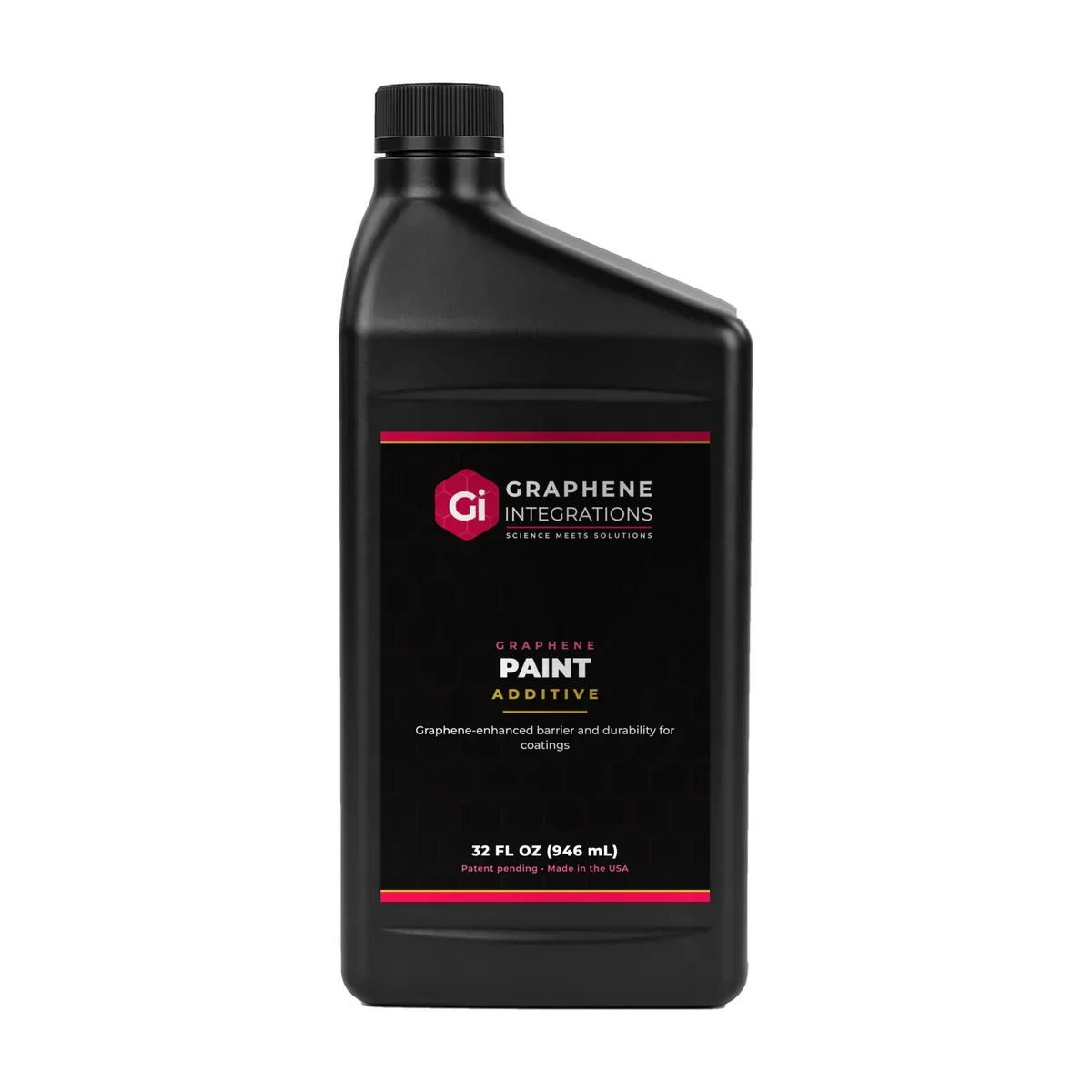
Shop: see sizes, SKUs and the spec sheet for the Graphene Paint Additive in our store, or browse all graphene products.
"Graphene paint" is one of those phrases that means different things to different people. For a homeowner it usually means a wall paint sold with graphene on the label. For a coatings company it means a primer, protective coating or sealer with graphene added to the formula. This article covers both: what graphene paint is, what graphene can realistically do in a paint film, what to be careful about, and how a paint maker adds graphene without handling powder.
What is graphene paint?
Graphene is a sheet of carbon one atom thick. In a paint, it is not one continuous sheet. It is a very large number of tiny, thin flakes spread through the binder. "Graphene paint" simply means a coating that contains those flakes. The base can be a water-based acrylic, a solvent-based alkyd, a two-component epoxy, a lime or mineral paint, or almost anything else. The graphene is an additive, like a pigment or a filler, and the rest of the paint still does most of the work.
That is why two "graphene paints" can behave very differently. What matters is how much graphene is in the film, how thin and well separated the flakes are, and whether the rest of the formula was designed around them.
What graphene can do in a coating
Published research points to a few main reasons formulators look at graphene:
- Barrier. A perfect graphene sheet does not even let helium through (Bunch et al., Nano Letters). In a film, well-dispersed flakes lying roughly parallel to the surface make the path for water, oxygen and salts longer and more winding. That is the idea behind graphene anti-corrosion primers.
- Corrosion protection on steel, mainly as a result of that barrier effect.
- Scratch and wear resistance, building on graphene's strength.
- Conductivity for antistatic or specialty coatings, which usually needs higher loadings and careful formulation.
These are things graphene is designed to help with, not guaranteed results. Graphene Integrations has not published coating test numbers. Every result is measured against the customer's own coating.
What to be careful about
Independent work shows why testing matters. One study added a commercial graphene additive to a commercial primer and found better barrier performance in salt spray, but also side effects that reduced other functions of the coating (Materials and Corrosion). Reviews make the same point: dispersion, flake orientation, adhesion and film integrity decide whether graphene helps (Coatings, MDPI). Badly dispersed graphene can create defects instead of closing them.
Two practical points also come up again and again:
- Colour. Graphene is black. At additive loadings it greys white and pastel tints. Primers, dark colours and protective systems are the easiest place to start.
- Dust and dispersion. Dry graphene powder is light, dusty and hard to wet out. Getting it into a paint evenly is the hard part.
Graphene paint for homeowners vs. paint makers
If you are a homeowner, the honest advice is to judge a graphene wall paint like any other paint: coverage, washability, the manufacturer's data and your own experience. The word "graphene" on its own does not tell you much.
If you make paint, the question is different: will graphene improve your coating, at what dose, and at what cost? That is the customer our product is built for.
How our Graphene Paint Additive works
The Graphene Paint Additive is graphene pre-dispersed in the carrier your coating already uses: solvent, water or resin. Because it arrives as a liquid, there is no powder to wet out and no dust to manage.
- Coatings: architectural paints, protective and industrial coatings, primers and sealers.
- Carrier: solvent, water or resin dispersion matched to your coating.
- Dose: typically 1% to 7% by weight, depending on the job.
- Mixing: shake or stir the container, add at the let-down stage or the point we recommend, and mix until uniform with your normal equipment.
- Sizes: 32 fl oz bottles, 1 gallon jugs and 5 gallon pails.
- Made in the USA in Charlotte, NC. Patent pending. No carbon black. Never sold as a powder.
What is a graphene additive?
A graphene additive is a product that brings graphene into another material at a low dose, the way a pigment or a reinforcing filler does. The graphene is the active part. The carrier around it decides whether it mixes into your product cleanly.
Why a pre-dispersed liquid beats powder. Dry graphene powder is light and dusty, hard to wet out, and its flakes tend to clump back together. Clumps act like defects, so a powder can make a product worse instead of better. Our graphene additives are supplied as liquids with the flakes already separated in a carrier matched to your system, so they mix in with the equipment you already run and there is no fine dust to manage. We never sell powder.
Dosing. Our graphene additives are typically used at 1% to 7% by weight, depending on the job. More is not automatically better, so a trial should bracket two or three doses.
Trialing. Compare against a baseline you already make, change only the additive dose, and run the tests your customers use. Our guide on how to run a graphene additive trial and our guide to choosing a graphene additive go into more detail.
How to test it
- Pick a baseline coating with known performance data.
- Tell us the binder, the solvent or water, and how you disperse today, so we can match the carrier.
- Make side-by-side batches at two or three doses within 1% to 7%, keeping everything else the same.
- Check the liquid paint: viscosity, fineness of grind and storage stability.
- Check the film: appearance, gloss, colour and adhesion.
- Run the exposure tests your customers use, such as salt spray, humidity or weathering, on panels prepared the same way.
For a deeper formulator's view, read our graphene paint additive guide for barrier and protective coatings, or see the graphene coatings page.
Frequently asked questions
Is graphene paint real?
Yes. Graphene paint is a coating that contains graphene flakes as an additive. How well it performs depends on the rest of the formula and how well the graphene is dispersed.
What does graphene do in paint?
Well-dispersed graphene flakes are designed to lengthen the path that water, oxygen and salts take through the film, which can help barrier and corrosion protection. Results depend on the formulation.
Does graphene change the colour of paint?
Yes. Graphene is black and greys light colours. Primers and dark coatings are the easiest place to start.
How much graphene paint additive do I add?
Typically 1% to 7% by weight, depending on the job, in a carrier matched to your coating.
Can I buy the Graphene Paint Additive online?
Yes. The Graphene Paint Additive is listed in our store in 32 fl oz, 1 gallon and 5 gallon sizes. Pricing is by quote.
Get the Graphene Paint Additive
Ready to test graphene in your own product? Go to the Graphene Paint Additive store page for sizes, SKUs, the spec sheet and SDS, or browse the full graphene store. Pricing and samples are by quote. Call 704-659-3682 or request a quote, samples or a spec sheet / SDS.


