
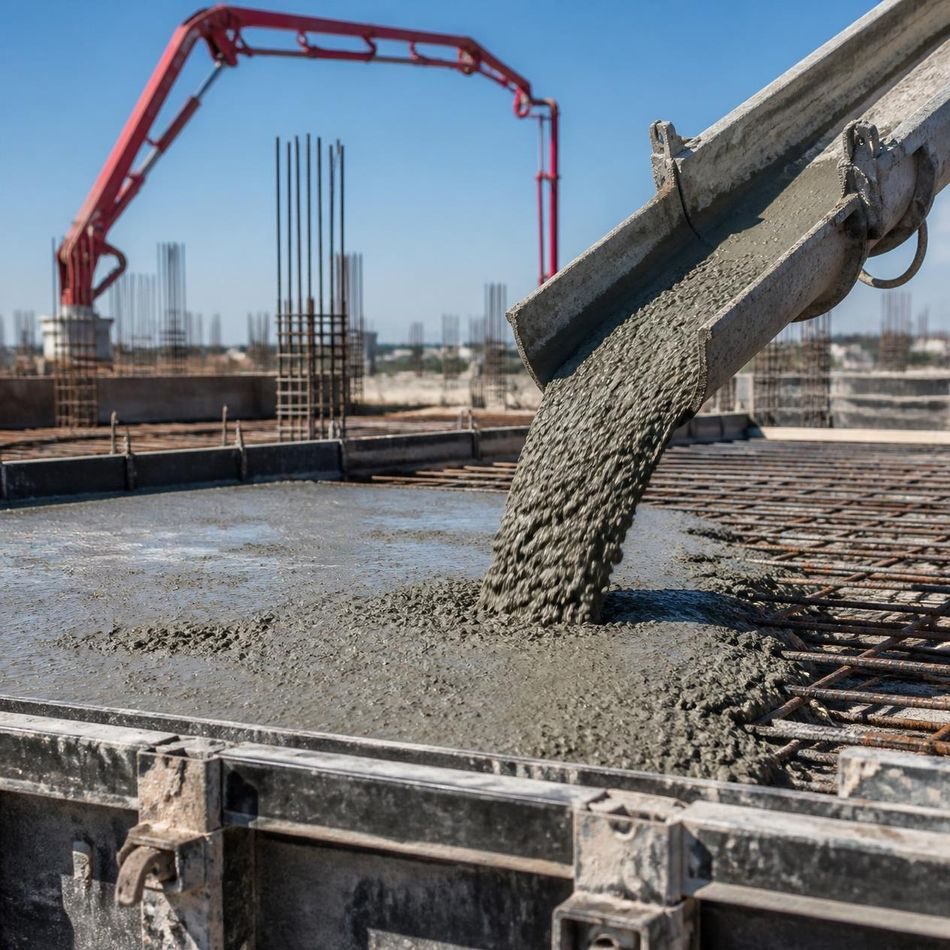
Contractors and producers who hear about graphene concrete usually ask the same question: where does it actually make sense? Not every pour needs a performance additive. This article looks at the applications where our NanoTechCrete graphene concrete additive is most relevant, what our testing shows, and how to trial it. For the mechanism, read how the graphene concrete additive works; for mix adjustments, read our mix design guide.
What our testing shows
- Compressive strength: independent third-party testing in 2023 showed a 67.7% increase in compressive strength at 5% by weight of cement.
- Water resistance: NanoTechCrete increases water resistance by 25%.
Results in your mix will depend on cement, aggregates, water-cement ratio and curing, so a trial batch with cylinders tested to ASTM C39 is always the first step.
Applications where it fits
Slabs and flatwork
Industrial floors, warehouse slabs and driveways take repeated loads and are exposed to water. Higher compressive strength and water resistance are relevant to both. The additive is a liquid, so it goes in with the mix water using normal batching.
Precast and prestressed products
Precast plants control their mixes and curing closely, which makes them a good setting for a measured trial. Strength gain matters for stripping and handling schedules as well as final strength. Test early-age strength as well as 28-day strength.
Marine and water-exposed structures
Sea walls, docks, culverts, water tanks and foundations in wet ground all face water and dissolved salts. Concrete that resists water penetration helps protect the reinforcement inside. Our 25% water resistance result is most relevant here.
Repairs and overlays
Repair mortars and overlays are often thin and exposed. Check compatibility with your repair system and bonding agents, and test with the product you actually use.
Where to wait
For structural elements designed to code, any change to the mix should go through the engineer of record and the normal submittal process. Use your trial data to support that conversation.
Dosing and handling
- Dose: 5% by weight of cement.
- Form: pre-mixed liquid; no powder to handle.
- Water: the additive contains water, so reduce batch water to keep the same water-cement ratio. Our mixing instructions explain how.
- Status: patent pending, made in the USA in Charlotte, NC, no carbon black.
A trial plan for producers and contractors
- Pick one mix you pour often and have strength data for.
- Batch a control and a treated mix the same day, with the same materials and the water adjusted for the additive.
- Test fresh properties: slump, air content and temperature.
- Cast cylinders and cure them the same way.
- Break at 7 and 28 days (and at early ages if stripping time matters).
- Add a water test if water exposure is the reason you are interested, using the method your specifications require.
- Compare and decide. If the data supports it, move to a non-critical placement before wider use.
"Break the cylinders. If our numbers hold up in your mix, you'll see it; if they don't, you've lost one trial batch." — Frans Alkemade
Questions to answer before you pour
- What is the goal? Higher strength, better water resistance or both. This decides which tests matter.
- What is your current mix? Cement type and content, supplementary materials such as fly ash or slag, aggregates, admixtures and water-cement ratio.
- How do you batch? Ready-mix truck, central mixer or site mixer. The additive goes in with the mix water in each case.
- How is it cured? Curing has a large effect on both strength and permeability, so keep it identical between control and treated batches.
- Who signs off? For specified work, involve the engineer and the testing lab early.
Admixture compatibility
Most mixes already contain admixtures such as water reducers, air entrainers or retarders. Tell us what you use. In a trial, keep admixture doses the same as the control at first, then adjust only if fresh properties such as slump or air content move outside your limits. Record every adjustment so the strength results can be read correctly.
Related reading
For the future of reinforcement, see why we are developing graphene composite rebar, and for the wider industry, graphene's use in construction.
Read the concrete strength results and the NanoTechCrete press release, see the graphene concrete page, or request a quote and samples.
Frequently asked questions
Where is graphene concrete most useful?
Slabs, precast, marine and water-exposed structures and repairs, where strength and water resistance matter.
How much NanoTechCrete do I add?
5% by weight of cement, with the batch water reduced to keep the same water-cement ratio.
What results has NanoTechCrete shown?
Independent third-party testing in 2023 showed a 67.7% increase in compressive strength at 5% by weight of cement, and it increases water resistance by 25%.
Can I use it in structural concrete?
Any change to a structural mix should go through the engineer of record. Use trial data to support that review.
Does NanoTechCrete work with my admixtures?
Tell us which admixtures you use. In a trial, keep their doses the same as your control and adjust only if fresh properties move outside your limits.
Request a quote, samples or a spec sheet
Tell us your material, the property you want to improve, the carrier you use (water, solvent, resin or oil) and your volumes. Pricing and samples are by quote. Call 704-659-3682 or request a quote, samples or a spec sheet / SDS.


