
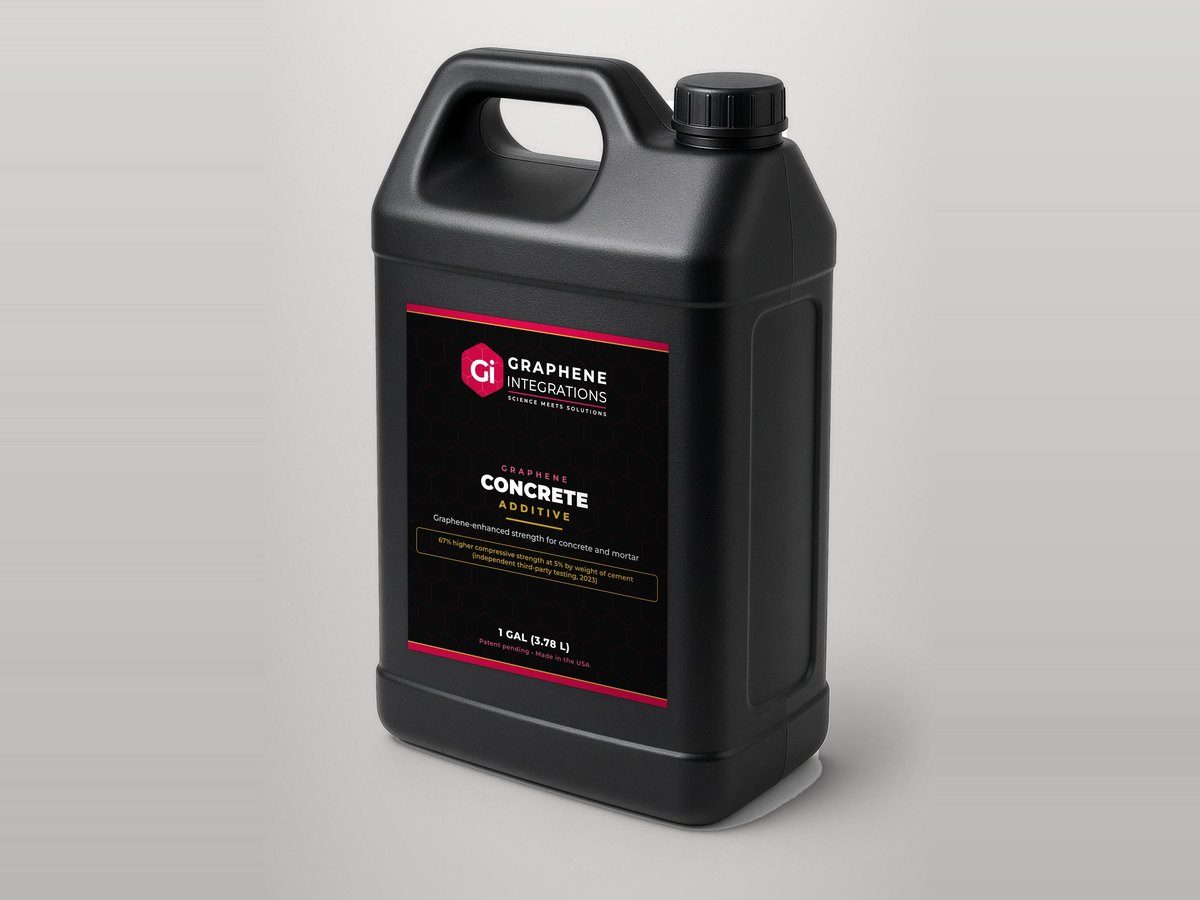
The most common mistake with a liquid concrete additive is not the dose. It is the water. NanoTechCrete, our graphene concrete additive, is a water-based liquid, so every pound you add is also a pound of liquid in the mix. If you keep your usual water and pour the additive on top, the mix comes out wetter than designed, and a wetter mix is a weaker mix. This article explains how NanoTechCrete fits into a mix design, why the water has to come down, and what to check on the first batch. The step-by-step tables are on our mixing instructions page; this is the reasoning behind them.
The two numbers that matter
NanoTechCrete mix design comes down to two simple rules:
- Dose: NanoTechCrete weight = cement weight × 0.05. That is 5% of the cement, not 5% of the whole mix, and not 5% of the water.
- Total liquid: water plus NanoTechCrete = cement weight × 0.45.
So the water you add is the total liquid minus the NanoTechCrete weight. NanoTechCrete weighs about 8.6 lb per gallon, a little more than water, so weigh it rather than measuring by volume whenever you can.
Why the water has to come down
Concrete strength is driven largely by the water-cement ratio. More water per pound of cement leaves more pore space once the excess water leaves the hardened paste, and that porosity lowers strength and raises permeability. Concrete technologists have relied on this relationship for about a century, and it is why ready-mix producers control water so tightly.
Because NanoTechCrete is mostly liquid, it has to be counted as part of the mix water. Keep the total liquid at 0.45 times the cement weight and you keep the water-cement ratio the mix was designed around. That is also the condition under which our results were measured: at 5% by weight of cement, the graphene concentrate gave a 67.7% increase in compressive strength in independent third-party testing in 2023, and concrete with 5% graphene increased water resistance by 25%.
Worked example: one cubic yard
Take a 1:2:3 mix with 670 lb of Portland cement per cubic yard.
- NanoTechCrete: 670 × 0.05 = 33.5 lb (about 3.9 gal).
- Total liquid: 670 × 0.45 = 301.5 lb.
- Water to add: 301.5 − 33.5 = 268 lb (about 32 gal), instead of 301.5 lb (about 36 gal) without the additive.
Sand and stone stay the same. Only the water changes. The same rule works at any size: 10 lb of cement takes 0.5 lb of NanoTechCrete and 4.0 lb of water. For a 94 lb bag of Portland cement, that is 4.7 lb of NanoTechCrete and 37.6 lb of water.
Premixed bags
Bagged concrete does not print its cement content, so our premixed-bag numbers are an estimate that assumes cement is about one sixth of the bag. For an 80 lb bag that is about 0.67 lb (302 g) of NanoTechCrete; for a 50 lb bag about 0.42 lb (189 g). If the bag gives its own water amount, use that amount and subtract the NanoTechCrete weight.
Order of addition
NanoTechCrete goes into the water, not onto the dry mix.
- Measure the reduced mix water.
- Stir the NanoTechCrete into all of the mix water until the colour is even.
- Add that liquid to the dry materials.
- Mix for 5 to 10 minutes, scraping the sides and bottom once.
- Place, finish and keep the concrete damp while it cures.
Spreading the graphene through all of the water first is what gets it evenly through the paste. Dumping a concentrated dose into one corner of the drum is the second most common mistake after the water.
What to check on the first batch
- Workability: run a slump test on the trial batch and on your control batch. If the NanoTechCrete batch looks stiffer or wetter than expected, check the water arithmetic before you change anything else.
- Other admixtures: if you use water reducers, air entrainers or accelerators, keep their doses the same for the first comparison and note them on the batch ticket. Changing two things at once makes the result impossible to read.
- Specimens: cast cylinders or cubes from both batches with the same materials and curing. Compressive strength of cylinders is normally tested to ASTM C39/C39M.
- Ages: break at the ages you normally test, such as 7 and 28 days, so the results slot into your existing records.
Results depend on the cement, aggregates, water-cement ratio and curing. Any change to a structural mix design, or to the amount of concrete in a project, should be confirmed by the project engineer with testing on that mix.
What NanoTechCrete is, and is not
NanoTechCrete is graphene pre-mixed in a water-compatible liquid. There is no powder to handle and no new equipment to buy. It is made in the USA, patent pending and contains no carbon black. It is an additive for the concrete itself. Graphene rebar is a separate project that is in development and not a product.
For the science behind the additive, read graphene concrete additive: how it works and what we tested. For the launch details, see the NanoTechCrete press release and the graphene concrete additive page.
"The water adjustment is the whole trick. Get that right and the rest of the mix is the one you already know." — Frans Alkemade
Frequently asked questions
How much NanoTechCrete do I add to concrete?
5% of the cement weight. For one cubic yard with 670 lb of cement, that is 33.5 lb, about 3.9 gallons.
Do I need to reduce the water?
Yes. NanoTechCrete is water-based, so keep total liquid at 0.45 times the cement weight and subtract the NanoTechCrete weight from your mix water.
Can I add NanoTechCrete to the dry mix?
No. Stir it into all of the mix water first until the colour is even, then add the liquid to the dry materials and mix for 5 to 10 minutes.
What results has NanoTechCrete shown?
At 5% by weight of cement, a 67.7% increase in compressive strength in independent third-party testing in 2023, and concrete with 5% graphene increased water resistance by 25%. Test it in your own mix.
Request a quote, samples or a spec sheet
Tell us your material, the property you want to improve, the carrier you use (water, solvent, resin or oil) and your volumes. Pricing and samples are by quote. Call 704-659-3682 or request a quote, samples or a spec sheet / SDS.
Concrete strength and embodied carbon
Cement is the binder in concrete. Its production releases CO₂ through limestone conversion and energy use, as explained by the IEA. That makes cement quantity an important part of a concrete carbon assessment.
GI’s additive achieved +67.7% compressive strength in third-party testing at the tested 5% supplied-additive dose by cement weight, not 5% pure graphene. This validated strength result supports investigating lower-cement mixes; it does not establish how much cement can be removed. Candidate mixes must meet the same required performance.
Conditional example: if 100 kg of Portland cement is actually avoided at the same required performance, gross avoided cement A1–A3 impact is 100 × 0.919 = 91.9 kg CO₂e. The 100 kg is an example assumption, not a reduction demonstrated by GI. The official US industry-average Portland cement EPD, revised July 2026, Table 4, gives 0.919 kg CO₂e/kg using 2019 production data, covering A1–A3, raw materials through manufacturing—not a current-year plant measurement or whole-life concrete footprint. CO₂e means carbon dioxide equivalent.
This is gross avoided cement-production impact, not measured GI net savings. Net savings require matched-performance mix validation and a consistent lifecycle comparison including additive manufacture, carrier, packaging, transport and all changed mix inputs. Unknown additive impacts are not zero. The strength result does not automatically establish cement reduction, longer service life or carbon capture.


