
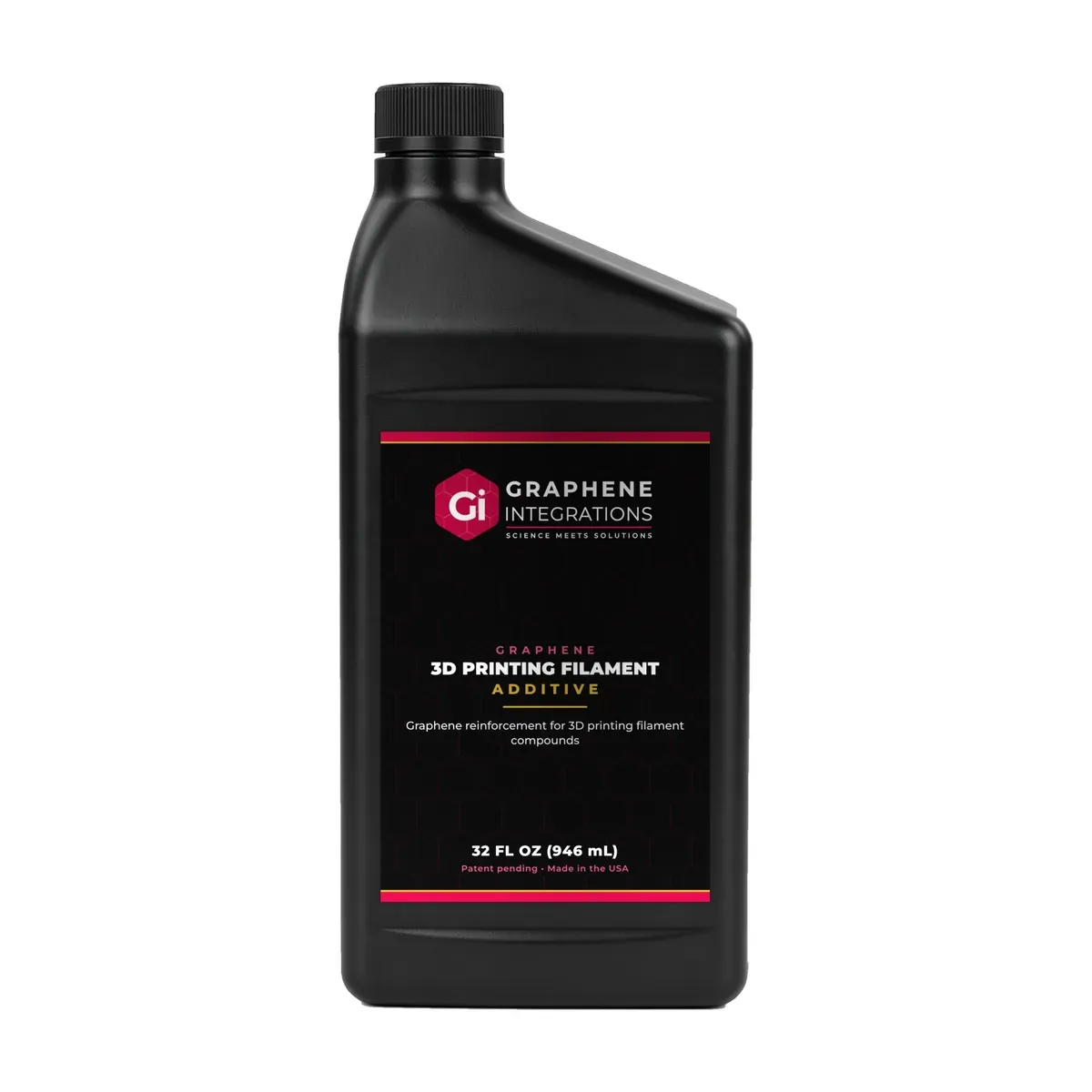
Shop: see sizes, SKUs and the spec sheet for the Graphene 3D Printing Filament Additive in our store, or browse all graphene products.
Graphene 3D printing usually means printing with a filament that has graphene mixed into the plastic. You can buy graphene PLA, PETG, ASA and nylon filaments today, sold for stronger parts, static-safe parts or printed sensors. This article explains what graphene filament is, what graphene can do in a printed part, how graphene gets into filament in the first place, and how filament makers can add it.
What is graphene 3D printing?
Most graphene 3D printing happens on ordinary FDM printers. The graphene is inside the filament, compounded into the polymer before the filament is extruded and spooled. To the printer it is just another filament, though some grades print a little differently from the neat polymer.
Graphene also appears in resins for SLA and in powders for SLS, but filament is by far the most common form.
What graphene can do in a printed part
Commercial graphene filaments are sold for two main reasons:
- Mechanical: stiffer, stronger parts and, in some products, better layer-to-layer bonding, which is the weak point of most FDM parts.
- Electrical: antistatic (ESD-safe) fixtures and housings, and conductive traces or touch sensors printed straight into a part.
Some makers also point to better heat resistance and thermal conductivity. Research on graphene polymer composites supports these directions in general terms, but the size of any gain depends on the polymer, the graphene, the dose and above all the dispersion. Graphene Integrations does not publish test numbers for filament. Each result is evaluated against the customer's current filament.
How graphene gets into filament
Filament makers compound graphene into the polymer on a twin-screw extruder, pelletize, then extrude the filament. The hard part is getting the flakes apart and spread evenly. Clumps cause weak spots, diameter variation and nozzle clogs. Dry graphene powder is also dusty and difficult to feed consistently.
Three things matter most for a good graphene filament:
- Dispersion, so the flakes are separated and evenly spread.
- Dose, since too little does nothing and too much can make filament brittle or hard to print.
- Diameter control and moisture, the same as any filament.
How our Graphene 3D Printing Filament Additive works
The Graphene 3D Printing Filament Additive is graphene pre-dispersed in resin for compounding into your filament polymer. You add a liquid during compounding instead of handling powder.
- For: filament makers compounding PLA, PETG, ABS or nylon before extrusion.
- Carrier: resin dispersion for compounding into your filament polymer.
- Dose: typically 1% to 7% by weight, depending on the application.
- Mixing: add during compounding at the point we recommend, then pelletize and extrude as normal.
- Made in the USA in Charlotte, NC. Patent pending. No carbon black. Never sold as a powder.
This is an additive for filament makers, not a finished spool for a desktop printer.
Graphene vs. carbon fiber and carbon black filaments
Carbon fiber filled filaments are the usual choice for stiff, light printed parts, and carbon black filled filaments are common for conductive and ESD-safe prints. Both have trade-offs. Chopped fiber is abrasive and wears brass nozzles, and conductive carbon black grades can be brittle at the loadings needed for low resistance. Graphene is studied because its flakes can form a network at lower loadings and may help layer bonding, but the result depends on the dose and the dispersion. Our additives contain no carbon black, so any change you measure comes from the graphene and the carrier.
What is a graphene additive?
A graphene additive is a product that brings graphene into another material at a low dose, the way a pigment or a reinforcing filler does. The graphene is the active part. The carrier around it decides whether it mixes into your product cleanly.
Why a pre-dispersed liquid beats powder. Dry graphene powder is light and dusty, hard to wet out, and its flakes tend to clump back together. Clumps act like defects, so a powder can make a product worse instead of better. Our graphene additives are supplied as liquids with the flakes already separated in a carrier matched to your system, so they mix in with the equipment you already run and there is no fine dust to manage. We never sell powder.
Dosing. Our graphene additives are typically used at 1% to 7% by weight, depending on the job. More is not automatically better, so a trial should bracket two or three doses.
Trialing. Compare against a baseline you already make, change only the additive dose, and run the tests your customers use. Our guide on how to run a graphene additive trial and our guide to choosing a graphene additive go into more detail.
How to run a filament trial
- Pick a current filament grade with known data as the baseline.
- Compound the baseline and two or three doses within 1% to 7% with the same screw setup and temperatures.
- Check diameter, ovality and moisture on the spooled filament.
- Print the same test parts on the same printer and settings.
- Test tensile in XY and Z, impact and, if relevant, surface resistivity.
For more, read what filament makers need to know about compounding graphene, or see the graphene polymer composites page.
Frequently asked questions
What is graphene filament?
A 3D printing filament, such as PLA, PETG or nylon, with graphene compounded into the polymer.
Is graphene filament stronger?
Graphene can improve stiffness, strength and layer bonding when well dispersed. Results depend on the polymer, dose and dispersion.
Can graphene filament conduct electricity?
Some graphene filaments are made for ESD-safe or conductive parts. That usually needs a higher loading and careful formulation.
How much additive do filament makers use?
Typically 1% to 7% by weight, depending on the application.
Can I buy the Graphene 3D Printing Filament Additive online?
Yes. It is listed in our store. Pricing is by quote.
Get the Graphene 3D Printing Filament Additive
Ready to test graphene in your own product? Go to the Graphene 3D Printing Filament Additive store page for sizes, SKUs, the spec sheet and SDS, or browse the full graphene store. Pricing and samples are by quote. Call 704-659-3682 or request a quote, samples or a spec sheet / SDS.


