
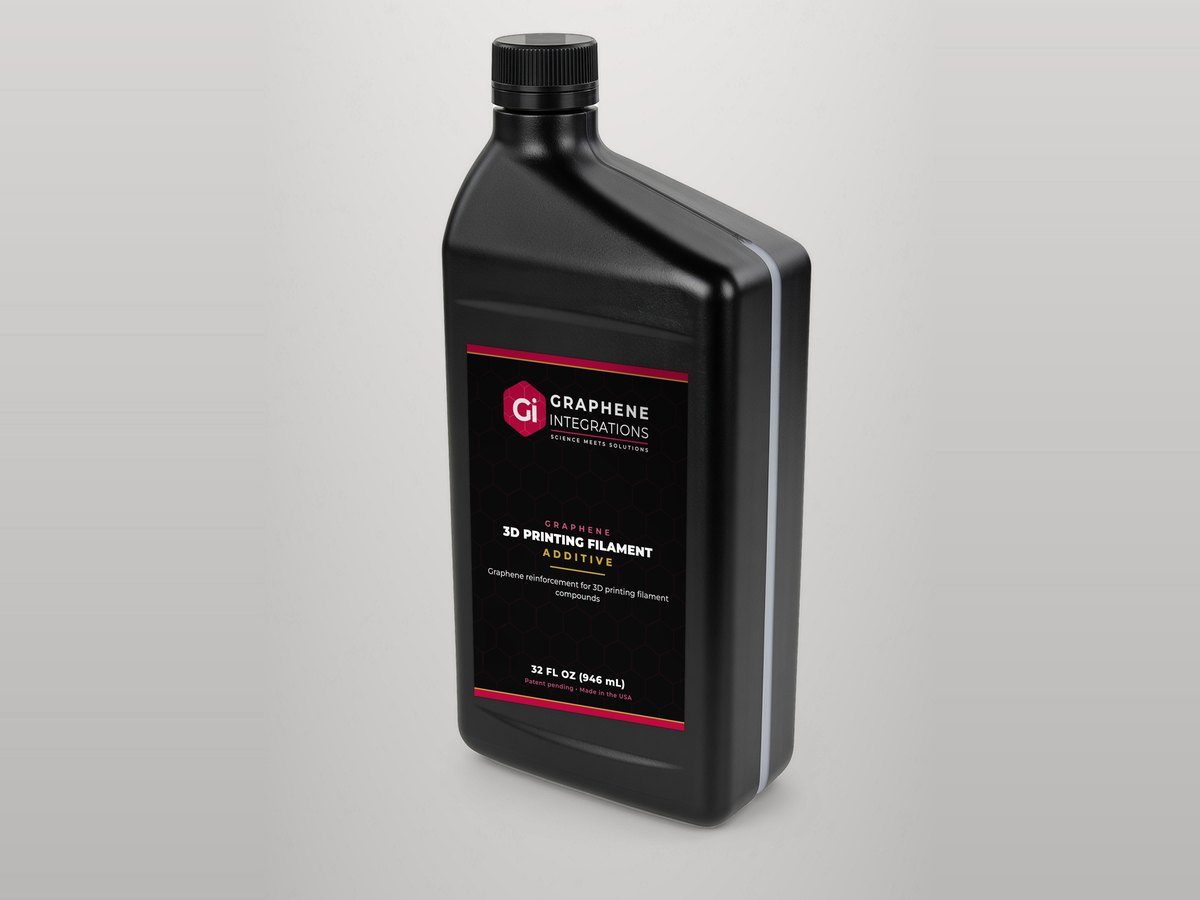
Graphene filament is one of the more visible uses of graphene in consumer and prosumer products. Behind every spool is a filament maker who had to get graphene evenly through a polymer and keep the diameter on spec for hundreds of metres. This article is for those makers. It covers what graphene is designed to bring to printed parts, why compounding is where it succeeds or fails, and how to test our Graphene 3D Printing Filament Additive.
Who this additive is for
Our additive is for filament producers, not for adding at the printer. It is compounded into PLA, PETG, ABS, nylon and other printable polymers before the filament is extruded. If you run a printer farm and want graphene filament, the right route is a filament maker who compounds it.
What graphene is designed to bring
- Stiffness and strength: graphene's strength as a single sheet is exceptional (Lee et al., Science, 2008), and well-dispersed flakes can help a polymer carry load.
- Thermal conductivity: can help printed parts spread heat, and may change how layers cool.
- Electrical conductivity: of interest for anti-static and conductive parts, usually at higher loadings.
- Appearance: graphene gives a deep black colour.
We do not publish performance numbers for filament. Results are compared with the maker's current filament.
Why compounding is the hard part
Filament has to print the same way from the first metre to the last. Agglomerates of graphene cause diameter variation, surface defects and, at worst, nozzle clogs, especially with fine nozzles. Even dispersion is not a nice-to-have; it is what makes graphene filament printable.
That is why our additive is pre-dispersed in resin. You add a resin concentrate during compounding instead of trying to break up dry flakes in a twin-screw extruder. Our article what is a graphene dispersion explains why we never ship powder.
What the additive is
- Carrier: resin dispersion for compounding.
- Polymers: PLA, PETG, ABS, nylon and other printable polymers.
- Dose: 1% to 7% by weight, depending on the job, with a suggested starting point for each polymer.
- Status: patent pending, made in the USA in Charlotte, NC, no carbon black, never sold as a powder.
A filament trial plan
- Baseline: choose one polymer grade and one filament you already make, with diameter, ovality and print data.
- Compound: add the additive at two or three loadings within 1% to 7%. Keep the screw profile, temperatures and throughput the same as your baseline for the first run.
- Dry: dry pellets and filament as you normally would. Hygroscopic polymers such as nylon and PETG still need it.
- Extrude filament: log diameter and ovality along the full spool. Look for spikes, which often signal agglomerates.
- Print test parts: same printer, nozzle, temperatures and settings as the baseline. Print tensile bars in more than one orientation, because layer adhesion often limits printed strength.
- Test: tensile and flexural properties, impact, and any thermal or conductivity tests your product claims will need.
- Check nozzle wear and clogging over a longer print, especially with brass nozzles and fine diameters.
Print settings to watch
Adding a thermally conductive filler can change how the melt behaves in the hot end and how quickly layers cool. Some makers find they need small changes to temperature or cooling. Make those changes only after a like-for-like baseline print, so you can see the effect of the additive on its own.
What we do not claim
We do not claim strength, stiffness, conductivity or printability numbers for filament made with our additive, and we have no customer case studies to share. Your spools and your test prints are the evidence, and any product claims on your filament should come from your own tests.
"Filament makers live and die by consistency. If the graphene is evenly dispersed in the resin, the spool has a chance." — Frans Alkemade
Quality control on the line
Once a formulation is chosen, build graphene into your normal quality checks. Log diameter and ovality continuously, keep retained samples from every lot, and print a short test part from each batch. Record the additive lot alongside the polymer lot. If a customer reports a problem, that traceability lets you check whether it came from the graphene, the polymer or the process.
Related reading
See our guide for plastics compounders and graphene in consumer goods.
Read the filament additive press release, see the graphene polymer composites page, or request a quote and samples.
Frequently asked questions
Can I add graphene at the printer?
No. Our additive is for filament makers and is compounded into the polymer before the filament is extruded.
Which polymers can graphene go into?
PLA, PETG, ABS, nylon and other printable polymers, using a resin dispersion matched for compounding.
How much graphene filament additive is used?
1% to 7% by weight, depending on the job. We suggest a starting point for each polymer.
Will graphene filament clog my nozzle?
Agglomerates can. Even dispersion is the key, which is why the additive is pre-dispersed in resin. Test long prints with your smallest nozzle.
Does graphene filament need different print settings?
Sometimes small changes to temperature or cooling help. Make them only after a like-for-like baseline print so you can see the additive's own effect.
Request a quote, samples or a spec sheet
Tell us your material, the property you want to improve, the carrier you use (water, solvent, resin or oil) and your volumes. Pricing and samples are by quote. Call 704-659-3682 or request a quote, samples or a spec sheet / SDS.


