


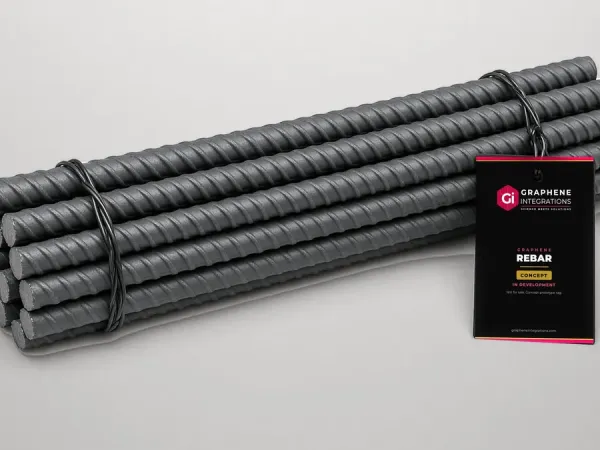
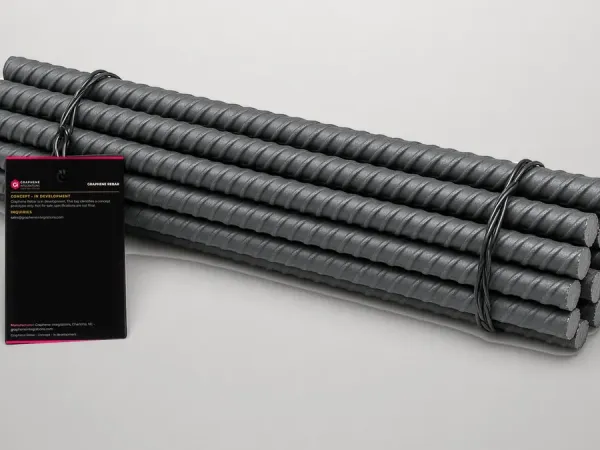
Graphene Rebar
Graphene-based reinforcement rods, in development as an alternative to steel rebar.
- Category
- Concrete & Construction
- Application
- Concrete reinforcement. In development; not yet available for use in structures.
- Carrier
- Not applicable (reinforcement rod, in development).
- Typical dose
- Not applicable.
- SKU
- GI-RBR
Downloads
Patent pending. Made in the USA. Manufacturer: Graphene Integrations, Charlotte, NC.
About this product
Graphene rebar is in development. It is not a product yet, and we make no performance claims for it. Any reinforcement product would need to be tested and approved under the applicable codes and standards before use in structures.
It builds on our graphene concrete additive. Read more about graphene rebar development, or contact us if you are interested in testing or development work.
Concrete strength and embodied carbon
The additive strength result below is not a rebar test or a demonstrated environmental benefit of the in-development reinforcement.
Cement is the binder in concrete. Its production releases CO₂ through limestone conversion and energy use, as explained by the IEA. That makes cement quantity an important part of a concrete carbon assessment.
GI’s additive achieved +67.7% compressive strength in third-party testing at the tested 5% supplied-additive dose by cement weight, not 5% pure graphene. This validated strength result supports investigating lower-cement mixes; it does not establish how much cement can be removed. Candidate mixes must meet the same required performance.
Conditional example: if 100 kg of Portland cement is actually avoided at the same required performance, gross avoided cement A1–A3 impact is 100 × 0.919 = 91.9 kg CO₂e. The 100 kg is an example assumption, not a reduction demonstrated by GI. The official US industry-average Portland cement EPD, revised July 2026, Table 4, gives 0.919 kg CO₂e/kg using 2019 production data, covering A1–A3, raw materials through manufacturing—not a current-year plant measurement or whole-life concrete footprint. CO₂e means carbon dioxide equivalent.
This is gross avoided cement-production impact, not measured GI net savings. Net savings require matched-performance mix validation and a consistent lifecycle comparison including additive manufacture, carrier, packaging, transport and all changed mix inputs. Unknown additive impacts are not zero. The strength result does not automatically establish cement reduction, longer service life or carbon capture.
Frequently asked questions
Can I buy graphene rebar now?
Not yet. Graphene rebar is in development and is not a product yet. You can register interest through a quote request.
What performance does it have?
We have no published test data for graphene rebar yet, so we make no claims about its strength, weight, cost or service life.
Will it be approved for structural use?
Any reinforcement product must be tested and approved under the codes and standards that apply before use in structures.
More in Concrete & Construction
-

Graphene Concrete Additive
A graphene concentrate for concrete, supplied ready to add so it fits into existing batching and mixing. View product -

Graphene Motor Oil Additive
A graphene additive for motor oils, supplied pre-mixed in an oil-based carrier so it blends straight into your oil. View product -

Graphene Gear Oil Additive
A graphene additive for gear oils, pre-mixed in an oil-based carrier for heavily loaded gear contacts. View product -

Graphene Hydraulic Fluid Additive
A graphene additive for hydraulic fluids, pre-mixed in an oil-based carrier for pumps, valves and cylinders. View product -

Graphene Grease Additive
A graphene additive for greases, pre-mixed in an oil-based carrier for blending into bearing and industrial greases. View product -

Graphene Coolant Additive
A graphene additive for liquid cooling loops, supplied pre-mixed in a water-based carrier. View product