
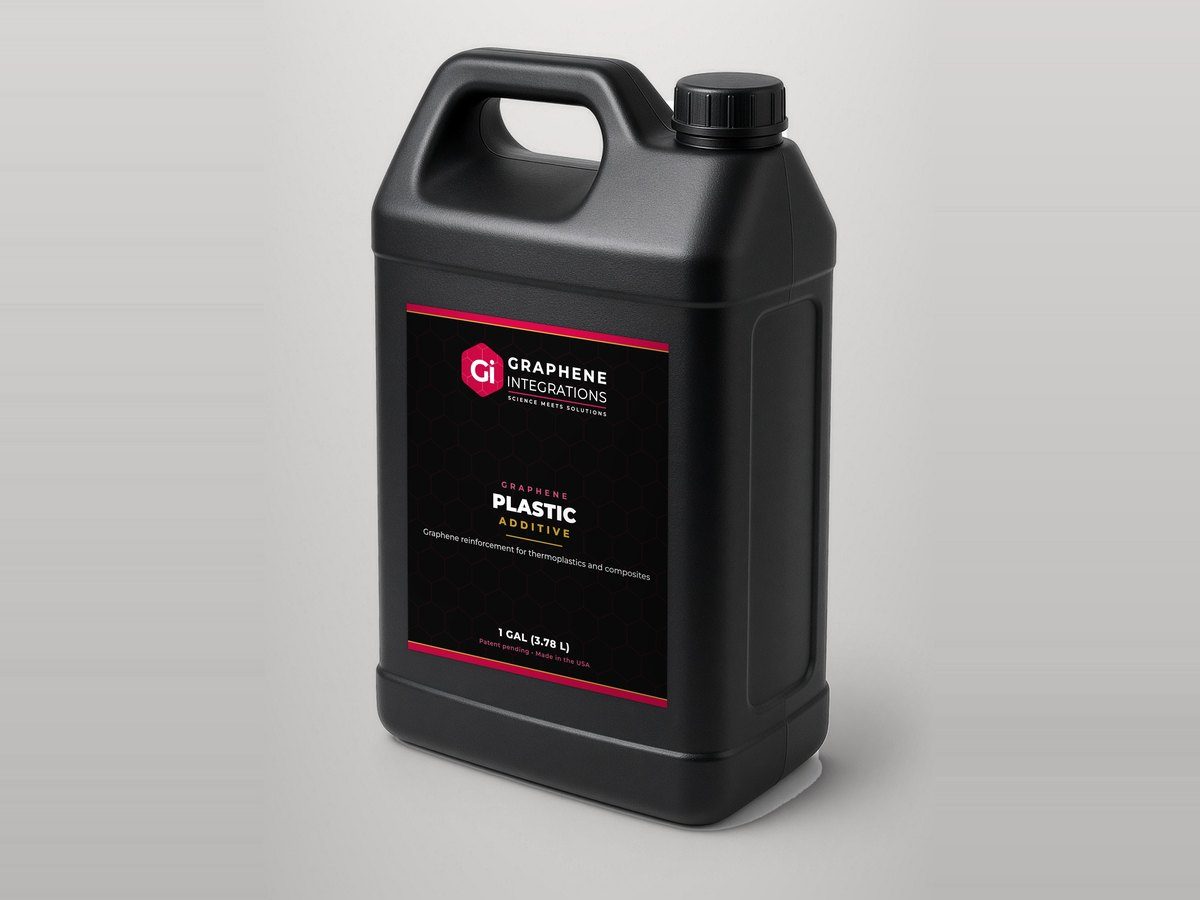
Graphene has an outstanding reputation in materials science. Measured on a single perfect sheet, it is one of the strongest materials known (Lee et al., Science, 2008). The challenge for a compounder is getting even a fraction of that into a real plastic part. This article covers how graphene is added to plastics, why dispersion is the hard part, how our Graphene Plastic Additive is supplied, and how to plan a trial.
Why graphene in plastics
Plastics engineers usually look at graphene for one or more of these reasons:
- Stiffness and strength: thin, high-aspect-ratio flakes can help carry load in a polymer matrix.
- Barrier: flat flakes can slow the passage of gases and moisture, which matters in packaging, tanks and fuel system parts.
- Thermal conductivity: graphene can help a plastic spread heat, of interest for housings and lighting.
- Electrical conductivity: for anti-static or dissipative parts, usually at higher loadings.
Each of these is something graphene is designed to help with. How much you get depends on the polymer, the loading, the dispersion and how the part is processed. We do not publish performance numbers for plastics; every trial is measured against the customer's current compound.
Dispersion is the hard part
Dry graphene flakes like to stack back together. In a polymer melt, stacked or clumped graphene behaves like a coarse filler and can even act as a defect. A well-dispersed graphene spreads thin flakes through the matrix, which is where the benefits come from. Compounders who have tried dry nanomaterials know how hard that is to achieve consistently, and how unpleasant the dust is to handle.
That is why we supply the Graphene Plastic Additive pre-dispersed in a resin matched to your polymer. The graphene arrives already spread through a compatible carrier, so your compounding step is mixing a liquid or resin concentrate, not breaking up dry agglomerates. For a primer on this, see what is a graphene dispersion.
What the additive is
- Carrier: resin dispersion matched to your polymer.
- Processes: injection molding, extrusion, compounding and composite layup.
- Dose: 1% to 7% by weight, depending on the job, with a suggested starting rate for each polymer and process.
- Status: patent pending, made in the USA in Charlotte, NC, no carbon black, never sold as a powder.
Thermoplastics versus thermosets
Thermoplastics
For polymers such as polypropylene, polyethylene, nylon, ABS or PET, the additive is typically introduced during compounding, so the graphene is distributed before pellets are made. Tell us your polymer grade and your compounding set-up, for example a twin-screw extruder with a side feeder, so we can match the carrier and suggest where to add it.
Thermosets
For epoxies, polyesters, vinyl esters and polyurethanes, the additive is mixed into the resin before the hardener or catalyst. Check viscosity and pot life after adding it, since any additive can change both.
How to run a molding trial
- Choose one part and one baseline compound. A part you already test regularly is ideal.
- Pick two or three loadings. Within 1% to 7%, around the starting rate we suggest.
- Keep the process the same. Same temperatures, screw speed and cycle as the baseline for the first run. Then adjust if you need to.
- Test what matters to the part. Tensile and flexural properties, impact, heat deflection, barrier or conductivity, using the same methods and specimen preparation as your baseline data.
- Look at the surface and cross-section. Streaks, specks or agglomerates are signs of poor dispersion and worth a conversation before more testing.
Impact strength deserves special attention. Fillers that increase stiffness can reduce toughness, so measure both.
What we do not claim
We do not publish strength, barrier or conductivity numbers for plastics and we have no customer case studies to share. If a lab or a competitor quotes a large percentage improvement, ask what polymer, what loading and what test, because the answer changes everything.
"Compounders know their resins better than we do. We match the carrier and let their parts decide." — Frans Alkemade
Handling and storage
Keep containers closed and stir or shake before use, since soft settling during storage is normal for many dispersions. Record the lot number of both the additive and the base polymer for every trial run, so results can be traced if you scale up.
Related reading
See how to choose a graphene dispersion carrier, and for printable polymers, our guide to graphene in 3D printing filament.
Read the plastic additive press release, see the graphene polymer composites page, or request a quote and samples.
Frequently asked questions
How is graphene added to plastic?
Usually during compounding, as a dispersion in a resin matched to the polymer, so the graphene is spread through the melt before pellets or parts are made.
How much graphene plastic additive is used?
1% to 7% by weight, depending on the job. We suggest a starting rate for each polymer and process.
What can graphene improve in plastics?
It is designed to help with stiffness, barrier, and thermal or electrical conductivity. Results depend on the polymer, loading and dispersion; we do not publish numbers for plastics.
Do I need new equipment?
No. The additive is pre-dispersed in a compatible resin, so it fits standard compounding, molding and extrusion equipment.
Request a quote, samples or a spec sheet
Tell us your material, the property you want to improve, the carrier you use (water, solvent, resin or oil) and your volumes. Pricing and samples are by quote. Call 704-659-3682 or request a quote, samples or a spec sheet / SDS.


